

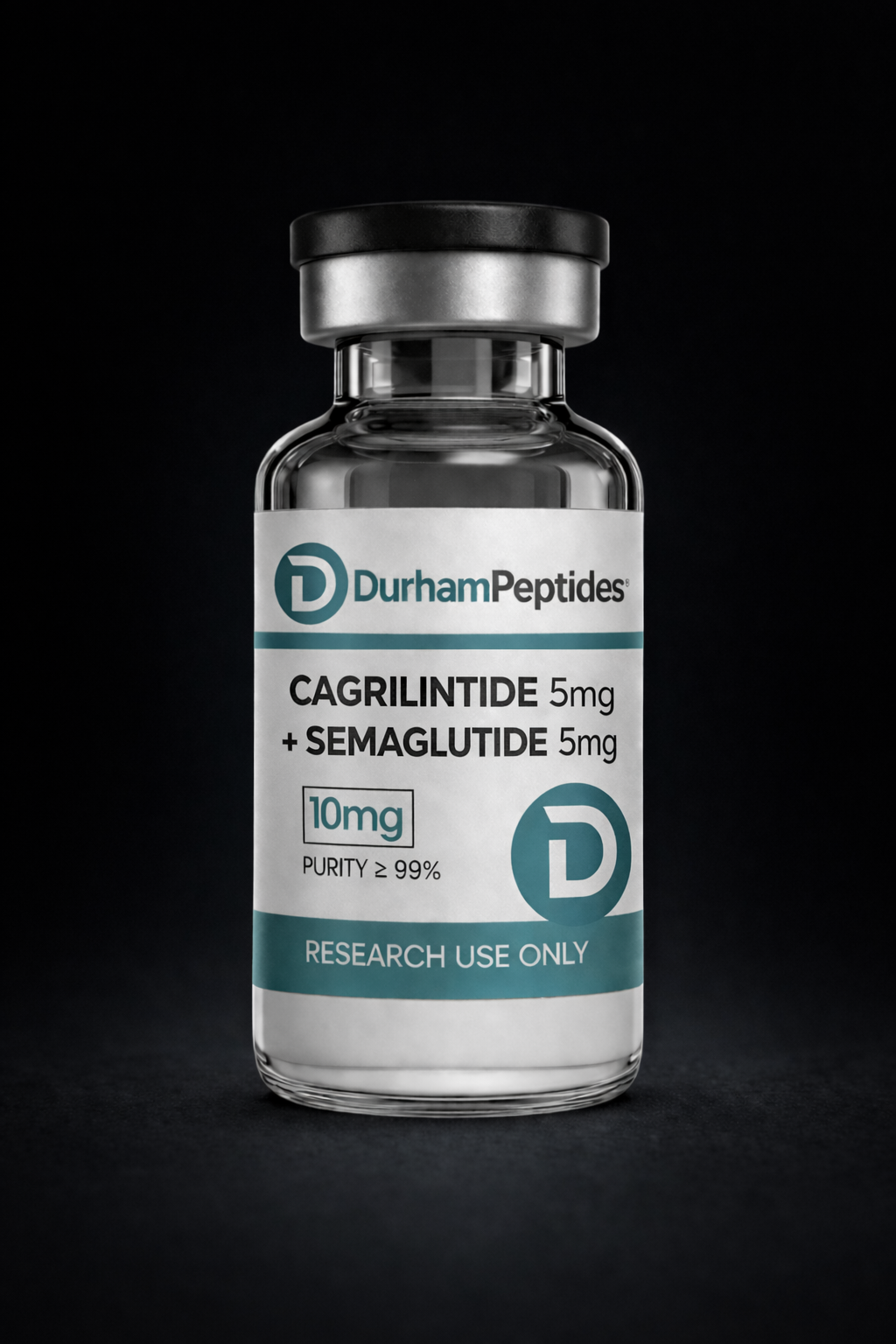
Amylin pathway cagrilintide metabolic research calcitonin receptor Durham Peptides Canada
The metabolic peptide research field is built around a handful of named pathways — GLP-1, GIP, glucagon, and increasingly, amylin. Of these, amylin is the least familiar to most researchers despite being one of the original hormones in the metabolic family, co-secreted with insulin by the same beta cells. Recent attention has shifted toward amylin not because the pathway is new, but because pairing it with GLP-1 has produced one of the most-watched investigational metabolic combinations. Understanding why amylin matters means understanding the upstream pathway itself.
This article is a pathway-level overview of amylin in metabolic research — the biology, the receptors, why amylin analogs were developed, and why combinations with GLP-1 became the next strategic direction. For the compound-level posts, see What Is Cagrilintide? Nothing here is medical, dosing, or therapeutic guidance.
Amylin: The Other Hormone the Pancreas Makes
When most people think about the pancreas's role in glucose regulation, they think of insulin. But pancreatic beta cells co-secrete a second hormone alongside insulin: amylin (also called islet amyloid polypeptide, or IAPP). Every pulse of insulin into the bloodstream is accompanied by a corresponding pulse of amylin, in a roughly fixed ratio. This co-secretion is biologically deliberate — amylin acts as a complementary regulator of glucose homeostasis, with effects that don't overlap with insulin's.
Amylin's main investigated effects in metabolic research include:
- Brainstem satiety signaling — amylin engages receptors in the area postrema, a brainstem region involved in appetite regulation
- Gastric emptying — slowing the rate at which food leaves the stomach
- Glucagon suppression — reducing the counter-regulatory hormone that opposes insulin
- Centrally-mediated food-intake regulation — distinct from leptin and the hypothalamic appetite circuits
These effects together position amylin as a satiety-and-glucose hormone that works in parallel with insulin rather than redundantly.
The Receptor Story: Amylin Is a Calcitonin-Family Receptor
This is where amylin gets technically interesting and where it cleanly separates from the GLP-1/GIP/glucagon receptor family. Amylin signals through the amylin receptor, which is a heteromeric complex formed by the calcitonin receptorplus a receptor activity-modifying protein (RAMP). This places amylin biology in the calcitonin-receptor family — entirely separate from the incretin-receptor family that GLP-1 and GIP work through.
This receptor-family separation is critical. It means activating amylin and activating GLP-1 engages non-overlapping receptor systems — and that non-overlap is the entire mechanistic basis for combination therapies that pair amylin analogs with GLP-1 agonists. Adding amylin to GLP-1 isn't a redundancy; it's a genuinely different signal.
Why Native Amylin Wasn't Practical for Research
Native human amylin has a notorious property: it tends to aggregate and form fibrils (the source of "islet amyloid" deposits in pancreatic tissue), which makes it physically difficult to formulate and study. This is why early metabolic research used pramlintide — a soluble amylin analog with key amino acid substitutions that prevent aggregation. Pramlintide is an established research and clinical amylin analog; it has a short half-life and was the first practical entry into amylin pharmacology.
The next generation — cagrilintide — extended this further with a fatty-acid lipidation that supports a much longer half-life, making once-weekly research profiles practical. Cagrilintide is one of the most-studied next-generation amylin analogs.
Why Combining Amylin with GLP-1 Became the Strategic Direction
The combination logic comes back to that receptor-family separation. GLP-1 agonists (like semaglutide) work through the GLP-1 receptor, engaging hypothalamic appetite circuits and glucose-dependent insulin secretion. Amylin analogs work through the calcitonin-receptor family, engaging brainstem satiety, gastric emptying, and glucagon suppression. The two pathways converge on overlapping metabolic outcomes (appetite regulation, glucose homeostasis) from different receptor systems — which is the textbook profile for studying synergistic effects.
This is exactly what the pairing (cagrilintide + semaglutide) was designed to study. The Phase 3 program (REDEFINE 1, REDEFINE 2, REIMAGINE 2) tested this combination logic, and the published REDEFINE 1 readout in NEJM (2025) reported substantially greater body-weight reduction in the combination arm than placebo over 68 weeks — supporting the additive/synergistic premise.
How Amylin Compares to the Other Multi-Mechanism Strategies
The amylin-plus-GLP-1 combination represents one of two architectural strategies for next-generation metabolic research:
- Combination approach — two separate molecules, each on its own pathway: amylin (cagrilintide) + GLP-1 (semaglutide).
- Single-molecule multi-agonist approach (Tirzepatide, Retatrutide) — one engineered peptide hitting multiple receptors: GLP-1 + GIP (tirzepatide), or GLP-1 + GIP + glucagon (retatrutide).
Notably, the amylin path is the only one of these that uses a non-incretin pathway. Tirzepatide and retatrutide stay within the incretin/glucagon family; the cagrilintide + semaglutide combination is the one that brings calcitonin-receptor-family signaling into the combination. That distinction is what makes the amylin pathway strategically interesting — it adds a genuinely separate mechanism rather than stacking related ones.
What Researchers Examine in Amylin Research
- Amylin / calcitonin receptor binding and downstream signaling
- Brainstem (area postrema) satiety pathways
- Gastric emptying delay and glucagon suppression in research models
- Amylin-plus-GLP-1 combination versus monotherapy in Phase 1–3 clinical data
- Aggregation properties and amylin-analog formulation strategies
- Comparative studies vs other metabolic peptide combinations
Frequently Asked Questions
What is the amylin pathway? A metabolic regulatory pathway in which amylin — a hormone co-secreted with insulin from pancreatic beta cells — signals through the calcitonin-receptor family to influence satiety, gastric emptying, and glucagon suppression.
How does amylin differ from GLP-1? Different receptor families entirely. GLP-1 acts on the GLP-1 incretin receptor; amylin acts on the calcitonin-receptor family. That non-overlap is why they're studied together.
Why isn't native human amylin used in research? Because it aggregates and forms fibrils, making it difficult to formulate. Amylin analogs (pramlintide, cagrilintide) were engineered with substitutions that prevent aggregation.
What is cagrilintide? A long-acting amylin analog with a fatty-acid lipidation that extends its half-life.
Why combine cagrilintide and semaglutide? Because amylin (cagrilintide) and GLP-1 (semaglutide) act through completely separate receptor families, making the combination studied for additive/synergistic effects.
Is the amylin pathway in tirzepatide or retatrutide? No — tirzepatide adds GIP, retatrutide adds GIP + glucagon. Both stay in the incretin/glucagon family. Only the cagrilintide + semaglutide combination currently brings amylin into the mix.
Final Thoughts
The amylin pathway is the metabolic research field's newest entry point — not because the biology is new (amylin was identified decades ago) but because next-generation amylin analogs and the strategic logic of combining amylin with GLP-1 have made the pathway practical to study at scale. Its receptor-family separation from incretin signaling makes it the cleanest non-redundant addition to GLP-1, which is why the cagrilintide + semaglutide combination sits at the frontier of combination metabolic research.
For the compound-level deep dives, see What Is Cagrilintide?. Browse the metabolic category at durhampeptides.ca/category/metabolic-research-peptides.
Selected Research References
- Lutz TA. The Role of Amylin in the Control of Energy Homeostasis. American Journal of Physiology - Regulatory, Integrative and Comparative Physiology. 2010;298(6):R1475-R1484. https://pubmed.ncbi.nlm.nih.gov/20357016/
- Garvey WT, Blüher M, Kushner RF, et al. Coadministered Cagrilintide and Semaglutide in Adults with Overweight or Obesity (REDEFINE 1). New England Journal of Medicine. 2025. https://pubmed.ncbi.nlm.nih.gov/40548661/
- Enebo LB, Berthelsen KK, Kankam M, et al. Safety, Tolerability, Pharmacokinetics, and Pharmacodynamics of Concomitant Administration of Multiple Doses of Cagrilintide with Semaglutide 2·4 mg. The Lancet. 2021;397(10286):1736-1748. https://pubmed.ncbi.nlm.nih.gov/33894838/
- Hay DL, Chen S, Lutz TA, Parkes DG, Roth JD. Amylin: Pharmacology, Physiology, and Clinical Potential. Pharmacological Reviews. 2015;67(3):564-600. https://pubmed.ncbi.nlm.nih.gov/26071095/
All products sold by Durham Peptides are for research and laboratory use only. They are not intended for human or animal consumption, diagnosis, treatment, cure, or prevention of any disease.