

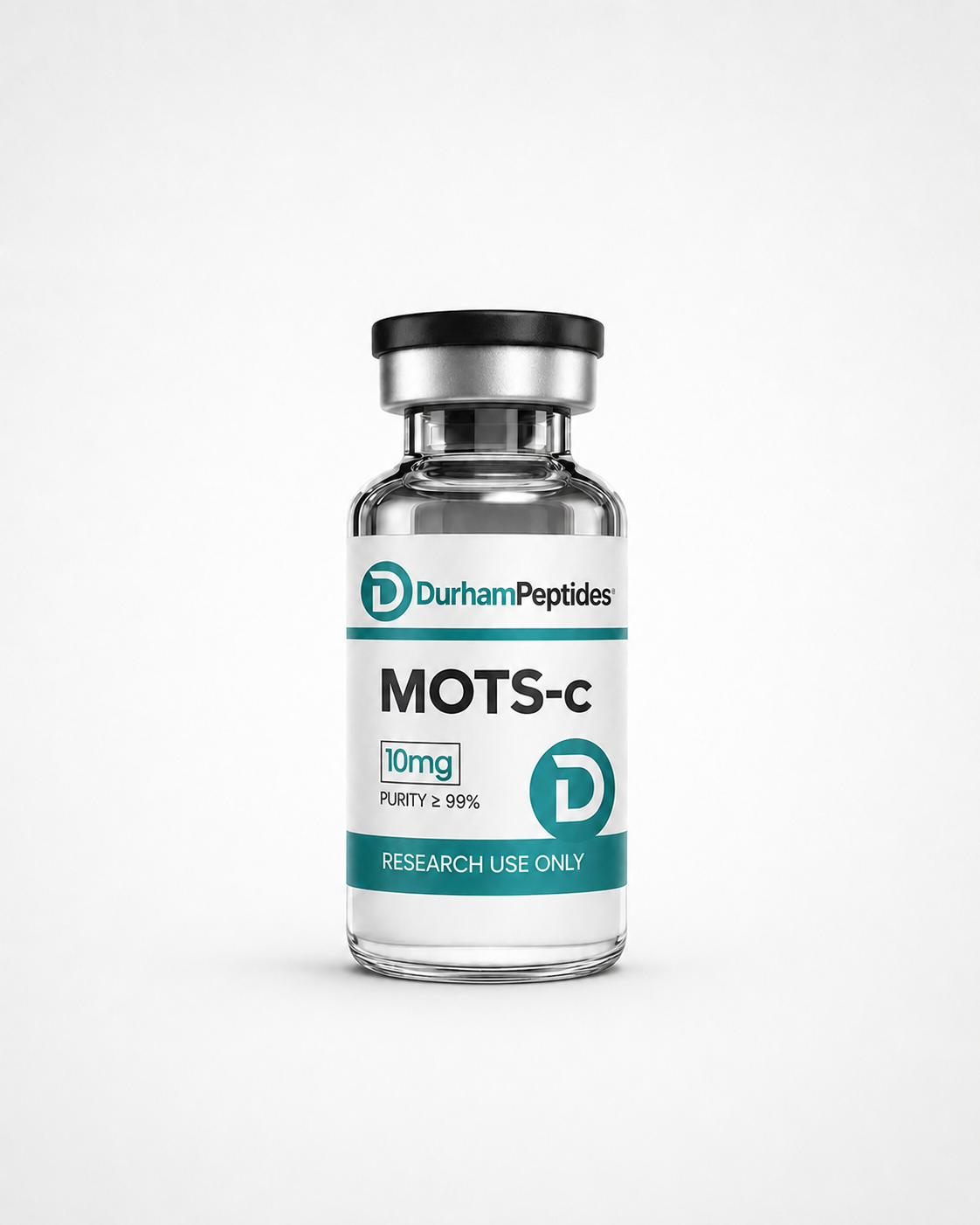
MOTS-c AMPK mechanism mitochondrial-derived peptide energy metabolism longevity research Durham Peptides Canada
MOTS-c sits in an unusual place in the research peptide landscape — most peptides are encoded by nuclear DNA and produced through standard ribosomal translation, but MOTS-c is encoded within mitochondrial DNA, making it part of a small and biologically distinctive class of mitochondrial-derived peptides. That origin is interesting on its own, but the more important point for research is what MOTS-c does once produced: it engages
AMPK (AMP-activated protein kinase), the cell's master energy sensor, with cascading effects across glucose metabolism, fat oxidation, and the broader metabolic-aging research landscape. This article opens that mechanism.
For the standalone MOTS-c overview, see What Is MOTS-c?; for the comparison to Epithalon, see MOTS-c vs Epithalon; for the longevity peptide map, see The Best Longevity Peptides for Research in Canada. Nothing here is medical, dosing, or therapeutic guidance.
The Mitochondrial-Derived Peptide Origin
MOTS-c — Mitochondrial Open Reading frame of the 12S rRNA-c — is a 16-amino-acid peptide encoded within the 12S ribosomal RNA gene of human mitochondrial DNA. This is a meaningful structural fact. Mitochondria have their own small circular genome (mtDNA, ~16.6 kilobases in humans), distinct from nuclear DNA, with their own translation machinery. Most peptides in biology come from nuclear DNA; MOTS-c is part of a small class produced within the mitochondrion itself.
I
dentified by Lee and colleagues at USC in research published in Cell Metabolism in 2015, MOTS-c was one of the first mitochondrial-derived peptides (MDPs) to receive substantial mechanistic characterization. It's distinguishable from the well-known earlier mitochondrial-derived peptide humanin and several others; together these MDPs form a small but growing research category.
Sequence: MRWQEMGYIFYPRKLR (16 amino acids) Class: Mitochondrial-derived peptide Origin: Encoded within the 12S rRNA region of mitochondrial DNA
The mitochondrial origin matters because it places MOTS-c in a unique position: a peptide produced by mitochondria that then signals about mitochondrial state to the rest of the cell. It's a built-in communication system from the powerhouse of the cell to the metabolic-regulation machinery elsewhere.
AMPK: The Cell's Energy Sensor
To understand what MOTS-c does, you need to understand AMPK.
AMPK (AMP-activated protein kinase) is one of the central regulators of cellular energy state. It's a heterotrimeric enzyme that's activated when intracellular AMP rises relative to ATP — a chemical signal that the cell is running low on energy. When AMPK becomes active, it triggers a coordinated set of responses designed to restore energy balance:
- Glucose uptake and utilization increase — pull more fuel into the cell
- Fatty acid oxidation increases — burn stored fat for energy
- Lipogenesis and cholesterol synthesis decrease — stop spending energy on storage
- Mitochondrial biogenesis is stimulated — make more power plants to handle the load
- Autophagy is stimulated — recycle cellular components to recover energy and clear damage
- Protein synthesis decreases — pause expensive anabolic activity until energy state recovers
AMPK is sometimes called "the cell's metabolic master switch." Its activation by exercise, caloric restriction, and various pharmacological compounds (most famously metformin) is one of the most-studied mechanisms in metabolic aging research. The connection between AMPK activation and longevity is foundational to multiple branches of aging research.
What MOTS-c Has Been Studied to Do at AMPK
The published research literature on MOTS-c, primarily building from the original 2015 Cell Metabolism paper, has documented several investigated effects centered on AMPK activation:
Investigated effect 1: AMPK activation in cell-culture models. The original Lee et al. paper reported that MOTS-c exposure was associated with increased AMPK phosphorylation (the active form) in cell-culture models. This is the core mechanistic anchor — MOTS-c engages the cell's energy-sensing pathway, activating it as if the cell were under energy stress.
Investigated effect 2: Glucose uptake and insulin sensitivity in research models. Building from AMPK activation, MOTS-c has been studied for investigated effects on glucose uptake in skeletal muscle (the body's largest glucose-disposal tissue) and on insulin sensitivity in metabolic-stress research models — including high-fat-diet animal models where insulin resistance develops.
Investigated effect 3: Mitochondrial function and biogenesis. AMPK activation drives mitochondrial biogenesis, and MOTS-c has been studied for investigated effects on mitochondrial function markers in research models — connecting the mitochondrial-origin peptide back to mitochondrial maintenance.
Investigated effect 4: Exercise-mimetic effects. Because exercise is one of the most potent natural activators of AMPK, MOTS-c has been studied in research models examining "exercise-mimetic" effects — whether the peptide can produce some of the AMPK-driven cellular responses that exercise itself produces. The investigated overlap with exercise responses is part of why MOTS-c is interesting in aging research where physical decline is a factor.
Investigated effect 5: Aging-related metabolic decline. Building from the AMPK-and-mitochondrial story, MOTS-c has been examined in aging-research models specifically — investigated effects on age-related decline in glucose handling, mitochondrial function, and physical performance markers in animal models.
Why AMPK Activation Matters in Longevity Research Specifically
AMPK activation occupies a distinctive position in longevity research for several reasons:
1. Caloric restriction signal. Caloric restriction is one of the most robust interventions in aging research, extending lifespan across many model organisms. AMPK is one of the central mediators of caloric restriction's effects at the cellular level. Compounds that activate AMPK are studied as potential "caloric restriction mimetics."
2. Exercise overlap. Exercise activates AMPK in working tissues. Compounds engaging the same pathway connect to exercise-related metabolic research.
3. Metformin connection. Metformin, the type 2 diabetes drug increasingly studied in aging contexts, activates AMPK as one of its central mechanisms. The metformin aging research connection makes AMPK a high-interest pathway across metabolic-aging research broadly.
4. Multi-hallmark engagement. AMPK activation influences multiple recognized hallmarks of aging — mitochondrial dysfunction, deregulated nutrient sensing, altered intercellular communication. A single pathway with broad downstream effects has efficiency in research design.
5. The mitochondrial-derived loop. MOTS-c is mitochondrial-encoded, signals about mitochondrial state, activates AMPK, which promotes mitochondrial biogenesis and quality control. There's a built-in feedback loop in MOTS-c's biology that connects mitochondrial state to AMPK-driven cellular response, which is conceptually interesting in mitochondrial-aging research.
MOTS-c in the Longevity Research Map
MOTS-c sits at a specific intersection in the longevity peptide landscape:
Compound | Primary investigated mechanism | Cellular target |
MOTS-c | AMPK activation | Mitochondria / energy sensor |
Epithalon | Telomerase activation | Chromosome ends / DNA replication |
NAD+ | Coenzyme replacement | NAD-dependent enzymes (sirtuins, etc.) |
GHK-Cu | Gene expression modulation | Hundreds of genes |
5-Amino-1MQ | NNMT inhibition | NAD salvage pathway |
MOTS-c is the only one of these that engages AMPK and mitochondrial signaling specifically. For research designed around mitochondrial-aging, AMPK-driven metabolic regulation, or exercise-mimetic effects, MOTS-c is the most defined research tool in the small-peptide category. See The Best Longevity Peptides for Research in Canada and MOTS-c vs Epithalon.
Practical Research Considerations
MOTS-c is supplied as a 10mg lyophilized peptide at Durham Peptides (MOTS-c 10mg, C$54.69). Janoshik-verified to ≥99% purity by HPLC with mass-spec identity confirmation; 100% synthetic; vegan. Storage: 2–8°C short-term, -20°C long-term, protected from light and moisture; reconstitute in bacteriostatic water. At 16 amino acids, it's a medium-sized peptide with standard handling properties for laboratory research.
Frequently Asked Questions
What is MOTS-c's primary research mechanism? Investigated AMPK activation — research has examined how MOTS-c exposure activates AMP-activated protein kinase, the cell's central energy sensor, with downstream effects on glucose metabolism, fat oxidation, mitochondrial biogenesis, and aging-related research outcomes.
What is AMPK and why does it matter? AMPK (AMP-activated protein kinase) is the cell's metabolic master switch, activated when energy is low. It triggers glucose uptake, fat oxidation, mitochondrial biogenesis, and autophagy while decreasing energy-expensive processes. It's central to caloric restriction biology and is a major aging research pathway.
Where does MOTS-c come from biologically? MOTS-c is encoded within the 12S rRNA region of mitochondrial DNA — it's a mitochondrial-derived peptide produced by mitochondria themselves. This makes it part of a small but biologically distinctive class of MDPs.
Why is MOTS-c called an "exercise mimetic"? Because exercise is one of the most potent natural activators of AMPK, and MOTS-c activates the same pathway. Research has examined investigated overlap between MOTS-c-driven cellular responses and exercise-induced responses in animal models.
How does MOTS-c compare to NAD+ in longevity research? Different mechanisms. MOTS-c activates AMPK; NAD+ is a coenzyme that supports NAD-dependent enzymes including the sirtuin family. They both engage cellular metabolism but through different pathways.
Where can I buy MOTS-c in Canada? Durham Peptides supplies MOTS-c 10mg (C$54.69), Janoshik-verified, for laboratory use only.
Final Thoughts
MOTS-c's research interest rests on its AMPK-activation mechanism, which connects it to one of the central pathways in metabolic and aging research. The mitochondrial-derived origin adds a unique biological framing — a peptide produced by mitochondria that then signals about mitochondrial state through AMPK to the rest of the cell. For research designed around mitochondrial-aging biology, AMPK-driven metabolic regulation, or exercise-mimetic effects, MOTS-c is the most defined small-peptide research tool in the
longevity category at the AMPK pathway.
For the standalone MOTS-c overview, see What Is MOTS-c?; for the comparison to telomere-focused Epithalon, see MOTS-c vs Epithalon; for the broader longevity peptide landscape, see The Best Longevity Peptides for Research in Canada.
Selected Research References
- Lee C, Zeng J, Drew BG, et al. The Mitochondrial-Derived Peptide MOTS-c Promotes Metabolic Homeostasis and Reduces Obesity and Insulin Resistance. Cell Metabolism. 2015;21(3):443-454. https://pubmed.ncbi.nlm.nih.gov/25738459/
- Reynolds JC, Lai RW, Woodhead JST, et al. MOTS-c Is an Exercise-Induced Mitochondrial-Encoded Regulator of Age-Dependent Physical Decline and Muscle Homeostasis. Nature Communications. 2021;12(1):470. https://pubmed.ncbi.nlm.nih.gov/33473109/
- Kim KH, Son JM, Benayoun BA, Lee C. The Mitochondrial-Encoded Peptide MOTS-c Translocates to the Nucleus to Regulate Nuclear Gene Expression in Response to Metabolic Stress. Cell Metabolism. 2018;28(3):516-524. https://pubmed.ncbi.nlm.nih.gov/29983246/
- Hardie DG, Ross FA, Hawley SA. AMPK: A Nutrient and Energy Sensor That Maintains Energy Homeostasis. Nature Reviews Molecular Cell Biology. 2012;13(4):251-262. https://pubmed.ncbi.nlm.nih.gov/22436748/
- López-Otín C, Blasco MA, Partridge L, Serrano M, Kroemer G. The Hallmarks of Aging. Cell. 2013;153(6):1194-1217. https://pubmed.ncbi.nlm.nih.gov/23746838/
All products sold by Durham Peptides are for research and laboratory use only. They are not intended for human or animal consumption, diagnosis, treatment, cure, or prevention of any disease.