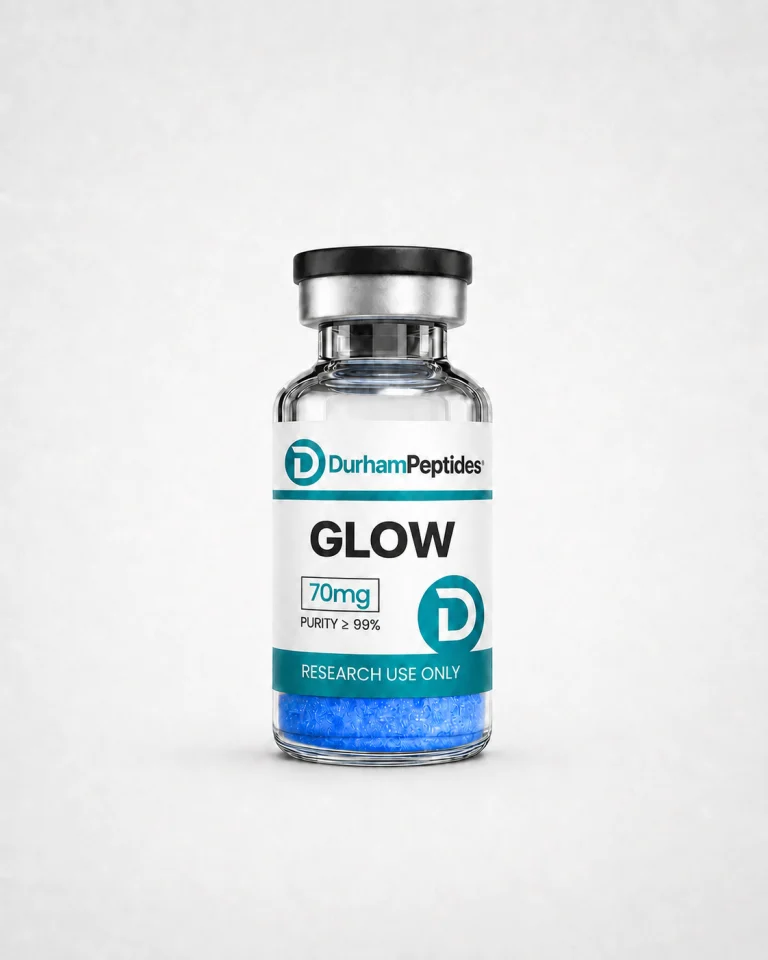

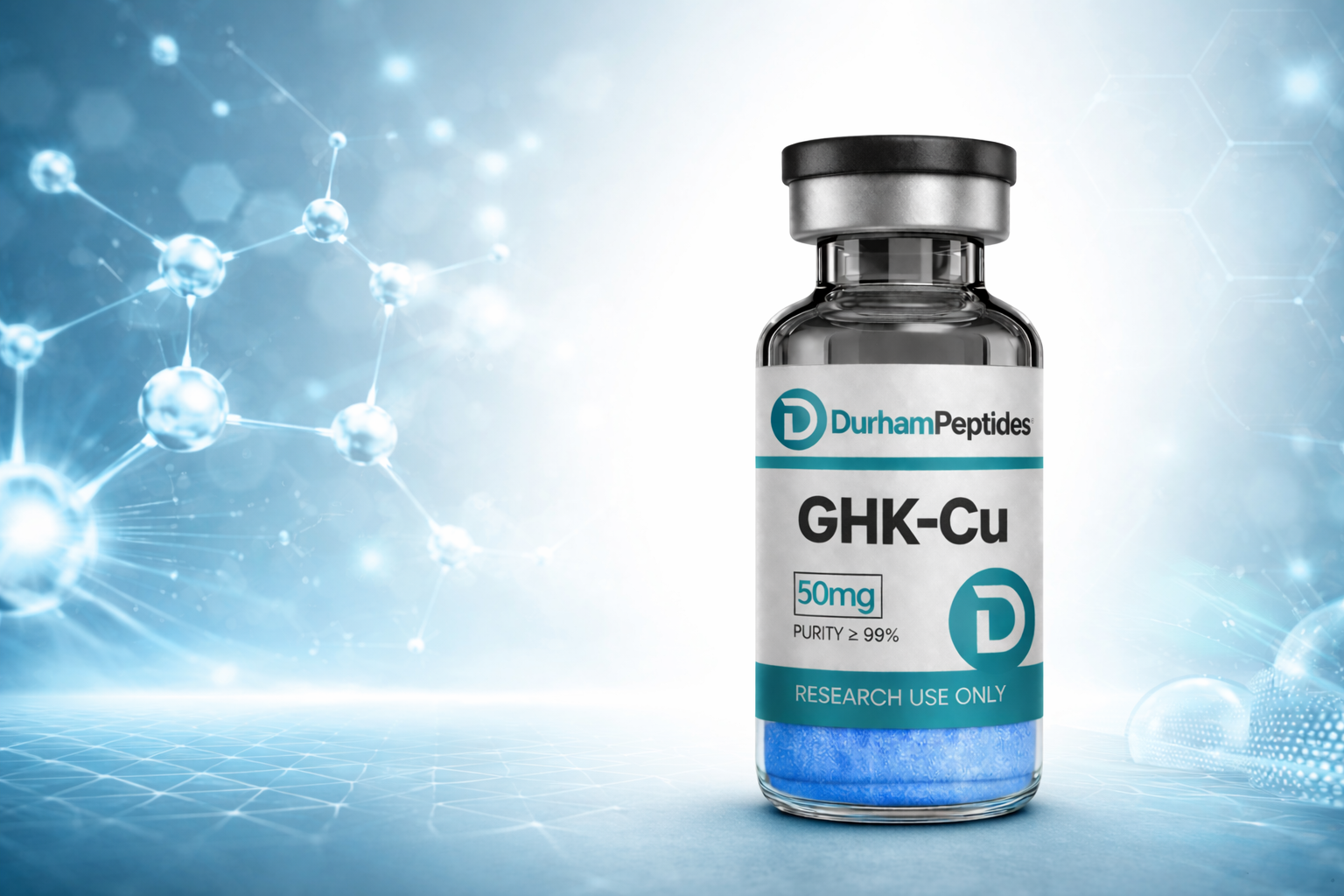
GHK-Cu 50mg vs 100mg vial size comparison copper peptide research Durham Peptides Canada
Now that Durham Peptides offers GHK-Cu in both 50mg and 100mg formats, a practical question follows: which size should you buy? It's a more meaningful decision than it first appears — vial size affects cost-per-milligram, reconstitution concentration, and how much usable research window you get before reconstituted material should be discarded. This guide walks through the tradeoffs so you can match the format to your research.
For the buying overview, see Buy GHK-Cu in Canada; for the underlying vial-size principles, see Peptide Vial Sizes Explained.
The Two Options
- GHK-Cu 50mg — C$55.00. The established format.
- GHK-Cu 100mg — the new larger format. (GHK-Cu 100mg)
Both are identical in everything except quantity: ≥99% purity, Janoshik-verified, mass-spec identity, 100% synthetic/vegan, same lyophilized form. The choice is purely about how much material fits your research.
Factor 1: Cost per Milligram
The most important factor. Larger vials almost always carry a lower per-mg cost because fixed costs (vial, lyophilization, testing, shipping) spread across more material. With Durham Peptides' two formats: 50mg at C$55.00 works out to C$1.10/mg, while 100mg
at C$95.00 is C$0.95/mg — about 14% cheaper per milligram. If your research will realistically consume a 100mg vial within its usable window, the 100mg format is more economical per milligram. This is the core reason larger formats exist — and the main argument for the 100mg vial.
Factor 2: Protocol Volume and Duration
- Short or exploratory protocols → 50mg. You avoid paying for material you won't use before it should be discarded.
- Longer or higher-volume protocols → 100mg. The per-mg savings compound, and you reduce reorder frequency.
A useful rule of thumb: estimate your total GHK-Cu consumption over the research window. If it comfortably exceeds 50mg, the 100mg vial usually wins on economics; if it's near or below 50mg, the smaller vial is the cleaner choice.
Factor 3: Reconstitution Concentration
Vial size interacts with reconstitution. With more material in the 100mg vial, you can either reconstitute in a larger volume of bacteriostatic water to hold concentration constant, or reconstitute in the same volume for a higher concentration. The peptide calculator handles the math either way. Researchers who want a specific working concentration should plan reconstitution volume around vial size — covered fully in Peptide Vial Sizes Explained.
Factor 4: Stability and the Usable Window
This is the counterweight to the cost-per-mg argument. Once reconstituted, GHK-Cu has a finite stable window in refrigeration. A 100mg vial only delivers its cost advantage if you actually use the material within that window — a large vial reconstituted and then mostly discarded is less economical than buying 50mg as needed. So the 100mg format makes sense when your usage rate matches the larger quantity. For the stability detail, see Does Vial Size Affect Stability? and Peptide Storage Guide.
Decision Summary
Your situation | Recommended format |
First time using GHK-Cu | 50mg |
Short / exploratory protocol | 50mg |
Total use likely under ~50mg | 50mg |
Longer / higher-volume protocol | 100mg |
Total use comfortably over 50mg | 100mg |
Prioritizing cost-per-mg, steady usage | 100mg |
A Note on Buying Two 50mg vs One 100mg
If you're unsure, two 50mg vials give flexibility — reconstitute one, keep the other lyophilized (which stores far longer than reconstituted material) until needed. The 100mg vial wins on per-mg cost and fewer reorders, but commits you to a single larger reconstitution. For steady, predictable research the 100mg is the efficient call; for variable or uncertain usage, staggered 50mg vials hedge against waste.
Frequently Asked Questions
What's the difference between GHK-Cu 50mg and 100mg? Only the quantity. Both are ≥99% purity, Janoshik-verified, mass-spec identity, 100% synthetic. The choice is about matching material quantity to research volume.
Is the 100mg GHK-Cu cheaper per milligram? Larger vials almost always carry a lower per-mg cost, so the 100mg is typically more economical per milligram — provided you use the material within its window.
Which size should a first-time GHK-Cu researcher buy? The 50mg, generally — it avoids over-committing material on a first or exploratory protocol.
Does the bigger vial change reconstitution? You adjust the bacteriostatic water volume to hit your target concentration. The peptide calculator handles the math.
Can I just buy two 50mg vials instead of one 100mg? Yes — that gives flexibility (keep one lyophilized until needed). The 100mg wins on per-mg cost and fewer reorders; staggered 50mg vials hedge against waste.
Are both sizes the same quality? Yes — identical purity, testing, and manufacturing. Only the quantity differs.
Final Thoughts
The GHK-Cu 50mg-vs-100mg decision comes down to matching vial size to your real research consumption. The 100mg rewards steady, higher-volume use with a better cost-per-mg; the 50mg suits exploratory, short, or first-time protocols and hedges against reconstituted-material waste. Both are the same research-grade GHK-Cu.
For the full buying guide, see Buy GHK-Cu in Canada; for the science, see Copper Peptides Explained; and for vial-size principles generally, see Peptide Vial Sizes Explained.
Selected Research References
- Pickart L, Margolina A. Regenerative and Protective Actions of the GHK-Cu Peptide. International Journal of Molecular Sciences. 2018;19(7):1987. https://pubmed.ncbi.nlm.nih.gov/29986520/
- Pickart L, Vasquez-Soltero JM, Margolina A. GHK Peptide as a Natural Modulator of Multiple Cellular Pathways in Skin Regeneration. BioMed Research International. 2015;2015:648108. https://pubmed.ncbi.nlm.nih.gov/26236730/
Shop the vial sizes compared in this guide: GHK-Cu 50mg and GHK-Cu 100mg — both Janoshik-tested, shipped same-day across Canada.
All products sold by Durham Peptides are for research and laboratory use only. They are not intended for human or animal consumption, diagnosis, treatment, cure, or prevention of any disease.