

KPV peptide anti-inflammatory tripeptide research Durham Peptides Canada
KPV is one of the smallest peptides in the entire research peptide field — just three amino
acids — but the published research literature on it has accumulated steadily over more than three decades. As the C-terminal tripeptide fragment of α-melanocyte-stimulating
hormone (α-MSH), KPV has been investigated extensively for anti-inflammatory effects in
published preclinical research. Its addition as the fourth peptide in the KLOW Blend
reflects the maturation of multi-mechanism combination formulations in the research
peptide field.
This article provides a research-focused overview of KPV — its discovery, the α-MSH biology that defines its origin, the published research history on its anti-inflammatory mechanisms, and its role within the broader KLOW Blend composition.
For the foundational concept of how multi-peptide combinations work, see Peptide Stacking Guide: The Science Behind Combination Research Protocols.
The Discovery: From α-MSH to a Three-Amino-Acid Fragment
KPV's research history begins with α-melanocyte-stimulating hormone (α-MSH), a 13-amino-acid peptide hormone produced from a larger precursor protein called
proopiomelanocortin (POMC). α-MSH was originally studied for its role in skin pigmentation through activation of melanocortin receptors — the same receptor system covered in the PT-141 research overview.
But α-MSH research in the 1980s and 1990s revealed something unexpected: the peptide had substantial anti-inflammatory effects that didn't seem to depend on the entire 13-amino-acid sequence. Researchers investigating which fragment of α-MSH carried the anti-inflammatory activity narrowed it down to the C-terminal tripeptide — the last three amino acids of the molecule: lysine, proline, and valine. This sequence — Lys-Pro-Val, or KPV — turned out to retain the anti-inflammatory properties of the full α-MSH peptide while being a fraction of the size.
The discovery represented an interesting principle in peptide research: sometimes biological activity is concentrated in a small fragment, and isolating that fragment produces a more practical research compound than the full parent molecule.
KPV Structure
KPV consists of three amino acids in sequence:
- K — Lysine (a positively charged basic amino acid)
- P — Proline (a structurally rigid amino acid that creates kinks in peptide chains)
- V — Valine (a hydrophobic branched-chain amino acid)
The molecular weight is small — approximately 343 daltons, compared to BPC-157 at roughly 1419 daltons or tirzepatide at roughly 4814 daltons. This small size has practical implications for tissue penetration, pharmacokinetics, and manufacturing.
KPV is produced via Solid-Phase Peptide Synthesis (SPPS) using synthetic amino acids — the modern manufacturing standard. The simple three-amino-acid structure means manufacturing is straightforward compared to longer modified peptides. See Peptide Manufacturing 101: How Research Peptides Are Made From Amino Acids to Vial.
The Anti-Inflammatory Research Mechanism
The published research literature has investigated KPV's anti-inflammatory mechanisms across multiple model systems. Several features have emerged:
NF-κB pathway modulation. Nuclear factor kappa-light-chain-enhancer of activated B cells (NF-κB) is a transcription factor central to inflammatory gene expression. Several published studies have investigated KPV's effects on NF-κB activation, with research findings suggesting modulation of this pathway as part of the anti-inflammatory mechanism.
Cytokine response modulation. Research has examined KPV's effects on pro-inflammatory cytokines including TNF-α, IL-1β, IL-6, and IL-8. The published literature includes studies investigating reduced cytokine expression in various inflammation model systems.
Independence from melanocortin receptors. Interestingly, while KPV is derived from α-MSH (which activates melanocortin receptors for its pigmentation effects), the anti-inflammatory effects of KPV appear to operate independently of the melanocortin receptor system. This distinguishes KPV's research mechanism from PT-141 and other melanocortin-receptor-active peptides. See What Is PT-141? for the contrasting melanocortin receptor mechanism.
Cellular uptake. Research has investigated how KPV enters cells, with some evidence pointing to specific transporter mechanisms (PEPT1 transporters, in particular) that allow oral absorption — distinguishing KPV from most other research peptides which are typically not orally bioavailable.
Published Research Areas
KPV has been studied in published research literature across several areas:
Inflammatory bowel disease research models. Some of the most extensive published research on KPV has investigated its effects in colitis and inflammatory bowel disease research models. The combination of anti-inflammatory mechanism and potential oral bioavailability through PEPT1 transporters has made KPV particularly interesting for gastrointestinal inflammation research.
Skin and dermatological research. Given KPV's origins from α-MSH (which is involved in skin biology), research has examined KPV's effects in skin inflammation models, wound healing research, and dermatological applications.
General inflammation models. Beyond specific tissue contexts, KPV has been studied in various general inflammation research models examining the broader anti-inflammatory mechanism.
Combination research. More recent research has begun examining KPV in combination with other peptides — particularly tissue-repair peptides like BPC-157 and TB-500 — exploring whether the combined anti-inflammatory and tissue-repair mechanisms produce additive or synergistic effects in research models. This is the research basis for KPV's inclusion in the KLOW Blend.
KPV in the KLOW Blend
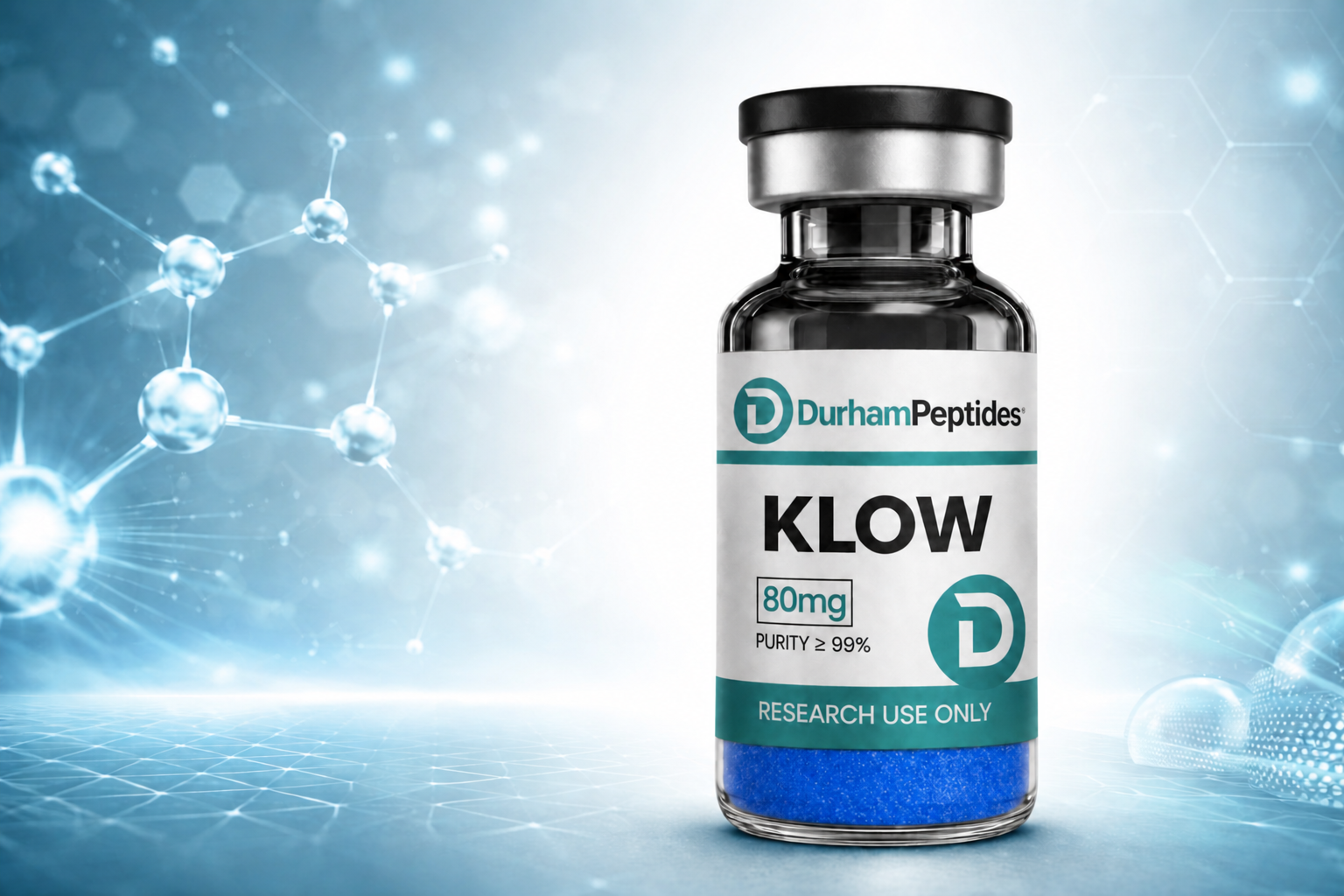
Durham Peptides' KLOW Blend combines four peptides in a single 80mg lyophilized vial:
- KPV — anti-inflammatory tripeptide derived from α-MSH
- GHK-Cu — the copper tripeptide studied for gene expression and skin remodeling effects
- BPC-157 — the angiogenic and tissue-repair peptide
- TB-500 — the actin-binding cell migration peptide
The four-peptide composition extends the three-pathway logic of the GLOW Blend by adding a fourth complementary mechanism — the anti-inflammatory pathway through KPV. The research basis is the same complementary-mechanism principle that underlies all serious combination peptide formulations: each component engages a distinct biological pathway, and together they cover more research territory than any single component could alone.
For the foundational logic of why complementary mechanisms produce additive effects rather than redundant ones, see Peptide Stacking Guide: The Science Behind Combination Research Protocols.
How KPV Differs From Other Research Peptides
KPV occupies a distinct position in the research peptide field:
Different from tissue-repair peptides. BPC-157 and TB-500 work through angiogenic and cell migration pathways. KPV's research mechanism centers on inflammation modulation — a different biological axis.
Different from melanocortin peptides. Despite being derived from α-MSH, KPV's anti-inflammatory effects appear independent of melanocortin receptor activation. Different mechanism from PT-141.
Different from gene expression peptides. GHK-Cu works through broad gene expression modulation. KPV's mechanism is more focused on specific inflammatory signaling pathways.
Different from metabolic peptides. Semaglutide, tirzepatide, and retatrutide work through incretin receptors. Entirely different category.
Pharmacokinetic Considerations
KPV's pharmacokinetic profile reflects its small molecular size:
Short half-life. Like most short native peptides, KPV is subject to enzymatic degradation. Research has investigated various administration approaches in research populations. For more on why short half-lives can be biologically appropriate rather than a limitation, see Peptide Half-Life Explained: Why Some Peptides Last Hours and Others Days.
Tissue penetration. The small molecular size facilitates penetration into various tissues compared to larger peptides.
PEPT1 transporter uptake. Research has identified PEPT1 (peptide transporter 1) as a mechanism for cellular uptake of KPV, particularly in intestinal epithelial cells. This transporter-mediated uptake is part of what distinguishes KPV from other research peptides.
Quality Control Considerations
For KPV — and the KLOW Blend as a whole — the standard research peptide quality framework applies:
Identity verification. Mass spectrometry confirms the molecular weight of KPV and the other components match expected values. See How to Read a Janoshik COA: HPLC, Mass Spec, and the Unique Key Explained.
Purity verification. ≥99% HPLC purity per peptide is the research-grade standard, including in combination formulations like the KLOW Blend.
Third-party testing. Independent verification via Janoshik Analytical is the research-grade industry standard. Durham Peptides publishes COAs for every batch at durhampeptides.ca/lab-results.
Storage. KPV, like other lyophilized research peptides, requires standard refrigerated or frozen storage. Reconstituted with bacteriostatic water, shelf life follows the typical research peptide framework. See Peptide Storage & Shelf Life.
Regulatory Status in Canada
KPV is not approved by Health Canada for human or veterinary therapeutic use. It exists in the standard research peptide framework — sold for laboratory and research applications under research-use-only framing.
The KLOW Blend — the formulation containing KPV alongside GHK-Cu, BPC-157, and TB-500 — operates under the same research-use-only framework that applies to all Durham Peptides catalog products.
For the broader Canadian regulatory context, see Are Peptides Legal in Canada? A Complete Guide to Research Peptide Laws.
The Research Position of KPV
KPV occupies a meaningful position in the broader peptide research field:
Substantive published research literature. While not as voluminous as the literature on BPC-157 or GHK-Cu, KPV has accumulated substantial published research over three decades.
Clear mechanism focus. Anti-inflammatory mechanism through NF-κB pathway modulation and cytokine response modulation provides a relatively well-defined research framework.
Combination utility. KPV's anti-inflammatory mechanism complements the angiogenic/repair mechanisms of BPC-157 and TB-500 and the gene expression mechanism of GHK-Cu — making it a logical addition to multi-peptide formulations.
Distinct from other research peptide categories. KPV doesn't overlap meaningfully with the metabolic, tissue-repair, anti-aging, or growth hormone peptide categories — it occupies its own corner of the field.
Frequently Asked Questions
What is KPV? KPV (Lysine-Proline-Valine) is a tripeptide derived from the C-terminal end of α-melanocyte-stimulating hormone (α-MSH). Studied extensively in published research literature for anti-inflammatory effects.
How is KPV related to α-MSH? KPV is the C-terminal three amino acids of α-MSH. Research determined that the anti-inflammatory activity of α-MSH is concentrated in this small fragment, allowing isolation of the activity in a much smaller research compound.
Does KPV activate melanocortin receptors? Despite being derived from α-MSH, KPV's anti-inflammatory effects appear to operate independently of the melanocortin receptor system. KPV is not generally classified as a melanocortin receptor agonist.
What is KPV's research mechanism? The published research literature has investigated KPV's effects on NF-κB pathway modulation, pro-inflammatory cytokine response, and cellular signaling related to inflammation. The mechanism centers on inflammation modulation rather than direct receptor agonism.
Where is KPV in the Durham Peptides catalog? KPV is included as one of the four peptides in the KLOW Blend(BPC-157 + GHK-Cu + TB-500 + KPV, 80mg total).
Why is KPV in the KLOW Blend? KPV's anti-inflammatory mechanism complements the tissue-repair and gene-expression mechanisms of the other three peptides. The four-peptide combination engages four distinct biological pathways simultaneously. See Peptide Stacking Guide.
What's the difference between KLOW and GLOW Blend? GLOW contains three peptides (GHK-Cu + BPC-157 + TB-500, 70mg total). KLOW adds KPV as a fourth peptide for an 80mg total. KLOW extends GLOW's three-pathway logic to four pathways by adding the anti-inflammatory mechanism.
Is KPV vegan? Yes. Modern KPV is manufactured via Solid-Phase Peptide Synthesis with synthetic amino acids — the modern standard. See Vegan Peptides.
Is KPV approved by Health Canada? KPV is not approved by Health Canada for human or veterinary therapeutic use. It is sold under research-use-only framing for laboratory and research applications. See Are Peptides Legal in Canada?.
How is KPV manufactured? Solid-Phase Peptide Synthesis (SPPS) using synthetic amino acids. The simple three-amino-acid structure makes manufacturing straightforward compared to longer modified peptides. See Peptide Manufacturing 101.
Can KPV be absorbed orally? KPV is unusual among research peptides in that the published research literature includes studies investigating PEPT1 transporter-mediated cellular uptake. Most research peptides are not orally bioavailable due to gastrointestinal degradation; KPV's small size and transporter-mediated uptake distinguish it.
How does KPV compare to other anti-inflammatory peptides? KPV occupies a distinct corner of the peptide research field. Its small size, α-MSH origin, and specific mechanism focus distinguish it from other peptides studied for inflammation-related research.
Final Thoughts
KPV represents an interesting principle in peptide research — sometimes biological activity concentrates in a small fragment of a larger parent molecule, allowing isolation of the
activity in a much smaller, simpler research compound. The three-amino-acid sequence at the C-terminal end of α-MSH carries substantive anti-inflammatory research relevance, and its inclusion in multi-peptide formulations like the KLOW Blend reflects the broader trend toward combination research approaches engaging complementary biological pathways.
For Canadian researchers, KPV is now available as part of the KLOW Blend through Durham Peptides — manufactured via Solid-Phase Peptide Synthesis, third-party tested by Janoshik Analytical, and sold with the same research-use-only framework that applies to the entire catalog.
For continued reading on related peptides and combination logic, see GLOW Blend Composition: Why GHK-Cu + BPC-157 + TB-500 Work Together, Peptide Stacking Guide, What Is PT-141?, and The Complete Peptide Glossary.
Browse the complete Durham Peptides catalog at durhampeptides.ca/category/all-products. View all Janoshik-verified COAs at durhampeptides.ca/lab-results.
Selected Research References
- Hiltz ME, Lipton JM. Antiinflammatory Activity of a COOH-Terminal Fragment of the Neuropeptide α-MSH. FASEB Journal. 1990;4(13):3095-3099. https://pubmed.ncbi.nlm.nih.gov/2120207/
- Brzoska T, Luger TA, Maaser C, Abels C, Böhm M. α-Melanocyte-Stimulating Hormone and Related Tripeptides: Biochemistry, Antiinflammatory and Protective Effects In Vitro and In Vivo, and Future Perspectives for the Treatment of Immune-Mediated Inflammatory Diseases. Endocrine Reviews. 2008;29(5):581-602. https://pubmed.ncbi.nlm.nih.gov/18612139/
- Dalmasso G, Charrier-Hisamuddin L, Nguyen HT, Yan Y, Sitaraman S, Merlin D. PepT1-Mediated Tripeptide KPV Uptake Reduces Intestinal Inflammation. Gastroenterology. 2008;134(1):166-178. https://pubmed.ncbi.nlm.nih.gov/18061177/
- Mandrika I, Muceniece R, Wikberg JE. Effects of Melanocortin Peptides on Lipopolysaccharide/Interferon-γ-Induced NF-κB DNA Binding and Nitric Oxide Production in Macrophage-Like RAW 264.7 Cells. Biochemical Pharmacology. 2001;61(5):613-621. https://pubmed.ncbi.nlm.nih.gov/11239505/
- Catania A, Gatti S, Colombo G, Lipton JM. Targeting Melanocortin Receptors as a Novel Strategy to Control Inflammation. Pharmacological Reviews. 2004;56(1):1-29. https://pubmed.ncbi.nlm.nih.gov/15001661/
- Kannengiesser K, Maaser C, Heidemann J, et al. Melanocortin-Derived Tripeptide KPV Has Anti-Inflammatory Potential in Murine Models of Inflammatory Bowel Disease. Inflammatory Bowel Diseases. 2008;14(3):324-331. https://pubmed.ncbi.nlm.nih.gov/18092346/
All products sold by Durham Peptides are for research and laboratory use only. They are not intended for human or animal consumption, diagnosis, treatment, cure, or prevention of any disease. This article is informational and does not constitute medical advice.