

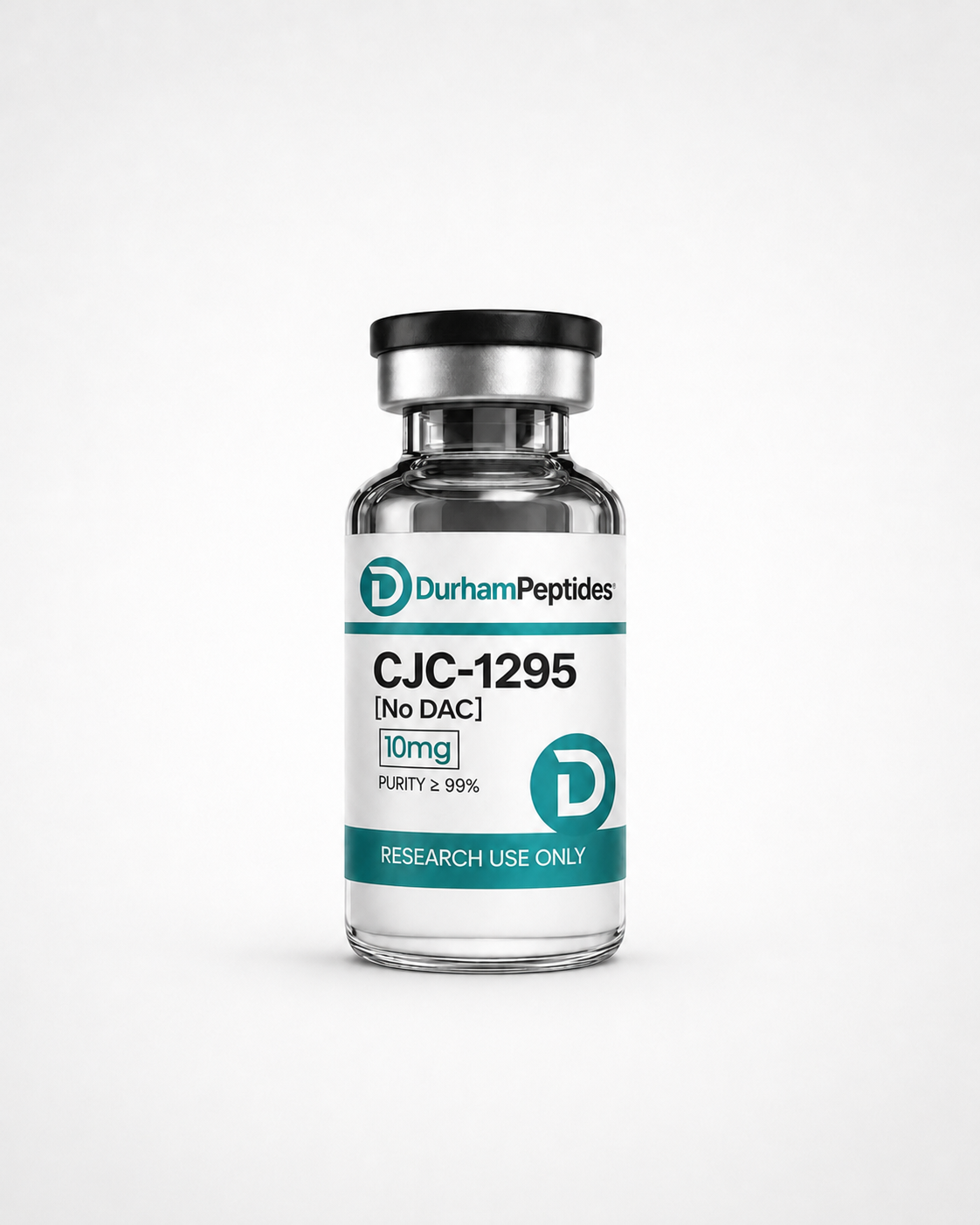
CJC-1295 No DAC vs DAC half-life pulsatile sustained GH release research peptide comparison Durham Peptides Canada
Researchers looking at CJC-1295 quickly encounter a confusing reality: there are actually two different CJC-1295 compounds — "CJC-1295 with DAC" and "CJC-1295 without DAC" (also called "Mod GRF 1-29" or simply "CJC-1295 No DAC"). They share most of their structure but have one critical difference that produces dramatically different research profiles. Durham Peptides stocks the No DAC version specifically, and that choice reflects a real research-design preference, not an arbitrary product selection. This article walks through why.
For the broader CJC-1295 context, see What Is CJC-1295?; for the combination with Ipamorelin, see CJC-1295 vs Ipamorelin; for the broader GHRH analog comparison, see Tesamorelin vs CJC-1295 vs Sermorelin. Nothing here is medical, dosing, or therapeutic guidance.
Both Versions Share the Same Core
Before getting to the difference, the similarity. Both CJC-1295 variants share:
- The same modified GHRH(1-29) sequence. GHRH (growth hormone releasing hormone) is naturally 44 amino acids; the first 29 amino acids carry most of the biological activity. CJC-1295 is built on this GHRH(1-29) backbone with four amino acid substitutions designed to resist degradation.
- The same target receptor. Both versions bind the GHRH receptor on pituitary somatotrophs, stimulating GH synthesis and release through the GHRH pathway.
- The same fundamental research category. Both are GHRH analogs studied in growth hormone research.
So the foundational mechanism is identical. What differs is one specific structural feature that has dramatic functional consequences.
The DAC Difference: A Single Molecule, Massively Different Behavior
DAC stands for Drug Affinity Complex. It's a chemical modification — specifically, a maleimidopropionic acid linker — added to the CJC-1295 backbone. The DAC linker covalently binds to albumin (the most abundant blood protein) when CJC-1295 enters circulation, anchoring the peptide to albumin's multi-day circulation lifetime.
The functional consequence: Albumin has a half-life of roughly 19-20 days. By covalently binding to albumin, CJC-1295 DAC extends its functional half-life from minutes (the natural fate of unmodified peptides) to approximately 6-8 days. CJC-1295 No DAC, without the albumin-binding linker, has a half-life closer to 30 minutes.
So the same core peptide, with or without a single chemical modification, has half-lives that differ by roughly 300x — minutes versus days. This is a remarkable functional difference for what looks like a small structural change.
Side-by-Side
Property | CJC-1295 No DAC | CJC-1295 DAC |
Core sequence | Modified GHRH(1-29) | Modified GHRH(1-29) |
DAC linker | None | Maleimidopropionic acid linker |
Albumin binding | No | Yes (covalent) |
Half-life | ~30 minutes | ~6-8 days |
GH release profile | Pulsatile (rises, peaks, clears) | Sustained (continuous elevation) |
Research alignment | Mimics physiological GH pulsing | Continuous-elevation research model |
Common research pairing | Ipamorelin (also pulsatile, also short half-life) | Less commonly paired with short-half-life compounds |
Durham Peptides | CJC-1295 No DAC 10mg ($69.99) | Not stocked |
Also called | Mod GRF 1-29; CJC-1295 No-DAC | CJC-1295 with DAC; CJC-1295 (DAC) |
Why Pulsatile vs Sustained Matters in GH Research
To understand why the half-life difference is a research-design distinction (not just a duration preference), you have to understand how the body naturally secretes GH.
Endogenous GH is pulsatile. Growth hormone is not secreted continuously. Instead, the pituitary releases GH in discrete pulses — typically several per day, with the largest pulses occurring during deep sleep. Between pulses, GH levels return to low baseline. This pulsatile pattern is biologically important: research has shown that the same total amount of GH delivered as pulses produces different biological effects than the same total delivered as continuous infusion.Receptor desensitization, downstream signaling kinetics, and the timing of IGF-1 production all behave differently under pulsatile vs sustained GH exposure.
Implication for CJC-1295 research:
- CJC-1295 No DAC (short half-life, ~30 minutes) produces a discrete GH pulse each time it's administered — rising quickly, peaking, and clearing. This mimics the body's natural pulsatile GH pattern. For research designed around physiological GH-release dynamics, this is the more research-aligned profile.
- CJC-1295 DAC (long half-life, ~6-8 days) produces a sustained continuous elevation in GH levels — fundamentally different from the body's natural pattern. This may be acceptable for some research questions but represents a non-physiological GH pattern.
For most growth hormone research designed around physiologically-relevant patterns, the No DAC version is the more appropriate research tool.
Why Pulsatile Pairs Well with Ipamorelin
This is the deeper research-design reason Durham Peptides' catalog stocks CJC-1295 No DAC. Ipamorelin — the selective ghrelin-receptor agonist that's the natural pairing for a GHRH analog — has its own short half-life (~2 hours) and produces its own pulsatile GH effects. For the receptor and selectivity context, see Ipamorelin's Selectivity.
The combination logic:
- CJC-1295 No DAC + Ipamorelin → both compounds pulsatile, both clear within hours, combination produces a discrete dual-pathway GH pulse with a clean rise-peak-clear pattern that aligns with physiological GH-release research designs.
- CJC-1295 DAC + Ipamorelin → mismatched kinetics. CJC-1295 DAC produces continuous GHRH-pathway signaling for days while Ipamorelin pulses through over hours. The combination delivers sustained GHRH stimulation overlapping with brief ghrelin-receptor pulses — a research-design awkwardness that complicates interpretation.
For the dual-pathway combination research, the No DAC version of CJC-1295 is mechanistically the better-paired option. This is the rationale behind the CJC-1295 (No DAC) + Ipamorelin Blend — both components pulsatile, both short half-life, kinetically matched.
For the combination logic, see CJC-1295 + Ipamorelin Blend Explained.
Why Some Researchers Would Choose the DAC Version
To be fair to the DAC version: there are research designs where the sustained-elevation profile is the appropriate tool, not the limitation. Examples:
- Research designed specifically around chronically elevated GH (e.g., modeling certain hypersecretion conditions)
- Convenience-focused research where weekly administration is preferable to more frequent administration (acknowledging the non-physiological pattern)
- IGF-1 elevation research where sustained GH stimulation is the explicit design
For most general GH research — and especially research designed around mimicking endogenous physiological patterns — the No DAC version's pulsatile profile is the more appropriate match.
Tesamorelin: A Third Option in the Same Receptor Family
Tesamorelin is the other major GHRH analog in research and uses a different stabilization strategy — a trans-3-hexenoic acid N-terminal modification rather than amino acid substitutions or DAC linkers. Tesamorelin's half-life sits between the two CJC-1295 versions and produces a different research-kinetic profile. For the head-to-head, see Tesamorelin vs CJC-1295 vs Sermorelin; for the broader GHRH-vs-GHS comparison, see Tesamorelin vs Ipamorelin.
Practical Research Considerations
CJC-1295 (No DAC) 10mg at Durham Peptides is C$69.99 (C$7.00/mg), Janoshik-verified to ≥99% purity by HPLC with mass-spec identity confirmation; 100% synthetic; vegan. Storage: 2–8°C short-term, -20°C long-term, protected from light and moisture; reconstitute in bacteriostatic water. The CJC-1295 + Ipamorelin Blend at C$94.99 provides the standard combination format for dual-pathway GH research.
Frequently Asked Questions
What's the difference between CJC-1295 No DAC and CJC-1295 DAC? The DAC version has a Drug Affinity Complex linker that covalently binds albumin, extending half-life from ~30 minutes (No DAC) to ~6-8 days (DAC). Same core peptide, dramatically different kinetics.
Why does Durham Peptides stock the No DAC version specifically? Because the No DAC version's short half-life produces a pulsatile GH release pattern that mimics the body's natural GH secretion. This aligns better with research designed around physiological GH dynamics — and it kinetically matches Ipamorelin for combination research.
Is CJC-1295 No DAC the same as Mod GRF 1-29? Yes — they're alternate names for the same compound. The modified GHRH(1-29) backbone without the DAC albumin-binding linker.
Does the half-life difference change the GH effect? Yes, substantially. The same amount of GH delivered as a pulse produces different biological effects than the same amount delivered as continuous elevation — receptor desensitization, downstream signaling kinetics, and IGF-1 timing all differ.
Can the two versions be combined with Ipamorelin? The No DAC version pairs naturally with Ipamorelin (both pulsatile, both short half-life, kinetically matched). The DAC version's sustained profile mismatches with Ipamorelin's pulsatile profile and produces interpretively complicated combinations.
Where can I buy CJC-1295 No DAC in Canada? Durham Peptides supplies CJC-1295 (No DAC) 10mg (C$69.99) standalone and in the CJC-1295 + Ipamorelin Blend (C$94.99), both Janoshik-verified.
Final Thoughts
The CJC-1295 No DAC vs DAC distinction is one of the cleanest examples of how a small structural modification — a single linker added to a peptide backbone — can produce dramatically different research profiles. The DAC linker extends half-life by roughly 300x by covalently binding albumin, transforming a pulsatile research tool into a sustained-elevation research tool. For most GH research designed around physiologically-relevant patterns, the No DAC version is the better-matched tool — which is why Durham Peptides stocks the No DAC version specifically and pairs it with Ipamorelin in the combination blend.
For the broader CJC-1295 context, see What Is CJC-1295?; for the combination logic, see CJC-1295 + Ipamorelin Blend Explained; for the receptor and selectivity context on the Ipamorelin side of the pairing, see Ipamorelin's Selectivity.
Selected Research References
- Teichman SL, Neale A, Lawrence B, et al. Prolonged Stimulation of Growth Hormone (GH) and Insulin-Like Growth Factor I Secretion by CJC-1295, a Long-Acting Analog of GH-Releasing Hormone. Journal of Clinical Endocrinology & Metabolism. 2006;91(3):799-805. https://pubmed.ncbi.nlm.nih.gov/16352683/
- Sackmann-Sala L, Ding J, Frohman LA, Kopchick JJ. Activation of the GH/IGF-1 Axis by CJC-1295, a Long-Acting GHRH Analog. Endocrine. 2009. (Foundational reference on CJC-1295 mechanism characterization.)
- Bowers CY. Editorial: Unnatural Growth Hormone-Releasing Peptide Begets Natural Ghrelin. Journal of Clinical Endocrinology & Metabolism. 2001;86(4):1464-1469. https://pubmed.ncbi.nlm.nih.gov/11297567/
- Müller EE, Locatelli V, Cocchi D. Neuroendocrine Control of Growth Hormone Secretion. Physiological Reviews. 1999;79(2):511-607. (Reference on pulsatile vs sustained GH pattern biology.)
All products sold by Durham Peptides are for research and laboratory use only. They are not intended for human or animal consumption, diagnosis, treatment, cure, or prevention of any disease.