

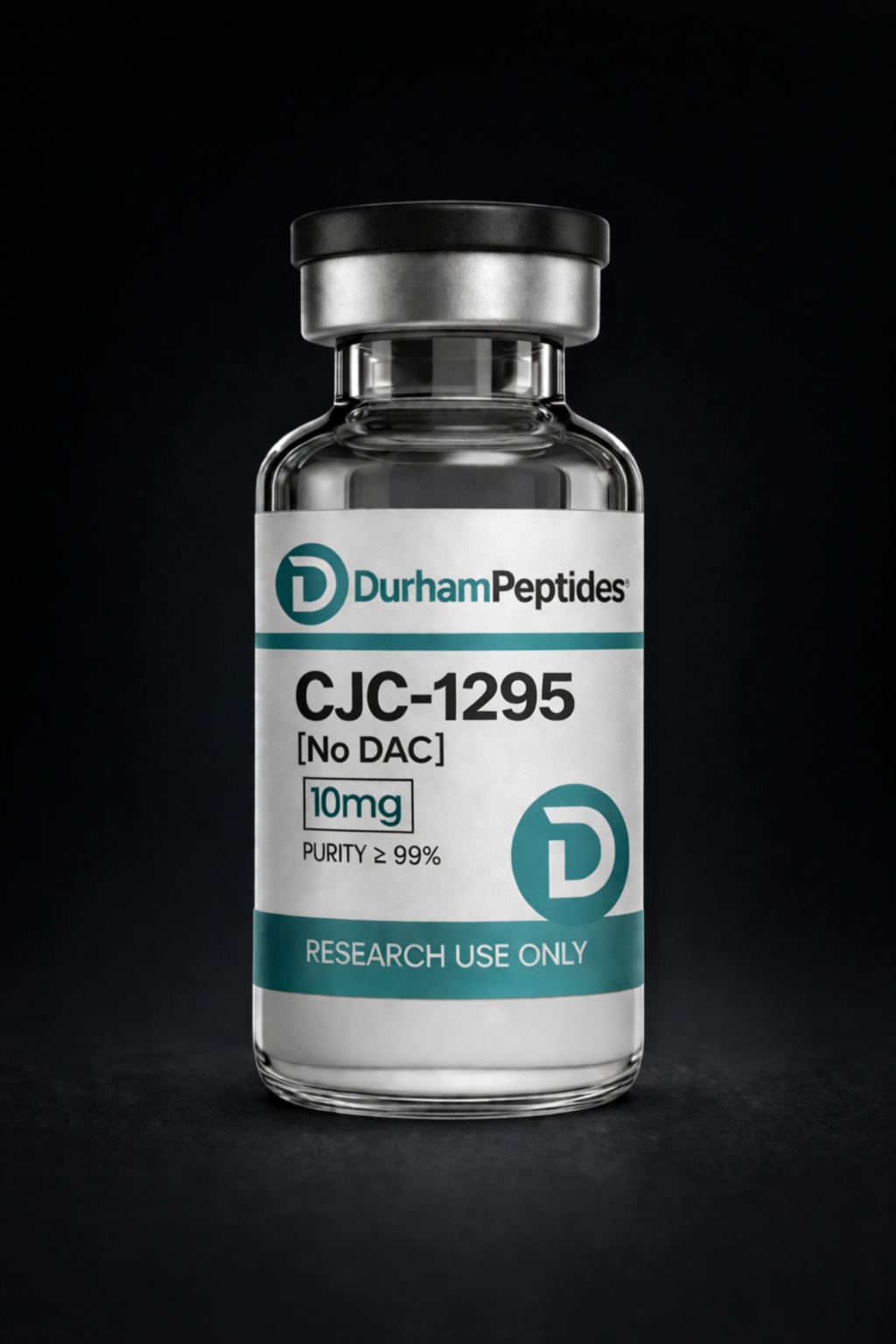
CJC-1295 Ipamorelin blend dual pathway growth hormone research peptide Durham Peptides Canada
The CJC-1295 + Ipamorelin blend is the single most-studied growth-hormone secretagogue combination in peptide research, and the logic behind it is elegant: rather than pushing one lever of growth-hormone release harder, it pulls two complementary levers at once. By pairing a GHRH-analog (CJC-1295) with a selective ghrelin-receptor agonist (Ipamorelin), the blend engages the two distinct upstream pathways that converge on growth-hormone-releasing somatotroph cells of the pituitary — a combination that published preclinical data suggests produces greater GH elevation than either compound alone.
This article explains what each component does, why the combination is studied together, and what researchers examine when they use the blend. For Canadian researchers, Durham Peptides supplies the CJC-1295 (No DAC) + Ipamorelin Blend 10mg. Nothing here is medical, dosing, or therapeutic guidance.
The Two Pathways of Growth-Hormone Release
Growth-hormone secretion from the pituitary is governed by several upstream signals. Two of them are the targets of this blend:
- The GHRH pathway. Growth-hormone-releasing hormone (GHRH) binds the GHRH receptor on pituitary somatotrophs and stimulates the synthesis and release of growth hormone. This is the primary "go" signal for GH production.
- The ghrelin / GHS pathway. Ghrelin (and synthetic ghrelin mimetics) binds the growth-hormone secretagogue receptor (GHS-R1a) and amplifies the amplitude of GH pulses, working through a mechanism distinct from GHRH.
Because these two pathways act through different receptors and different intracellular signals, activating both simultaneously is studied for producing a synergistic — not merely additive — effect on GH release. This dual-pathway synergy is the central rationale for the blend, and for the broader practice of combining a GHRH analog with a ghrelin mimetic, which is discussed in depth in Growth Hormone Secretagogues Explained.
Component 1: CJC-1295 (No DAC) — the GHRH Analog
CJC-1295 (No DAC) is a 30-amino-acid analog of GHRH, also known as Modified GRF (1-29). Its key identity data:
- CAS number: 446036-97-1
- Molecular weight: 3367.9 g/mol
- Class: GHRH receptor agonist
The "No DAC" designation is important. The original CJC-1295 molecule included a Drug Affinity Complex (DAC) that bound to serum albumin, extending its half-life to several days. The No DAC version omits that complex, giving it a short half-life (on the order of minutes). That short half-life is a deliberate research feature: it allows the compound to stimulate a GH pulse and then clear, preserving the body's natural pulsatile pattern of GH secretion rather than producing a continuous elevation. Researchers studying pulsatile GH dynamics specifically favor the No-DAC form for this reason.
Component 2: Ipamorelin — the Selective Ghrelin-Receptor Agonist
Ipamorelin is a pentapeptide (five amino acids) that selectively activates the GHS-R1a (ghrelin) receptor. Its key identity data:
- CAS number: 170851-70-4
- Molecular weight: 711.85 g/mol
- Class: Selective growth-hormone secretagogue (GHS) receptor agonist
Ipamorelin's defining research characteristic is its selectivity. Earlier-generation growth-hormone-releasing peptides (such as GHRP-6 and GHRP-2) also stimulate GH but tend to raise cortisol and prolactin as well. Ipamorelin was characterized in the literature as the first GHS that stimulates GH with minimal effect on cortisol and prolactin — making it a cleaner research tool for isolating GH-release effects. Like CJC-1295 No DAC, it has a short half-life that preserves pulsatile secretion.
Why the Blend Combines Them
Durham Peptides' CJC-1295 (No DAC) + Ipamorelin Blend contains:
- 5mg CJC-1295 (No DAC) — the GHRH-pathway component
- 5mg Ipamorelin — the ghrelin-pathway component
- 10mg total, in a 1:1 ratio
The combination is studied because the two compounds engage GH release through complementary, non-overlapping mechanisms:
- CJC-1295 increases the synthesis and release of GH through the GHRH receptor.
- Ipamorelin increases the amplitude of the GH pulse through the GHS receptor.
When both pathways are activated concurrently, published preclinical data suggests a greater GH response than either pathway produces alone — the basis of the "GHRH + GHS synergy" that has been documented across the secretagogue literature. The 1:1, both-short-half-life design preserves the natural pulsatile profile while engaging both axes. For the head-to-head breakdown of the two components, see CJC-1295 vs Ipamorelin: Why Researchers Combine Them.
What Researchers Examine
In research protocols using the blend, common areas of investigation include:
- Synergistic GH release: GHRH analog + GHS agonist combination versus monotherapy
- Pulsatile GH secretion patterns in pituitary cell models
- Downstream IGF-1 effects under combined GHRH/GHS activation
- Comparative analysis versus single-compound administration
- Optimal component ratios for dual-pathway GH research protocols
The Convenience Factor
Beyond the pharmacology, the blend has a practical research advantage: it eliminates the need to reconstitute, calculate, and store two separate vials for a combination protocol. A single co-reconstituted vial produces consistent per-unit amounts of both components. For the reconstitution math, the peptide calculator handles the volume calculations, and How to Reconstitute Peptides covers the physical protocol. Both components reconstitute in bacteriostatic water and store under the same conditions.
Quality Standards
Durham Peptides' blend is verified to ≥99% purity per component by HPLC, with mass-spectrometry identity confirmation for both peptides through Janoshik Analytical, each batch carrying an independently verifiable COA key. Per-component verification matters for a blend — you want confirmation that both peptides are present, identified, and pure, not just an aggregate number. For how to read those documents, see How to Read a Janoshik COA and the Lab Results page.
Frequently Asked Questions
What is the CJC-1295 + Ipamorelin blend? A dual-pathway growth-hormone research peptide combining CJC-1295 (No DAC), a GHRH-receptor agonist, with Ipamorelin, a selective ghrelin-receptor agonist, in a 1:1 (5mg + 5mg) ratio.
Why are CJC-1295 and Ipamorelin used together? They activate GH release through two complementary pathways — GHRH and ghrelin/GHS — and published preclinical data suggests the combination produces greater GH elevation than either compound alone.
What does "No DAC" mean in CJC-1295? "No DAC" means the molecule omits the Drug Affinity Complex, giving it a short half-life that preserves the natural pulsatile pattern of GH secretion, unlike the long-acting DAC version.
Is Ipamorelin selective? Yes. Ipamorelin is characterized as a selective GHS agonist that stimulates GH with minimal effect on cortisol and prolactin, distinguishing it from earlier GHRPs.
Can I buy CJC-1295 and Ipamorelin separately? Yes. Durham Peptides stocks CJC-1295 (No DAC) and Ipamorelinindividually, as well as the combined blend.
How is the blend stored? 2–8°C short-term, -20°C long-term, protected from light and moisture; reconstitute in bacteriostatic water.
Final Thoughts
The CJC-1295 + Ipamorelin blend endures as a research staple because its design is genuinely rational: two short-acting compounds, two distinct pathways, one pulsatile-preserving combination studied for synergistic GH release. For Canadian researchers, Durham Peptides supplies the CJC-1295 (No DAC) + Ipamorelin Blend 10mg at C$95.00, Janoshik-verified per component.
For the component comparison, see CJC-1295 vs Ipamorelin; for the category context, see Growth Hormone Secretagogues Explained; and for the buying decision, see Buy CJC-1295 + Ipamorelin in Canada.
Selected Research References
- Teichman SL, Neale A, Lawrence B, et al. Prolonged Stimulation of Growth Hormone and Insulin-Like Growth Factor I Secretion by CJC-1295, a Long-Acting Analog of GHRH. Journal of Clinical Endocrinology & Metabolism. 2006;91(3):799-805. https://pubmed.ncbi.nlm.nih.gov/16352683/
- Raun K, Hansen BS, Johansen NL, et al. Ipamorelin, the First Selective Growth Hormone Secretagogue. European Journal of Endocrinology. 1998;139(5):552-561. https://pubmed.ncbi.nlm.nih.gov/9849822/
- Bowers CY, Momany FA, Reynolds GA, Hong A. On the In Vitro and In Vivo Activity of a New Synthetic Hexapeptide That Acts on the Pituitary to Specifically Release Growth Hormone. Endocrinology. 1984. https://pubmed.ncbi.nlm.nih.gov/1349865/
All products sold by Durham Peptides are for research and laboratory use only. They are not intended for human or animal consumption, diagnosis, treatment, cure, or prevention of any disease.