

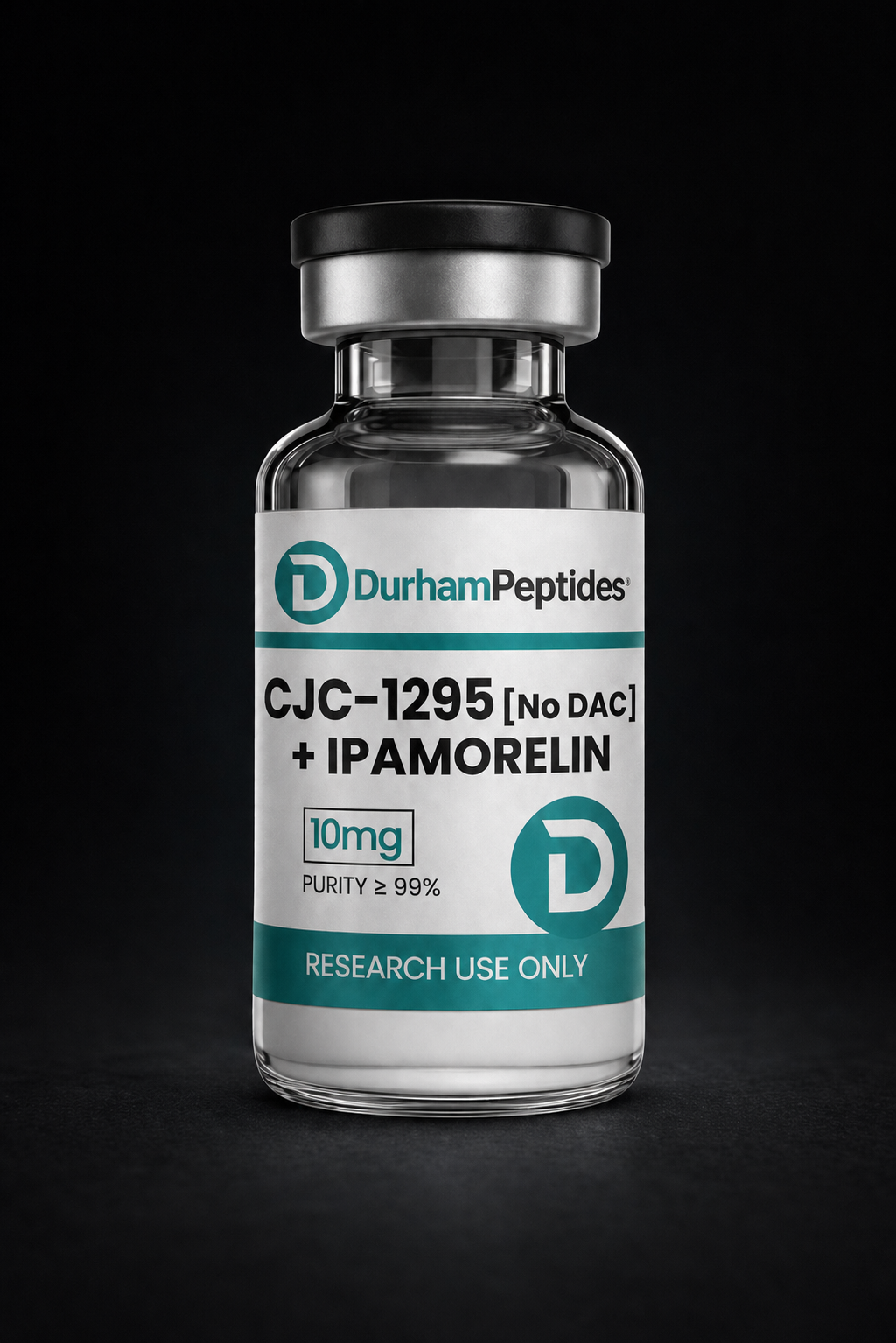
CJC-1295 vs Ipamorelin GHRH analog ghrelin agonist comparison Durham Peptides Canada
"CJC-1295 vs Ipamorelin" is a common search, but it frames the two compounds as competitors when, in research practice, they're collaborators. They act on different receptors, through different pathways, with different effects on the growth-hormone pulse — which is precisely why they're so often studied together rather than chosen one over the other. Understanding the difference between them is the key to understanding why the combination is studied at all.
This article compares the two compounds directly: what each is, how their mechanisms differ, and the research logic of pairing them. For the blend itself, see CJC-1295 + Ipamorelin Blend Explained.
The Fundamental Difference: Two Different Receptors
The single most important distinction is which receptor each compound targets:
- CJC-1295 (No DAC) is a GHRH analog. It binds the GHRH receptor on pituitary somatotrophs and stimulates the synthesis and release of growth hormone.
- Ipamorelin is a ghrelin mimetic. It binds the GHS-R1a (ghrelin) receptor and amplifies the amplitude of growth-hormone pulses.
These are genuinely different molecular targets engaging different intracellular signaling. That non-overlap is the foundation of everything else.
Side-by-Side Comparison
Property | CJC-1295 (No DAC) | Ipamorelin |
Class | GHRH analog | Selective GHS / ghrelin-receptor agonist |
Receptor | GHRH receptor | GHS-R1a (ghrelin) receptor |
Size | 30 amino acids | 5 amino acids (pentapeptide) |
Molecular weight | 3367.9 g/mol | 711.85 g/mol |
CAS number | 446036-97-1 | 170851-70-4 |
Primary research effect | Stimulates GH synthesis/release | Amplifies GH pulse amplitude |
Half-life (No DAC form) | Short (minutes) | Short (minutes) |
Effect on cortisol/prolactin | Minimal | Minimal (selective) |
How Their Mechanisms Differ
CJC-1295 (No DAC) works "upstream," mimicking the body's own GHRH signal. It tells the somatotrophs to produce and release growth hormone. As a GHRH analog, its effect is gated by somatostatin (the inhibitory counter-signal), so it works within the body's natural regulatory feedback.
Ipamorelin works through a separate channel entirely. As a ghrelin-receptor agonist, it both stimulates GH release and suppresses somatostatin tone, and it's studied for increasing the amplitude of GH pulses. Its selectivity is its signature trait — unlike older GHRPs (GHRP-6, GHRP-2), it produces GH release with minimal cortisol or prolactin effects, making it a cleaner research tool.
Why the Difference Creates Synergy
Because the two compounds engage GH release through separate, complementary mechanisms, activating both at once is studied for a synergistic effect — a combined GH response greater than the sum of either alone. The classic model:
- CJC-1295 raises the baseline drive for GH synthesis and release (GHRH pathway).
- Ipamorelin amplifies the pulse and reduces inhibitory tone (ghrelin pathway).
Together, they push the same output (GH release) through two independent inputs. This GHRH-analog-plus-ghrelin-mimetic synergy is well documented across the secretagogue literature and is the reason the two are combined in Durham Peptides' CJC-1295 (No DAC) + Ipamorelin Blend. For the broader category framing, see Growth Hormone Secretagogues Explained.
This is the same compositional logic that underlies other studied combinations in the Durham Peptides catalog — pairing compounds with distinct, complementary mechanisms rather than redundant ones. The Wolverine Stack (BPC-157 + TB-500) follows the same principle in the tissue-repair category.
When You'd Choose One Over the Other
Despite the synergy story, there are research reasons to use a single compound:
- Study the GHRH pathway in isolation → CJC-1295 (No DAC) alone.
- Study the ghrelin/GHS pathway in isolation → Ipamorelin alone.
- Study the combined, synergistic effect → the blend, or both compounds together.
So the honest answer to "CJC-1295 vs Ipamorelin" is that it's rarely an either/or in combination research — but for mechanistic isolation work, the choice depends entirely on which pathway is under study.
Frequently Asked Questions
What's the difference between CJC-1295 and Ipamorelin? CJC-1295 (No DAC) is a GHRH analog acting on the GHRH receptor to stimulate GH synthesis/release; Ipamorelin is a selective ghrelin-receptor agonist that amplifies GH pulse amplitude. Different receptors, different mechanisms.
Why are CJC-1295 and Ipamorelin combined? Because they engage GH release through complementary, non-overlapping pathways, the combination is studied for synergistic GH elevation greater than either alone.
Is CJC-1295 or Ipamorelin better? Neither is universally "better" — they do different
things. For combination research they're used together; for mechanistic isolation, the choice depends on which pathway is being studied.
Does Ipamorelin raise cortisol like other GHRPs? No. Ipamorelin is characterized as selective, producing GH release with minimal cortisol and prolactin effects, unlike GHRP-6 and GHRP-2.
Can I buy them individually? Yes. Durham Peptides stocks CJC-1295 (No DAC) and Ipamorelin separately, plus the combined blend.
Do they both have short half-lives? Yes — CJC-1295 No DAC and Ipamorelin both have short half-lives, which preserves the natural pulsatile pattern of GH secretion.
Final Thoughts
CJC-1295 and Ipamorelin aren't rivals — they're two halves of a dual-pathway approach to growth-hormone research, each engaging a different receptor to push the same output. That's why "vs" is the wrong frame for combination work, and why the blend exists.
For the full mechanism, see CJC-1295 + Ipamorelin Blend Explained; for the category, see Growth Hormone Secretagogues Explained; and for buying, see Buy CJC-1295 + Ipamorelin in Canada.
Selected Research References
- Raun K, Hansen BS, Johansen NL, et al. Ipamorelin, the First Selective Growth Hormone Secretagogue. European Journal of Endocrinology. 1998;139(5):552-561. https://pubmed.ncbi.nlm.nih.gov/9849822/
- Teichman SL, Neale A, Lawrence B, et al. Prolonged Stimulation of Growth Hormone and Insulin-Like Growth Factor I Secretion by CJC-1295, a Long-Acting Analog of GHRH. Journal of Clinical Endocrinology & Metabolism. 2006;91(3):799-805. https://pubmed.ncbi.nlm.nih.gov/16352683/
- Bowers CY, Momany FA, Reynolds GA, Hong A. On the In Vitro and In Vivo Activity of a New Synthetic Hexapeptide That Acts on the Pituitary to Specifically Release Growth Hormone. Endocrinology. 1984. https://pubmed.ncbi.nlm.nih.gov/1349865/
All products sold by Durham Peptides are for research and laboratory use only. They are not intended for human or animal consumption, diagnosis, treatment, cure, or prevention of any disease.