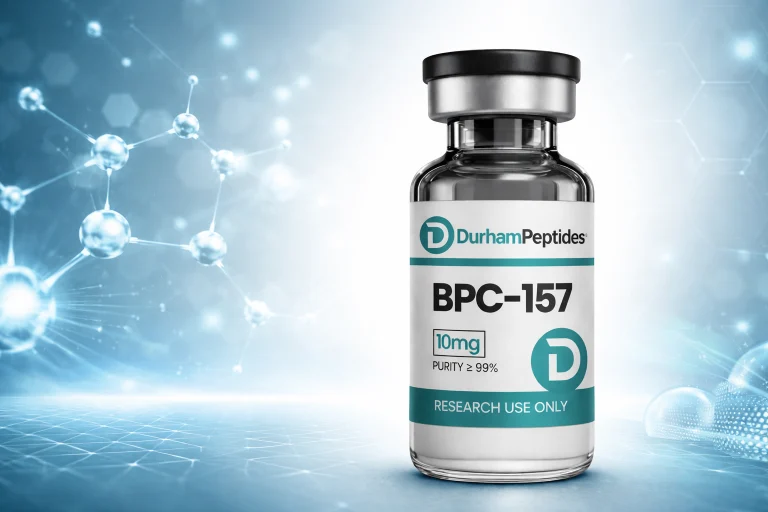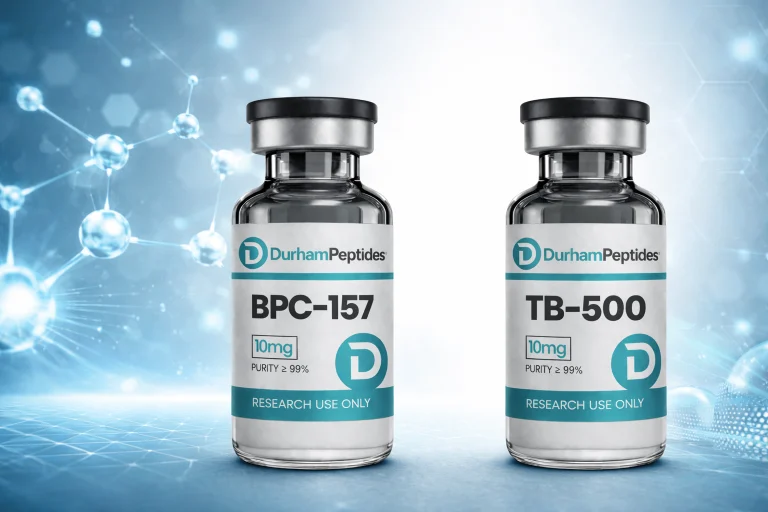

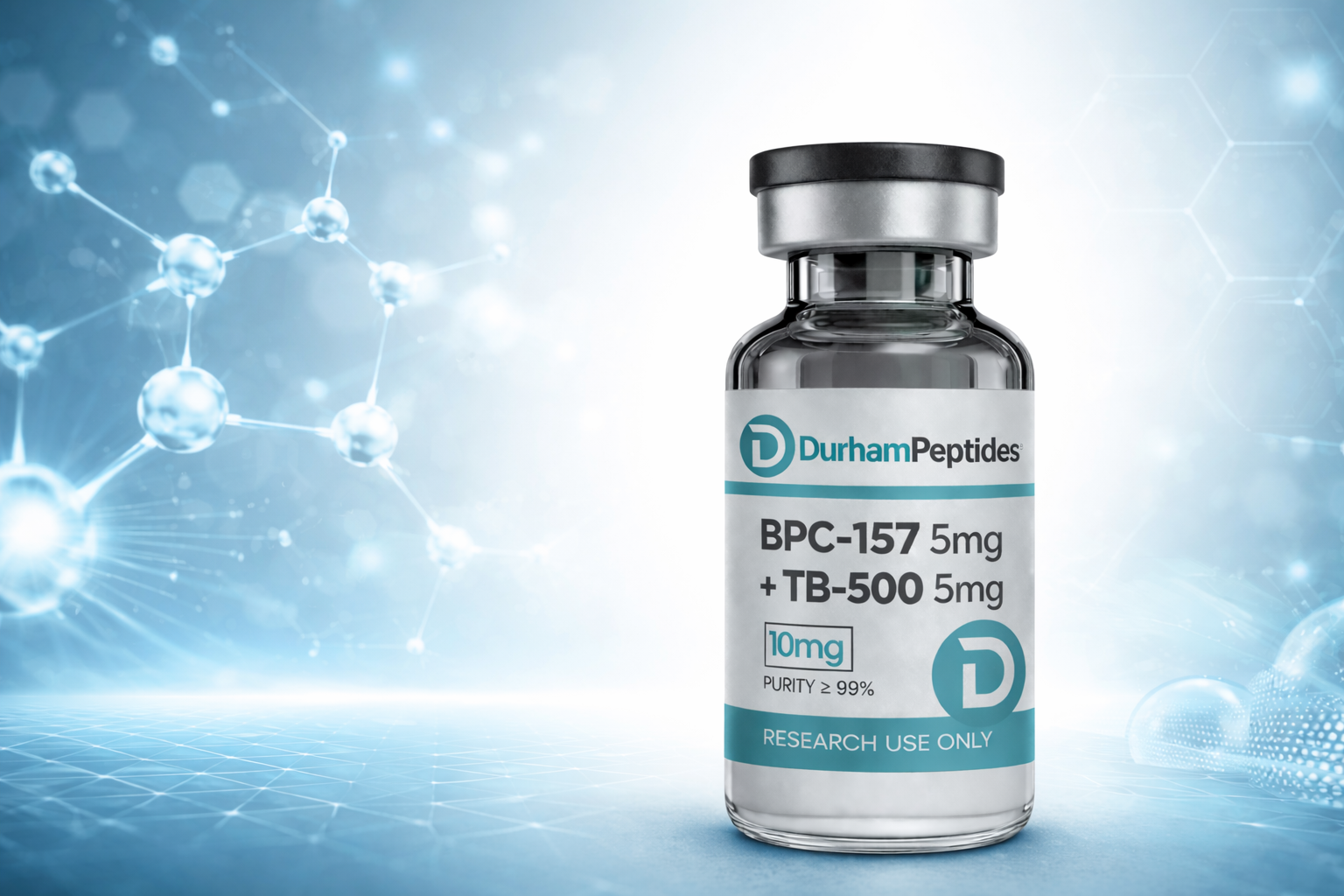
If you've spent any time in peptide research communities, fitness forums, or biohacking circles, you've almost certainly come across the term "Wolverine Stack." It's one of the most searched peptide terms in Canada, and for good reason — it represents a combination of two of the most individually popular research peptides on the market.
But what exactly is the Wolverine Stack, where did the name come from, and why is this particular combination of peptides so widely discussed?
What Is the Wolverine Stack?
The Wolverine Stack is a blend of two peptides in a single vial: BPC-157 (Body Protection Compound-157) at 5mg, and TB-500 (a synthetic fragment of Thymosin Beta-4) at 5mg, for a total of 10mg per vial.
BPC-157 is a 15-amino-acid synthetic peptide derived from a protective protein found in human gastric juice. TB-500 is a synthetic version of Thymosin Beta-4, a 43-amino-acid peptide found in virtually all human and animal cells. Both peptides have been individually studied in extensive preclinical research, and the combination in a single vial has become one of the most popular product formats in the Canadian peptide market.
Where Did the Name Come From?
The name "Wolverine Stack" originated in online fitness and recovery communities, likely on Reddit and bodybuilding forums, as a reference to the Marvel Comics character Wolverine — known for his superhuman regenerative healing factor. The name caught on organically and is now the standard term used across the peptide industry for this particular combination.
It's worth noting that this is a community-created nickname, not an official scientific or pharmaceutical term. You won't find "Wolverine Stack" in any published research paper — but you will find extensive published research on both BPC-157 and Thymosin Beta-4 individually.
BPC-157: The Gastric Peptide
BPC-157 has been studied in preclinical models for its effects on tissue repair in tendon, ligament, and muscle injury models, protective effects on gastric and intestinal lining, promotion of angiogenesis (new blood vessel formation), and modulation of inflammatory signaling.
A comprehensive review in Cell and Tissue Research (2019) noted that BPC-157 demonstrated positive healing effects across every injury type studied, though the authors emphasized that the majority of data comes from rodent models.
BPC-157 has a CAS number of 137525-51-0 and a molecular weight of 1419.53 g/mol.
TB-500: The Thymosin Peptide
TB-500 is studied for a different but complementary set of mechanisms. Its primary area of research interest is actin regulation — it is known to sequester G-actin, which plays a central role in cell migration and structural organization.
Published research on Thymosin Beta-4 has examined its effects on cellular migration to injury sites through actin upregulation, wound closure and tissue repair across skin, corneal, and cardiac models, anti-inflammatory cytokine modulation, and angiogenesis through promotion of endothelial cell differentiation.
A foundational paper by Malinda et al. (1999) demonstrated that topical and intraperitoneal application of Thymosin Beta-4 increased re-epithelialization by 42-61% over controls in a rat full-thickness wound model. A 2012 review by Goldstein et al. described Thymosin Beta-4 as a "multifunctional regenerative peptide" with multiple activities relevant to tissue repair.
TB-500 has a CAS number of 77591-33-4 and a molecular weight of approximately 4963.44 g/mol.
Why Combine Them?
The rationale for combining BPC-157 and TB-500 is based on the premise that the two peptides may act through complementary mechanisms. BPC-157's studied effects center on angiogenesis, growth factor expression, and nitric oxide modulation, while TB-500's studied effects center on actin regulation, cell migration, and anti-inflammatory signaling.
Researchers interested in tissue recovery biology often study both compounds, and the pre-blended format eliminates the need to source, store, and reconstitute two separate vials. This convenience factor is a significant driver of the Wolverine Stack's popularity.
It should be noted that while both peptides have been individually studied extensively, published research specifically examining the combination of BPC-157 and TB-500 together is limited. The synergistic premise is based on complementary mechanisms observed in separate studies, not on direct combination studies.
Blend vs Individual Compounds
Durham Peptides carries both options. The pre-blended Wolverine Stack (BPC-157 5mg + TB-500 5mg, 10mg total) is ideal for researchers who want the convenience of a single reconstitution. For researchers who prefer to control ratios or study each compound independently, BPC-157 (10mg) and TB-500 (10mg) are both available as individual products.
All products require reconstitution with bacteriostatic water, which is also available from Durham Peptides.
Quality and Verification
As with all Durham Peptides products, the Wolverine Stack is third-party tested by Janoshik Analytical. Every batch comes with a COA that includes HPLC purity data and mass spectrometry identity confirmation. COA verification keys can be independently checked on Janoshik's website.
Selected Research References
- Gwyer D, Wragg NM, Wilson SL. "Gastric pentadecapeptide body protection compound BPC 157 and its role in accelerating musculoskeletal soft tissue healing." Cell Tissue Res. 2019. PMID: 30915550
- Malinda KM, et al. "Thymosin beta4 accelerates wound healing." J Invest Dermatol. 1999. PMID: 10469335
- Goldstein AL, et al. "Thymosin β4: a multi-functional regenerative peptide." Expert Opin Biol Ther. 2012. PMID: 22074294
All products mentioned in this article are sold by Durham Peptides for research and laboratory use only. They are not intended for human or animal consumption, diagnosis, treatment, cure, or prevention of any disease.