

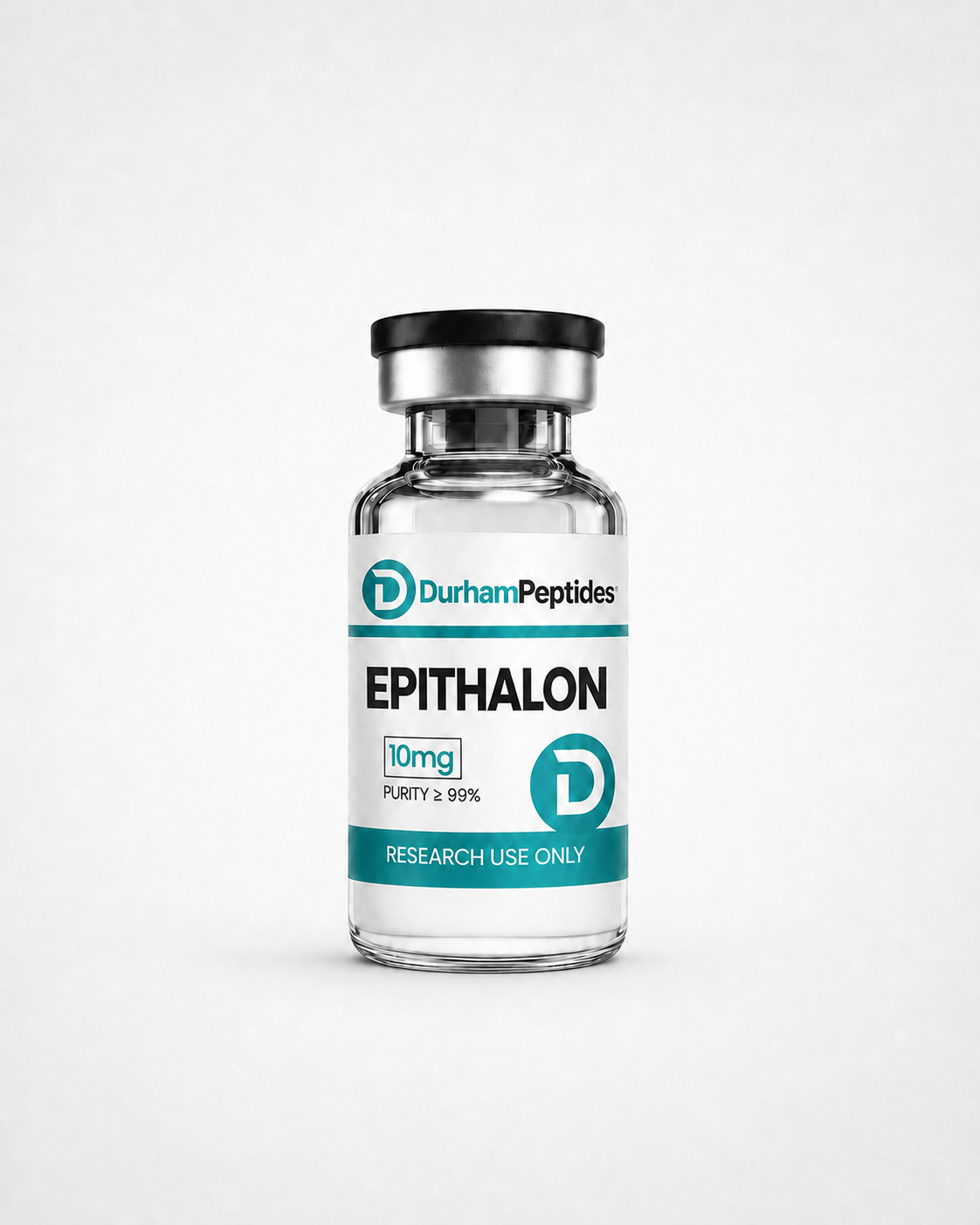
Epithalon telomerase mechanism Ala-Glu-Asp-Gly tetrapeptide pineal longevity research Durham Peptides Canada
Epithalon's research story has a single mechanistic anchor that distinguishes it from almost every other research peptide in the longevity category: investigated telomerase activation. Most longevity peptides work through pathways that influence cellular metabolism, mitochondrial function, gene expression, or growth-factor signaling. Epithalon's research literature uniquely centers on telomere biology and the enzyme that maintains telomere length — telomerase. This article opens that mechanism in detail: how telomerase actually works, what Epithalon has been studied to do at that pathway, and why the telomere-biology framing places Epithalon in a distinctive corner of longevity research.
For the standalone Epithalon overview, see What Is Epithalon?; for comparison to other longevity compounds, see MOTS-c vs Epithalon and The Best Longevity Peptides for Research in Canada. Nothing here is medical, dosing, or therapeutic guidance.
The Origin: A Pineal-Derived Tetrapeptide
Epithalon (also written Epitalon) is a synthetic tetrapeptide developed by Russian gerontologist Vladimir Khavinson at the St. Petersburg Institute of Bioregulation and Gerontology. The compound was identified through research into epithalamin — a pineal-gland extract that, in Khavinson's research, showed life-extending effects in aging animal models. Epithalon represents the active tetrapeptide sequence isolated from that extract, refined into a defined synthetic compound.
Sequence: Ala-Glu-Asp-Gly (alanine, glutamic acid, aspartic acid, glycine) Molecular
weight: ~390.4 g/mol Class: Synthetic tetrapeptide
At four amino acids, Epithalon is one of the smallest research peptides — comparable in size to KPV (three amino acids) and dramatically smaller than the larger longevity-research compounds like MOTS-c (16 amino acids). The small size has implications for stability, manufacturing, and how the compound is studied.
Telomerase: The Enzyme at the Center of Epithalon's Research
To understand Epithalon's research story, you need to understand telomerase. Here's the brief version of the biology:
Chromosomes have caps called telomeres. At the ends of every chromosome are repeating non-coding DNA sequences (TTAGGG in humans, repeated thousands of times). These telomeres act as protective caps — they prevent the chromosome ends from being recognized as DNA damage, and they prevent fusion of chromosome ends to each other.
Every cell division shortens telomeres. Standard DNA replication can't fully copy the very ends of linear chromosomes — a small piece is lost each replication cycle. Over many divisions, telomeres get shorter and shorter. When they become critically short, the cell enters senescence (stops dividing) or apoptosis (dies). This is the end-replication problem, and it's part of what limits the number of times most cells can divide.
Telomerase is the enzyme that lengthens telomeres back. Telomerase is a ribonucleoprotein complex containing a catalytic protein component (hTERT in humans, the telomerase reverse transcriptase) and an RNA template (hTR/hTERC, telomerase RNA). When active, telomerase adds new telomere repeats to chromosome ends, compensating for the per-division loss. Telomerase is highly active in germ cells, stem cells, and many cancer cells; it's mostly silent in most somatic cells in adults.
The investigated longevity link: Telomere shortening has been studied as one of the hallmarks of aging — a well-characterized molecular hallmark associated with cellular senescence and age-related decline. Research compounds that could activate telomerase in somatic cells, in principle, would address that specific hallmark.
This is the conceptual scaffold of Epithalon's research interest.
What Epithalon Has Been Studied to Do at the Telomerase Pathway
The published research literature on Epithalon and telomerase, primarily from Khavinson's group and collaborators, has examined several investigated effects:
Investigated effect 1: Telomerase activity upregulation in cell-culture models. The earliest mechanistic studies on Epithalon and telomerase reported investigated increases in telomerase activity in human somatic cell cultures — primary fibroblasts and other cell types where telomerase is normally low or absent. The reported finding is that Epithalon exposure in vitro is associated with measurable telomerase activity above untreated controls.
Investigated effect 2: Telomere length effects in cell-culture models. Following from telomerase upregulation, research has examined whether telomere length itself is affected. Reports include investigated telomere length maintenance or extension in cell cultures exposed to Epithalon, consistent with the telomerase-activation mechanism.
Investigated effect 3: hTERT gene expression effects. Some research has examined whether Epithalon affects expression of the hTERT gene itself (the catalytic protein component of telomerase). Investigated effects on hTERT expression would provide a transcriptional-level mechanism for the observed telomerase activity changes.
Investigated effect 4: Lifespan and aging markers in animal models. The original Khavinson research program examined Epithalon in aging animal models, with reported effects on lifespan, age-related biomarkers, and various physiological aging endpoints. These findings predate and underpin the molecular-mechanism research on telomerase.
Important framing on this evidence base: Much of the foundational Epithalon research comes from Russian-language publications and the St. Petersburg Institute, with smaller representation in Western peer-reviewed journals. The research literature is substantial in volume but more concentrated in source than for compounds like BPC-157 or the GLP-1 peptides. Western replication efforts are ongoing. For broader research integrity context, see Peptide Research Ethics and Reproducibility.
Why Telomerase Activation Specifically Matters in Longevity Research
Telomerase activation as a research target has a few distinctive properties that explain its position in longevity research:
1. It addresses a specific, well-characterized hallmark of aging. Telomere attrition is one of the original nine hallmarks of aging identified in the seminal 2013 Cell paper by López-Otín and colleagues. Compounds that directly address a recognized hallmark have a clear theoretical place in aging research.
2. The mechanism is upstream of multiple downstream effects. Telomere maintenance influences cellular replicative capacity, senescence onset, and tissue-renewal capacity. A pathway-level intervention has potential effects across multiple downstream readouts.
3. The mechanism is distinct from most other longevity research compounds. MOTS-c works through mitochondrial signaling and AMPK; NAD+ works through enzyme cofactor biology; GHK-Cu works through copper-peptide gene expression. None of these engage telomere biology. Epithalon occupies its own mechanistic lane.
4. Telomerase activation has been deeply studied in other contexts. The telomerase research literature outside Epithalon — across cancer biology, stem cell biology, and aging research — is vast. Epithalon's place within that broader literature is as a candidate small-molecule research compound studied for telomerase modulation.
Where Epithalon Fits the Longevity Research Map
Mapping Epithalon onto the broader longevity-research landscape, the categorization is clear:
Compound | Primary investigated mechanism | Cellular target |
Epithalon | Telomerase activation | Chromosome ends / DNA replication |
MOTS-c | AMPK signaling | Mitochondria |
NAD+ | Coenzyme replacement | NAD-dependent enzymes (sirtuins, etc.) |
GHK-Cu | Gene expression modulation | Hundreds of genes including aging-related |
5-Amino-1MQ | NNMT inhibition | NAD salvage pathway preservation |
Epithalon is the only one of these that engages telomere biology specifically. Researchers designing aging-research protocols typically have to choose which hallmark of aging to engage; Epithalon answers "telomere attrition." For the broader category overview, see The Best Longevity Peptides for Research in Canada.
Comparing Epithalon to Other Telomerase-Targeted Research
A worth-knowing framing: Epithalon is not the only research compound studied for telomerase effects. The broader telomerase-activator research landscape includes compounds like TA-65 (cycloastragenol-derived), various plant-derived telomerase modulators, and a range of investigational small molecules. What distinguishes Epithalon in this category is its small-peptide structure (vs the larger natural-product class), its accumulated Russian research literature, and its commercial availability as a defined synthetic compound.
Practical Research Considerations
Epithalon is supplied as a 10mg lyophilized peptide at Durham Peptides (Epithalon 10mg, C$65.99). Janoshik-verified to ≥99% purity by HPLC with mass-spec identity confirmation; 100% synthetic; vegan. Storage: 2–8°C short-term, -20°C long-term, protected from light and moisture; reconstitute in bacteriostatic water. At four amino acids it's a chemically simple molecule with reasonable stability properties for laboratory research.
Frequently Asked Questions
What is Epithalon's primary research mechanism? Investigated telomerase activation — research has examined how Epithalon exposure affects telomerase enzyme activity, telomere length, and hTERT gene expression in cell-culture models, with downstream interest in aging-research applications.
What is telomerase and why does it matter for aging research? Telomerase is the enzyme that lengthens telomeres (the protective caps on chromosome ends). Telomere shortening is one of the recognized molecular hallmarks of aging, so telomerase activation
is studied as a potential research approach to that specific hallmark.
Is Epithalon the same as Epitalon? Yes — the two spellings refer to the same compound. Different transliterations from the original Russian.
How does Epithalon's mechanism compare to MOTS-c or NAD+? Different mechanisms, different targets. Epithalon works at telomeres/telomerase; MOTS-c works through mitochondrial signaling and AMPK; NAD+ works through NAD-dependent enzyme biology. They address different aging hallmarks.
Where does most Epithalon research come from? The foundational research is from Vladimir Khavinson's group at the St. Petersburg Institute of Bioregulation and Gerontology, with growing international research interest. Western peer-reviewed replication efforts are ongoing.
Where can I buy Epithalon in Canada? Durham Peptides supplies Epithalon 10mg (C$65.99), Janoshik-verified, for laboratory use only.
Final Thoughts
Epithalon's research interest rests on a single distinctive mechanism: investigated telomerase activation, addressing telomere attrition as a recognized hallmark of aging. The Ala-Glu-Asp-Gly tetrapeptide structure, the pineal-extract origin via Khavinson's research, and the accumulated Russian research literature all sit on top of that telomerase-pathway anchor. For aging-research protocols specifically designed around telomere biology,
Epithalon is the most defined small-peptide research tool available in the Canadian market.
For the standalone Epithalon overview, see What Is Epithalon?; for direct comparison to MOTS-c's mitochondrial approach, see MOTS-c vs Epithalon; for the broader longevity peptide landscape, see The Best Longevity Peptides for Research in Canada.
Selected Research References
- Khavinson VK, Bondarev IE, Butyugov AA. Epithalon Peptide Induces Telomerase Activity and Telomere Elongation in Human Somatic Cells. Bulletin of Experimental Biology and Medicine. 2003;135(6):590-592. https://pubmed.ncbi.nlm.nih.gov/14523499/
- López-Otín C, Blasco MA, Partridge L, Serrano M, Kroemer G. The Hallmarks of Aging. Cell. 2013;153(6):1194-1217. https://pubmed.ncbi.nlm.nih.gov/23746838/
- Khavinson VK, Bondarev IE, Butyugov AA, Smirnova TD. Peptide Promotes Overcoming of the Division Limit in Human Somatic Cell. Bulletin of Experimental Biology and Medicine. 2004;137(5):503-506. https://pubmed.ncbi.nlm.nih.gov/15455130/
- Anisimov VN, Khavinson VK. Peptide Bioregulation of Aging: Results and Prospects. Biogerontology. 2010;11(2):139-149. https://pubmed.ncbi.nlm.nih.gov/19690988/
All products sold by Durham Peptides are for research and laboratory use only. They are not intended for human or animal consumption, diagnosis, treatment, cure, or prevention of any disease.