

MOTS-c mitochondrial-derived peptide mtDNA AMPK metabolic longevity research Durham Peptides Canada
MOTS-c is one of the most conceptually interesting compounds in metabolic and longevity research, for a reason that sets it apart from nearly every other peptide: it isn't encoded by the cell's main DNA. MOTS-c is a mitochondrial-derived peptide — encoded within the small, separate genome of the mitochondria themselves. That unusual origin places it at the intersection of mitochondrial biology, metabolic regulation, and aging research, and has made it a focal point for researchers studying how the mitochondria communicate with the rest of the cell.
This article explains what MOTS-c is, its remarkable mitochondrial origin, the metabolic and AMPK pathways it's studied for, and where it fits in metabolic and longevity research. For Canadian researchers, Durham Peptides carries MOTS-c 10mg. Nothing here is medical, dosing, or therapeutic guidance.
The Remarkable Origin: A Peptide Encoded in Mitochondrial DNA
Most peptides and proteins are encoded by genes in the cell nucleus. MOTS-c is different: its name stands for Mitochondrial ORF of the Twelve S rRNA type-c — it's encoded within the mitochondrial 12S rRNA gene, part of the mitochondria's own small genome (mtDNA).
This makes MOTS-c part of a small but important class of mitochondrial-derived peptides (MDPs) — short peptides produced from mtDNA that act as signaling molecules. The discovery of MDPs reshaped part of how researchers think about mitochondria: not just as the cell's "power plants," but as active signaling hubs that send out peptide messengers to coordinate cellular metabolism. MOTS-c is among the most-studied of these messengers.
The Molecular Basics
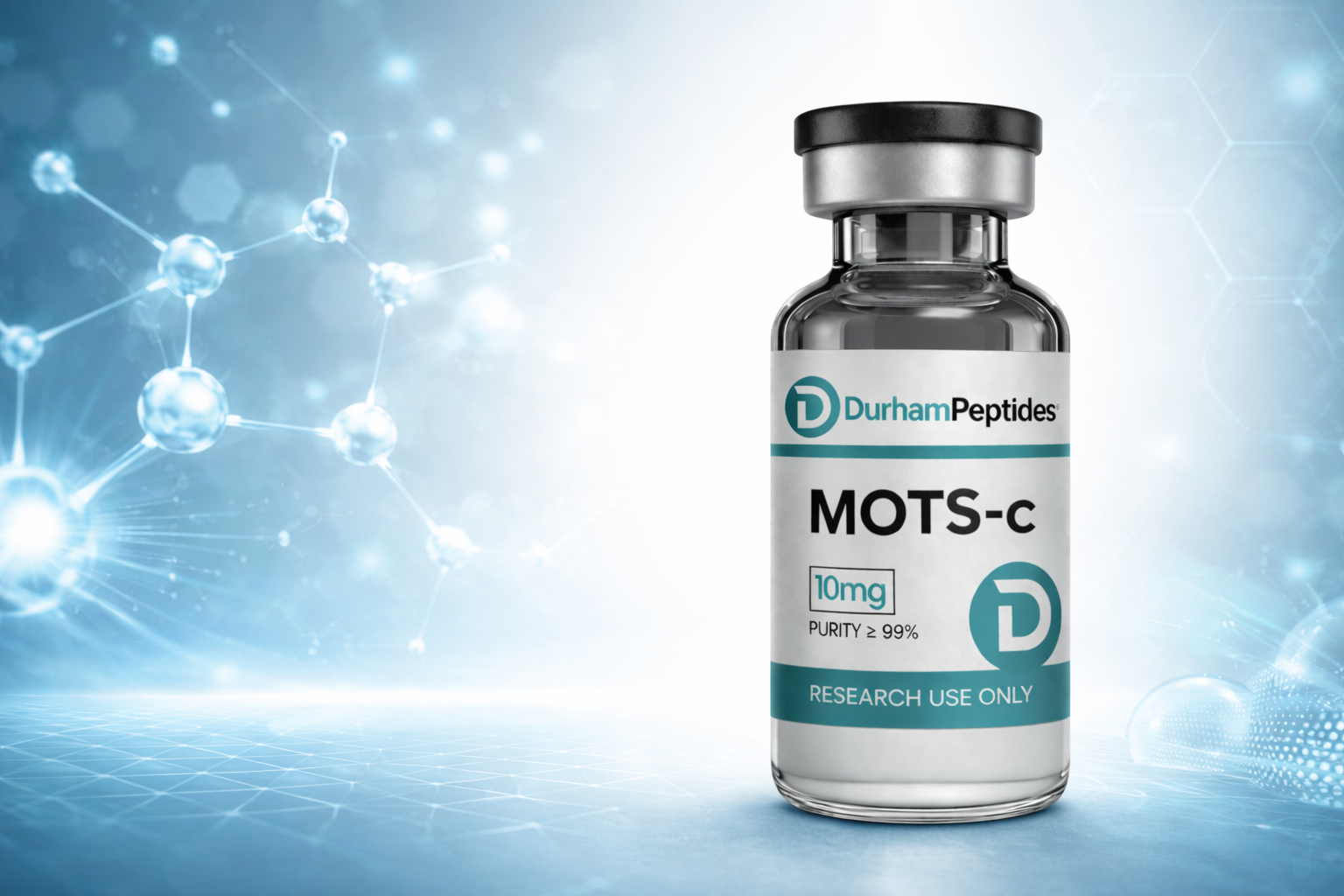
Durham Peptides' MOTS-c is a short mitochondrial-derived peptide:
- Class: mitochondrial-derived peptide (MDP)
- Origin: encoded within the mitochondrial 12S rRNA gene
- Length: 16 amino acids
- Form: 10mg lyophilized powder
Its small size and signaling-molecule role distinguish it from the larger structural and repair peptides in the catalog.
The Core Mechanism: AMPK and Metabolic Regulation
The central research interest in MOTS-c is its investigated role in metabolic regulation, particularly through the AMPK pathway. AMPK (AMP-activated protein kinase) is one of the cell's master energy sensors — it's activated when cellular energy runs low and switches on processes that restore energy balance (glucose uptake, fatty-acid oxidation, mitochondrial function).
MOTS-c has been studied for its investigated activation of AMPK and its influence on metabolic homeostasis, glucose metabolism, and insulin sensitivity in research models. Because AMPK sits at the center of how cells manage energy, a mitochondrial-derived peptide that influences AMPK represents a direct line of communication from the mitochondria to the cell's energy-management machinery — which is the heart of why MOTS-c is studied.
The "Exercise Mimetic" Research Angle
One of the most-discussed aspects of MOTS-c research is its characterization as a potential exercise mimetic — a compound studied for producing some of the metabolic adaptations associated with physical exercise. Exercise itself activates AMPK and drives metabolic and mitochondrial adaptations; MOTS-c's investigated AMPK activation has led researchers to study whether it can engage overlapping pathways. This exercise-mimetic framing is a major reason MOTS-c attracts attention in both metabolic and performance-research contexts, though it remains an area of active investigation rather than settled conclusion.
The Longevity Connection
MOTS-c sits at the intersection of metabolic and longevity research. Mitochondrial dysfunction is one of the recognized hallmarks of aging, and the levels of mitochondrial-derived peptides like MOTS-c have been studied in the context of age-related metabolic decline. This places MOTS-c alongside the other major longevity compounds — each targeting a different aging pathway:
- NAD+ → energy metabolism and sirtuin signaling
- Epithalon → telomere biology
- MOTS-c → mitochondrial-derived signaling and AMPK
- GHK-Cu → gene expression and skin aging
MOTS-c and NAD+ are conceptually related — both concern cellular energy biology — but work through distinct mechanisms (mitochondrial-peptide/AMPK signaling versus coenzyme/sirtuin biology). For the full longevity landscape, see The Best Longevity Peptides for Research in Canada.
What Researchers Examine
- AMPK pathway activation and downstream metabolic signaling
- Glucose metabolism and insulin sensitivity in research models
- Mitochondrial-derived peptide signaling and mitochondrial function
- Exercise-mimetic metabolic adaptations
- Age-related metabolic decline and longevity contexts
Quality and Storage
Durham Peptides' MOTS-c is supplied as a 10mg lyophilized peptide, Janoshik-verified to ≥99% purity by HPLC with mass-spec identity confirmation, 100% synthetically manufactured (vegan). Storage: 2–8°C short-term, -20°C long-term, protected from light and moisture; reconstitute in bacteriostatic water. See How to Read a Janoshik COA and the peptide calculator for reconstitution math.
Frequently Asked Questions
What is MOTS-c? A mitochondrial-derived peptide (encoded in mitochondrial DNA, in the 12S rRNA gene) studied for metabolic regulation through the AMPK pathway, and in metabolic and longevity research contexts.
What does MOTS-c stand for? Mitochondrial ORF of the Twelve S rRNA type-c — reflecting that it's encoded within the mitochondrial 12S rRNA gene.
Why is MOTS-c unusual? Unlike most peptides (encoded by nuclear DNA), MOTS-c is encoded by the mitochondria's own separate genome, making it a mitochondrial-derived signaling peptide.
What is MOTS-c studied for? Primarily AMPK activation and metabolic regulation (glucose metabolism, insulin sensitivity), the "exercise mimetic" research angle, and age-related metabolic decline.
Is MOTS-c an exercise mimetic? It's studied as a candidate exercise mimetic because its investigated AMPK activation overlaps with pathways engaged by exercise — but this remains an area of active research, not a settled conclusion.
Where can I buy MOTS-c in Canada? Durham Peptides supplies MOTS-c 10mg for laboratory use only, Janoshik-verified and shipped same-day from Ontario.
Final Thoughts
MOTS-c is a window into one of the more surprising discoveries in cell biology — that the mitochondria encode their own signaling peptides and use them to coordinate the cell's energy metabolism. Its investigated AMPK activation, exercise-mimetic research angle, and place among the hallmarks-of-aging pathways make it a compelling compound for both metabolic and longevity research.
For Canadian researchers, Durham Peptides supplies MOTS-c 10mg at C$55.00. To see how it fits alongside the other longevity compounds, see The Best Longevity Peptides for Research in Canada and What Is NAD+?. Browse the Metabolic Research Peptides category for related compounds.
Selected Research References
- Lee C, Zeng J, Drew BG, et al. The Mitochondrial-Derived Peptide MOTS-c Promotes Metabolic Homeostasis and Reduces Obesity and Insulin Resistance. Cell Metabolism. 2015;21(3):443-454. https://pubmed.ncbi.nlm.nih.gov/25738459/
- Reynolds JC, Lai RW, Woodhead JST, et al. MOTS-c Is an Exercise-Induced Mitochondrial-Encoded Regulator of Age-Dependent Physical Decline and Muscle Homeostasis. Nature Communications. 2021;12(1):470. https://pubmed.ncbi.nlm.nih.gov/33473109/
- Kim KH, Son JM, Benayoun BA, Lee C. The Mitochondrial-Encoded Peptide MOTS-c Translocates to the Nucleus to Regulate Nuclear Gene Expression in Response to Metabolic Stress. Cell Metabolism. 2018;28(3):516-524. https://pubmed.ncbi.nlm.nih.gov/29983246/
- López-Otín C, Blasco MA, Partridge L, Serrano M, Kroemer G. The Hallmarks of Aging. Cell. 2013;153(6):1194-1217. https://pubmed.ncbi.nlm.nih.gov/23746838/
All products sold by Durham Peptides are for research and laboratory use only. They are not intended for human or animal consumption, diagnosis, treatment, cure, or prevention of any disease.