
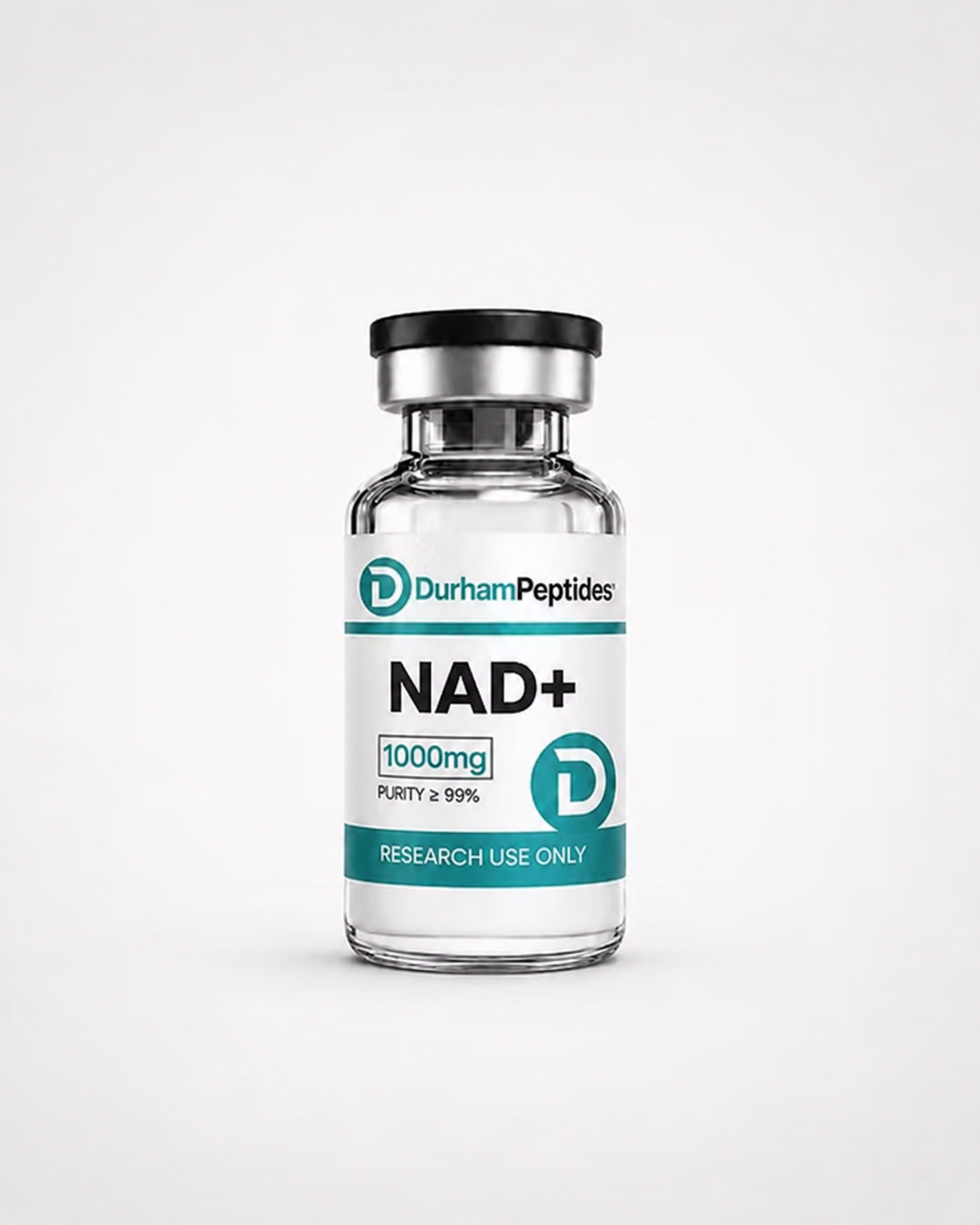
NAD+ 500mg vs 1000mg vial size comparison longevity research compound cost per mg Durham Peptides Canada
NAD+ is now available in two formats in the Durham Peptides catalog — 500mg and 1000mg — which makes the buying decision a little richer than before. The two vials are identical in quality (≥99% purity, Janoshik-verified) but meaningfully different on per-milligram economics. This article walks through the comparison so longevity researchers can match the format to their research.
For the science behind NAD+, see What Is NAD+?; for the broader NAD+-boosting compound landscape, see NAD+ vs NMN vs NR. Nothing here is medical, dosing, or therapeutic guidance.
The Two Options at a Glance
Format | Price | Cost per mg | Best for |
C$114.99 | C$0.230/mg | Standard protocols; first-time NAD+ research | |
C$165.00 | C$0.165/mg | Longer or higher-volume protocols; ~28% per-mg savings |
Both formats are ≥99% purity, Janoshik-verified, mass-spec identity, 100% synthetic. The choice is purely about how much material fits your research.
The Cost-per-Milligram Math
The most useful concept when choosing an NAD+ format is cost per milligram. Larger vials carry lower per-mg costs because fixed costs (vial, lyophilization, Janoshik testing, the COA, shipping) spread across more material. With Durham Peptides' two formats:
- 500mg at C$114.99 = C$0.230 per mg
- 1000mg at C$165.00 = C$0.165 per mg (~28% cheaper per mg)
The 1000mg vial is meaningfully cheaper per milligram. If your research will use the 1000mg within its reconstituted-stability window, the larger format is the more economical choice. If you're running a short or exploratory NAD+ protocol, the 500mg vial avoids paying for material you won't use before it should be discarded.
Factor 1: Total NAD+ Consumption
The single most important factor. NAD+ research often involves substantial milligram quantities relative to many other research peptides, which makes vial-size economics matter more here than in lower-volume compounds:
- Total estimated use ≤ 500mg → the 500mg vial is the cleanest choice.
- 500–1000mg estimated use → the 1000mg vial captures meaningful per-mg savings.
- >1000mg estimated use → multiple 1000mg vials likely the most economical path.
Because NAD+ is one of the higher-volume compounds in longevity research, the larger format is more often the right pick than for lower-volume peptides.
Factor 2: The Reconstituted-Stability Window
Once reconstituted, NAD+ has a finite stable window. A larger vial reconstituted all at once means more material to consume within that same window. For research with steady consumption, this works in your favor; for research with stop-start patterns, the smaller vial hedges against waste. For the underlying stability framework, see Does Vial Size Affect Stability?.
Factor 3: Reconstitution Volume and Concentration
With more NAD+ in the 1000mg vial, you have flexibility at reconstitution. You can either add proportionally more bacteriostatic water to hold concentration constant, or reconstitute in the same volume for a higher final concentration. The peptide calculator handles the math for any vial size and target concentration. For the underlying principles, see Peptide Vial Sizes Explained.
Factor 4: Reorder Frequency
For longer NAD+ research protocols, the 1000mg vial reduces reorder frequency. Two 500mg vials require two orders; one 1000mg vial requires one. The shipping efficiency compounds for steady protocols.
Decision Framework
Your situation | Recommended format |
First-time NAD+ research; exploratory | 500mg |
Short window or uncertain consumption | 500mg |
Steady research with use approaching/exceeding 500mg | 1000mg |
Long, well-scoped protocol with substantial NAD+ use | 1000mg |
Maximizing per-mg savings, steady usage | 1000mg |
Variable or unpredictable consumption | 500mg (stack as needed) |
A Note on Buying Two 500mg vs One 1000mg
If you're uncertain about consumption rate, two 500mg vials offers flexibility — reconstitute one, keep the other lyophilized (which stores far longer than reconstituted material) until needed. The 1000mg wins on per-mg cost and fewer reorders, but commits you to a single larger reconstitution. For steady, predictable research the 1000mg is the efficient call; for variable usage, staggered 500mg vials hedge against waste.
Why NAD+ Vial Economics Differ from Most Peptides
NAD+ is interesting on the vial-size question because it's typically used at higher milligram quantities than most research peptides — a 500mg vial for NAD+ contains far more material than a 10mg vial for, say, BPC-157. This means the cost-per-mg differential matters proportionally more in NAD+ research budgets, and the 1000mg format earns its place more often than the equivalent "largest format" of lower-volume compounds. For the broader budget framework, see Peptide Research Budgeting and The NAD+ Research Budget.
Frequently Asked Questions
What's the difference between NAD+ 500mg and 1000mg? Only the quantity. Both are ≥99% purity, Janoshik-verified, mass-spec identity. The choice is about matching material quantity to research consumption.
Is the 1000mg NAD+ cheaper per milligram? Yes — meaningfully. At C$0.165/mg vs C$0.230/mg, the 1000mg saves about 28% per milligram.
Which size should a first-time NAD+ researcher buy? The 500mg, generally — it avoids overcommitting material on a first or exploratory protocol.
Does the bigger vial change reconstitution? You adjust the bacteriostatic water volume to hit your target concentration. The peptide calculator handles the math.
Can I just buy two 500mg vials instead of one 1000mg? Yes — that gives flexibility (keep one lyophilized until needed). The 1000mg wins on per-mg cost and fewer reorders; staggered 500mg vials hedge against waste if your consumption rate is uncertain.
Are both vials the same quality? Yes — identical purity, testing, and manufacturing. Only the quantity differs.
Final Thoughts
The NAD+ 500mg-vs-1000mg decision comes down to matching vial size to your real research consumption. The 1000mg rewards steady, higher-volume use with a meaningful per-mg saving (~28% cheaper); the 500mg suits exploratory or first-time protocols and hedges against reconstituted-material waste. Both are the same research-grade NAD+.
For the full buying guide, see Buy NAD+ in Canada; for the science, see What Is NAD+?; for when 1000mg makes the most sense specifically, see The NAD+ Research Budget.
Selected Research References
- Verdin E. NAD+ in Aging, Metabolism, and Neurodegeneration. Science. 2015;350(6265):1208-1213. https://pubmed.ncbi.nlm.nih.gov/25540137/
- Rajman L, Chwalek K, Sinclair DA. Therapeutic Potential of NAD-Boosting Molecules: The In Vivo Evidence. Cell Metabolism. 2018;27(3):529-547. https://pubmed.ncbi.nlm.nih.gov/29514064/
- United States Pharmacopeia. USP Chapter <1225>: Validation of Compendial Procedures. Analytical validation standards applicable to research-compound quality testing.
All products sold by Durham Peptides are for research and laboratory use only. They are not intended for human or animal consumption, diagnosis, treatment, cure, or prevention of any disease.