
NAD+ 1000mg research budget longevity protocol scale annual cost Durham Peptides Canada
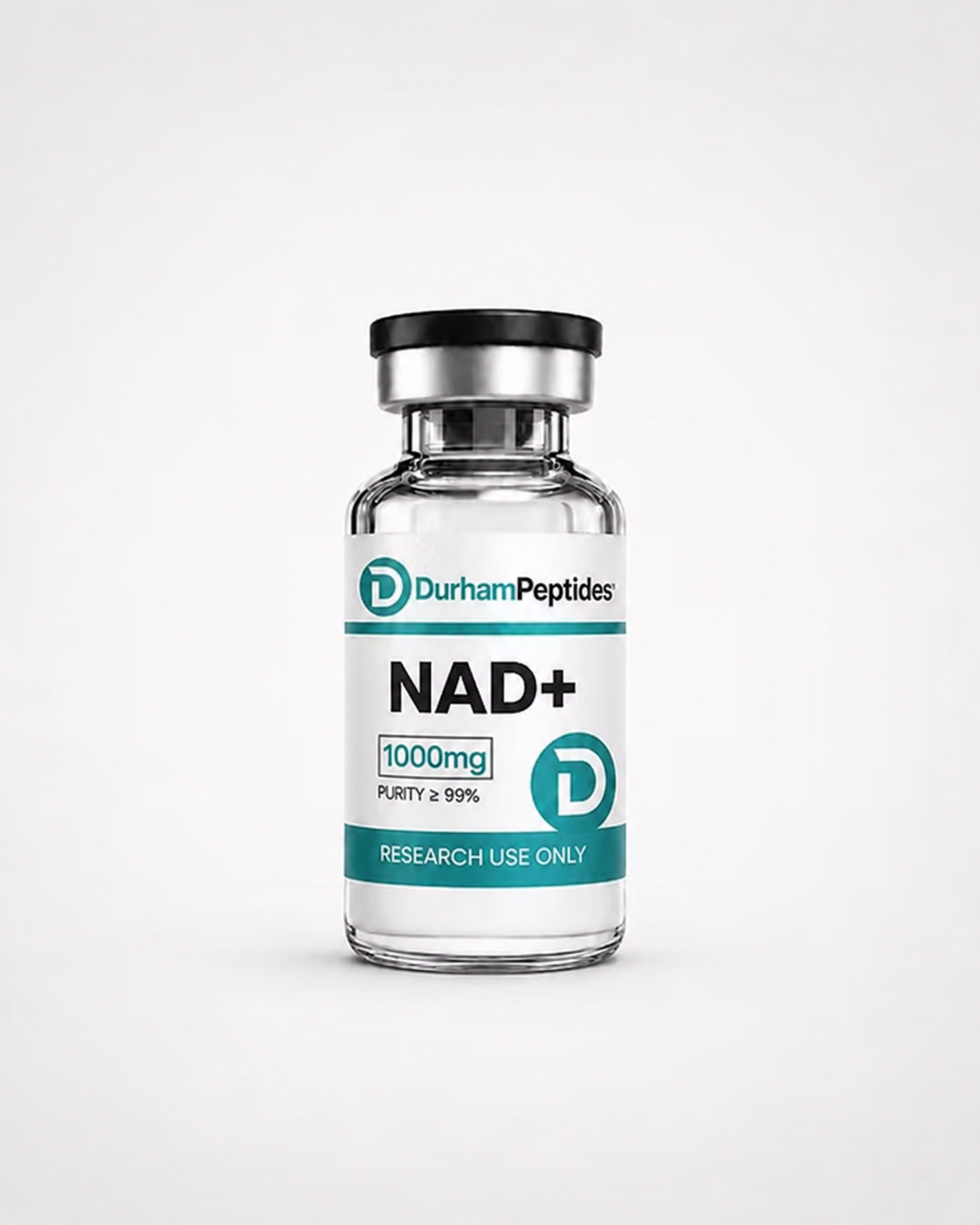
The new NAD+ 1000mg format in the Durham Peptides catalog represents a meaningful change for serious longevity researchers: at C$0.165 per milligram versus C$0.230 for the 500mg, the 1000mg delivers about a 28% per-mg saving on what is typically one of the largest material-volume compounds in any longevity research budget. But the format isn't right for every researcher. This article walks through the protocol scales, consumption rates, and budget situations where the 1000mg vial actually earns its place — and where the 500mg remains the more economical choice in practice.
For the head-to-head, see NAD+ 500mg vs 1000mg; for the full buyer's guide, see Buy NAD+ in Canada. Nothing here is medical, dosing, or therapeutic guidance.
Why NAD+ Vial Choice Matters More Than for Most Peptides
NAD+ research typically uses milligram quantities that dwarf those of most research peptides. Where a BPC-157 protocol might use 5–10 mg per month, NAD+ protocols routinely consume hundreds of milligrams over the same window. This volume difference means vial-size economics matter proportionally more for NAD+ than for most compounds — the per-mg savings on the 1000mg vial compound across the total research budget faster than the equivalent saving on, say, a BPC-157 vial would.
So while "matching vial size to consumption" is the principle for every compound, it's especially load-bearing for NAD+. The wrong vial choice on NAD+ can shift annual budget by hundreds of dollars in either direction.
The Three Protocol Scales
Useful to think about NAD+ research at three tiers of scale, because each maps cleanly to a vial-size choice:
Tier 1: Exploratory or short-window research (single 500mg vial fits)
- Total NAD+ consumption: ≤500 mg over the planning window
- Use case: First-time NAD+ research; short protocols; uncertain consumption
- Right format: NAD+ 500mg (C$114.99)
- Logic: A single 500mg vial covers the entire window; no overcommitment.
Tier 2: Steady mid-volume research (1000mg fits, 500mg wastes orders)
- Total NAD+ consumption: 500–2000 mg over the planning window
- Use case: Established protocols with predictable steady consumption
- Right format: NAD+ 1000mg (C$165.00)
- Logic: The 1000mg captures the per-mg saving; consumption is steady enough that the reconstituted-stability window is well-matched.
Tier 3: High-volume or long protocols (multiple 1000mg the cleanest path)
- Total NAD+ consumption: >2000 mg over the planning window
- Use case: Large-scale longevity research; multi-arm protocols; long timelines
- Right format: Multiple NAD+ 1000mg vials
- Logic: Stacking 1000mg vials maximizes per-mg savings and minimizes reorder/handling overhead.
This three-tier framework covers most practical NAD+ research situations.
The Annual Budget Differential
A worked example shows why this matters concretely. Three researchers, each consuming 1000 mg/month of NAD+ over a year (12,000 mg total):
- Buying 500mg vials: 24 vials × C$114.99 = C$2,759.76
- Buying 1000mg vials: 12 vials × C$165.00 = C$1,980.00
- Annual differential: C$779.76 — a ~28% reduction in annual NAD+ spend
That's nearly C$780 saved on a single line item in the research budget, just by choosing the larger format. For mid- and high-volume NAD+ research, this is meaningful money.
For full quarterly and annual budget planning across the broader research catalog, see Peptide Research Budgeting.
When the 1000mg Is NOT the Right Choice
Three scenarios where the 500mg vial is the more economical choice in practice, regardless of the per-mg math:
1. Exploratory NAD+ research with uncertain consumption. If you don't yet know how much NAD+ your protocol will consume, starting with a single 500mg vial avoids overcommitting. If consumption turns out higher than expected, you can step up to 1000mg vials on the next order.
2. Stop-start research patterns. NAD+ research that pauses and restarts on irregular schedules makes the reconstituted-stability window harder to track. The 500mg vial reconstituted in smaller working volumes — or kept in two staggered vials — handles intermittent use better than a single large reconstitution.
3. Storage constraints. If your refrigeration setup or research environment limits how much reconstituted material can be kept ready-to-use at once, the 500mg format's smaller working volume can be the practical constraint that decides.
In each case, the per-mg savings of the 1000mg are real on paper, but the actual economy comes from material that gets used, not material that gets discarded.
The Reconstitution Logistics of 1000mg
A 1000mg vial reconstituted at the same concentration as a 500mg vial requires twice the bacteriostatic water and produces twice the working volume. Practical implications:
- More bacteriostatic water needed per reconstitution (factor this into ancillary budget)
- More working volume to track in the lab notebook per reconstitution (see Peptide Researcher Lab Notebook)
- Same per-vial reconstitution time as the 500mg
Alternatively, the 1000mg can be reconstituted in the same volume as a 500mg for a doubled concentration — the peptide calculator handles the math for any vial size and target concentration.
A Quick Cross-Check Against Other Compounds
The 28% per-mg saving on the NAD+ 1000mg over the 500mg is comparable to (slightly larger than) the larger-format savings across the Durham Peptides catalog:
- NAD+ 1000mg vs 500mg: ~28%
- GHK-Cu 100mg vs 50mg: ~14%
- BPC-157 20mg vs 10mg: ~13%
NAD+'s saving is on the larger end because the 1000mg is a clean 2× size jump on a research compound where fixed costs are a meaningful share of the per-vial price. For the fixed-cost economics behind these savings, see Vial Size Engineering.
Frequently Asked Questions
When does the NAD+ 1000mg make the most sense? When your research has steady, predictable consumption of more than 500 mg of NAD+ over the planning window, with usage matching the reconstituted-stability window of the larger vial.
How much can I save by switching from 500mg to 1000mg vials? At 1000 mg/month consumption over a year, the 1000mg format saves approximately C$780 annually versus stacking 500mg vials — about a 28% reduction in annual NAD+ spend.
Is the 500mg vial obsolete now that the 1000mg exists? No. The 500mg remains the right choice for exploratory research, uncertain consumption, stop-start protocols, and storage-constrained environments. The 1000mg is for steady, mid- to high-volume research.
Does the 1000mg vial change how I reconstitute NAD+? It uses proportionally more bacteriostatic water for the same target concentration, or the same volume for a doubled concentration. Same reconstitution mechanics as any other vial size.
Can I split a 1000mg vial into two reconstitutions? The lyophilized 1000mg vial can be kept sealed until reconstitution if your protocol allows partial use. Once reconstituted, however, all the material shares the same stable window. See Does Vial Size Affect Stability?.
Where do I get current Canadian pricing on both NAD+ formats? NAD+ 500mg at C$114.99 and NAD+ 1000mg at C$165.00 on the Durham Peptides product pages.
Final Thoughts
The NAD+ 1000mg format makes sense for steady, mid- to high-volume NAD+ research where the per-mg savings (~28%) actually materialize through use, not waste. For protocols that fit the 500mg or have uncertain consumption, the smaller format is the more economical choice in practice. The decision comes down to honest forecasting: will you actually use 500mg+ within the stable window? If yes, the 1000mg is the meaningfully better value. If uncertain, the 500mg hedges.
For the head-to-head, see NAD+ 500mg vs 1000mg; for budgeting context, see Peptide Research Budgeting; for the science, see What Is NAD+?.
Selected Research References
- Verdin E. NAD+ in Aging, Metabolism, and Neurodegeneration. Science. 2015;350(6265):1208-1213. https://pubmed.ncbi.nlm.nih.gov/25540137/
- Yoshino J, Baur JA, Imai SI. NAD+ Intermediates: The Biology and Therapeutic Potential of NMN and NR. Cell Metabolism. 2018;27(3):513-528. https://pubmed.ncbi.nlm.nih.gov/29211728/
- Covarrubias AJ, Perrone R, Grozio A, Verdin E. NAD+ Metabolism and Its Roles in Cellular Processes during Ageing. Nature Reviews Molecular Cell Biology. 2021;22(2):119-141. https://pubmed.ncbi.nlm.nih.gov/33353981/
All products sold by Durham Peptides are for research and laboratory use only. They are not intended for human or animal consumption, diagnosis, treatment, cure, or prevention of any disease.