

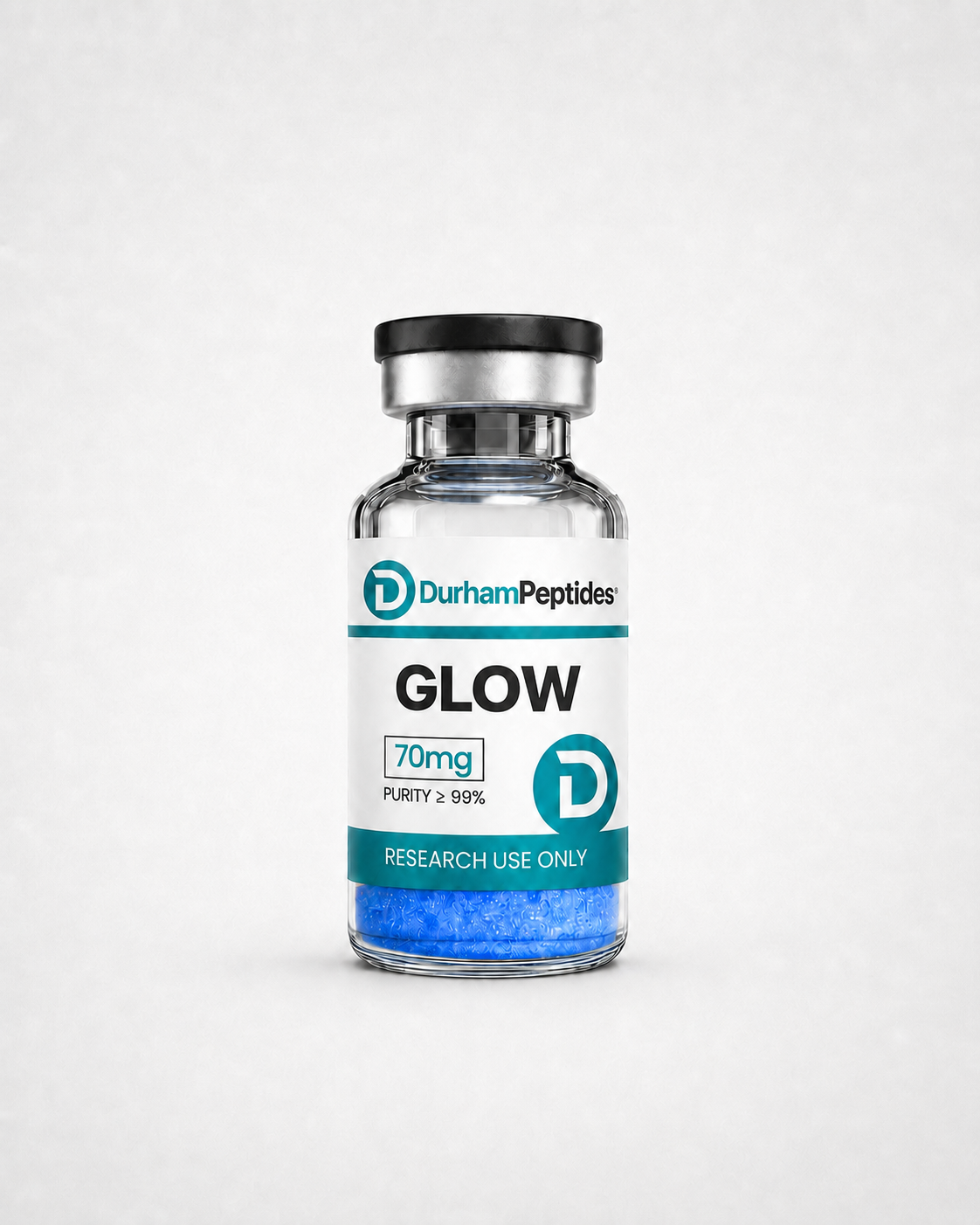
Wolverine Stack vs Glow Blend BPC-157 TB-500 GHK-Cu research peptide blend comparison Durham Peptides Canada
The Wolverine Stack and the Glow Blend are the two recovery-focused multi-component formulations in the Durham Peptides catalog. They overlap mechanistically — both contain BPC-157 and TB-500 — but the Glow Blend adds GHK-Cu as a third component, fundamentally changing what the formulation is studied for. The choice between them comes down to a specific question: does your research need the GHK-Cu gene-expression and collagen-synthesis mechanism added to the BPC-157 + TB-500 base? This article walks through the comparison.
For the underlying blend logic, see When Do You Actually Need a Peptide Blend?; for the per-component breakdowns, see The Wolverine Stack 1:1 Ratio and Inside the GLOW Blend. Nothing here is medical, dosing, or therapeutic guidance.
Side-by-Side at a Glance
Property | Wolverine Stack | Glow Blend |
Components | BPC-157 + TB-500 | GHK-Cu + BPC-157 + TB-500 |
Total peptide | 10mg (5+5) | 70mg (50+10+10) |
Ratio | 1:1 (BPC-157:TB-500) | 5:1:1 (GHK-Cu:BPC-157:TB-500) |
Mechanism focus | Angiogenesis + cell migration | Gene expression + angiogenesis + cell migration |
Primary research area | Recovery, tendon/ligament repair | Skin biology, anti-aging, broader tissue research |
Price | C$79.99 | C$159.99 |
Per-mg total cost | C$8.00/mg | C$2.29/mg |
Durham product |
The Core Difference: GHK-Cu
The two blends share BPC-157 and TB-500 at identical quantities (10mg each in Glow Blend; 5mg + 5mg in Wolverine Stack). The fundamental difference is whether GHK-Cu is included.
What GHK-Cu adds to the formulation:
- Gene expression modulation across hundreds of genes including collagen genes (Type I, III), tissue inhibitors of metalloproteinases, anti-inflammatory mediators
- Collagen synthesis stimulation, specifically Type I and Type III collagen — the structural proteins of skin, connective tissue, and many other tissues
- Anti-inflammatory signaling through investigated effects on TNF-α, IL-6, and NF-κB pathways
- Copper-peptide chemistry effects including cofactor activity for skin-relevant enzymes
- Skin-research and hair-research applications (the GHK-Cu literature in these areas is substantial)
For the GHK-Cu deep-dive, see Copper Peptides Explained; for the hair-research angle, see GHK-Cu for Hair Research.
Mechanism Mapping
The three-mechanism vs two-mechanism distinction is the clearest selection framework:
Mechanism | Component | Wolverine Stack | Glow Blend |
Gene expression / collagen synthesis | GHK-Cu | — | ✓ |
Angiogenesis (new blood vessels) | BPC-157 | ✓ | ✓ |
Cell migration (repair cell mobilization) | TB-500 | ✓ | ✓ |
Wolverine Stack engages the blood-supply-plus-cell-mobilization combination — the two mechanisms that directly address recovery and repair bottlenecks. Glow Blend adds the structural-protein-and-gene-expression dimension on top, broadening the research scope to skin biology and broader tissue-research applications where GHK-Cu's specific contributions matter.
When Wolverine Stack Is the Right Choice
Research applications where the BPC-157 + TB-500 combination without GHK-Cu is the better fit:
- Tendon and ligament research. TB-500's cell migration mechanism is particularly well-aligned with connective-tissue repair research. See TB-500 for Tendon and Ligament Research.
- Cost-constrained recovery research. The Wolverine Stack at C$79.99 is meaningfully more economical than Glow Blend at C$159.99 when the GHK-Cu component isn't needed.
- Isolated angiogenesis + cell migration research. When the research question specifically isolates these two mechanisms, adding GHK-Cu introduces confounding from its gene-expression and anti-inflammatory effects.
- Research replicating Wolverine-style protocols. Existing published research using BPC-157 + TB-500 combinations is the literature this blend replicates at established ratios.
- Research where GHK-Cu's skin-research thread isn't relevant. Internal recovery, muscle repair, GI research — applications where the skin/copper-peptide angle isn't part of the research design.
When Glow Blend Is the Right Choice
Research applications where the three-component formulation is the better fit:
- Skin and anti-aging research. GHK-Cu is the most-studied component for skin biology research, and the addition of BPC-157 (angiogenesis) and TB-500 (cell migration) supports the broader skin-research mechanisms. See What Is the GLOW Blend?.
- Multi-mechanism research designs. When the research question specifically engages gene expression, angiogenesis, AND cell migration together — the three-mechanism approach is what Glow Blend is built for.
- Research replicating Glow-style protocols. Published research using this specific three-peptide combination at the 5:1:1 ratio is the literature this blend replicates.
- Hair research. GHK-Cu's hair follicle research literature combines naturally with the tissue-repair mechanisms of BPC-157 and TB-500.
- Research where higher per-mg total cost is acceptable. Glow Blend's C$2.29/mg vs Wolverine's C$8.00/mg looks dramatic, but the comparison is misleading — see the per-mg analysis below.
The Per-mg Math: A Misleading Number
The headline per-mg figures (Wolverine: C$8.00/mg; Glow: C$2.29/mg) might suggest Glow is dramatically cheaper. But this comparison is misleading because the composition differs:
- Wolverine: 10mg total = 5mg BPC-157 + 5mg TB-500. Cost = C$79.99 → C$8.00/mg of recovery peptides.
- Glow: 70mg total = 50mg GHK-Cu + 10mg BPC-157 + 10mg TB-500. Cost = C$159.99 → C$2.29/mg of blended peptides, but the GHK-Cu (lower per-mg cost compound) dominates by mass.
A more meaningful comparison: what would the equivalent components cost if bought separately at standalone vial pricing?
For Wolverine Stack equivalent (5mg BPC-157 + 5mg TB-500):
- 5mg BPC-157 from a 10mg vial at C$65.69 = ~$32.85 worth
- 5mg TB-500 from a 10mg vial at C$79.69 = ~$39.85 worth
- Equivalent cost ~$72.70 vs Wolverine Stack at $79.99 (small blend premium)
For Glow Blend equivalent (50mg GHK-Cu + 10mg BPC-157 + 10mg TB-500):
- 50mg GHK-Cu vial at C$54.99 = $54.99
- 10mg BPC-157 vial at C$65.69 = $65.69
- 10mg TB-500 vial at C$79.69 = $79.69
- Equivalent cost ~$200.37 vs Glow Blend at $159.99 (~20% blend savings)
So Glow Blend's per-mg looks better than Wolverine's per-mg only because GHK-Cu is much cheaper per mg than BPC-157 or TB-500. On a "blend vs separate components" basis, Glow Blend offers larger savings versus separate purchase than Wolverine Stack does — but you should only buy a Glow Blend if you actually need GHK-Cu in your research.
The Decision Framework
The clean decision tree:
- Need GHK-Cu in your research? Yes → Glow Blend. No → Wolverine Stack.
What's your research focused on?
- Tendon, ligament, internal tissue repair → Wolverine Stack typically fits
- Skin, anti-aging, hair, broader tissue research → Glow Blend typically fits
- Cost-sensitive but want recovery research? Wolverine Stack at C$79.99 is the lower-cost entry point.
- Want maximum per-mg savings on a multi-component blend? Glow Blend saves ~20% vs equivalent separate components; Wolverine Stack saves less.
KLOW Blend: The Four-Component Extension
Worth noting: KLOW Blend extends Glow Blend by adding KPV as a fourth component — bringing dedicated anti-inflammatory signaling alongside the three Glow mechanisms. For research designed around four-mechanism approaches, see GLOW vs KLOW and What Is the KLOW Blend?.
Frequently Asked Questions
What's the difference between Wolverine Stack and Glow Blend? Wolverine is BPC-157 + TB-500 (two components, 1:1 ratio, 10mg total). Glow Blend is GHK-Cu + BPC-157 + TB-500 (three components, 5:1:1 ratio, 70mg total). Glow adds the gene-expression and collagen-synthesis mechanism of GHK-Cu on top of the angiogenesis-plus-cell-migration combination.
Is Wolverine Stack cheaper than Glow Blend? On per-vial basis, yes (C$79.99 vs C$159.99). On per-mg total basis, Glow looks cheaper but the comparison is misleading because GHK-Cu is much cheaper per mg than BPC-157 or TB-500. The right comparison is what you're actually researching.
Which blend is better for tendon research? Wolverine Stack typically — TB-500's cell migration mechanism is well-aligned with connective-tissue repair, and the GHK-Cu component of Glow Blend doesn't add much for tendon-specific research.
Which blend is better for skin and anti-aging research? Glow Blend — GHK-Cu is the most-studied compound for skin biology research, and the blend provides all three mechanisms (gene expression, angiogenesis, cell migration) at established research proportions.
Can I use Wolverine Stack and GHK-Cu separately instead of Glow Blend? Yes. Buy Wolverine Stack (or BPC-157 and TB-500 separately) plus GHK-Cu 50mg as standalone vials. This gives flexibility on ratios but loses the documentation and reconstitution simplification of the pre-formulated blend.
Where can I buy both in Canada? Durham Peptides supplies the Wolverine Stack (C$79.99) and Glow Blend(C$159.99), both Janoshik-verified.
Final Thoughts
The Wolverine Stack vs Glow Blend decision is really a decision about whether your research needs GHK-Cu's specific contributions (gene expression, collagen synthesis, anti-inflammatory signaling, skin-research relevance) added to the BPC-157 + TB-500 base. For tendon, ligament, and internal recovery research focused on angiogenesis-plus-cell-migration mechanisms, Wolverine Stack is the cleaner and more economical choice. For skin, anti-aging, hair, and broader multi-mechanism tissue research, Glow Blend's three-component formulation is what the literature supports. The choice isn't "which is better" — it's "which mechanisms does my research need."
For the formulation details, see The Wolverine Stack 1:1 Ratio and Inside the GLOW Blend; for the four-component extension, see What Is the KLOW Blend?; for the broader blend decision framework, see When Do You Actually Need a Peptide Blend?.
Selected Research References
- Sikiric P, Seiwerth S, Rucman R, et al. Stable Gastric Pentadecapeptide BPC 157: Novel Therapy in Gastrointestinal Tract. Current Pharmaceutical Design. 2011;17(16):1612-1632. https://pubmed.ncbi.nlm.nih.gov/21548867/
- Goldstein AL, Hannappel E, Kleinman HK. Thymosin Beta-4: Actin-Sequestering Protein Moonlights to Repair Injured Tissues. Trends in Molecular Medicine. 2005;11(9):421-429. https://pubmed.ncbi.nlm.nih.gov/16099219/
- Pickart L, Margolina A. Regenerative and Protective Actions of the GHK-Cu Peptide. International Journal of Molecular Sciences. 2018;19(7):1987. https://pubmed.ncbi.nlm.nih.gov/29986520/
- Chang CH, Tsai WC, Lin MS, Hsu YH, Pang JH. The Promoting Effect of Pentadecapeptide BPC 157 on Tendon Healing Involves Tendon Outgrowth, Cell Survival, and Cell Migration. Journal of Applied Physiology. 2011;110(3):774-780. https://pubmed.ncbi.nlm.nih.gov/21030672/
All products sold by Durham Peptides are for research and laboratory use only. They are not intended for human or animal consumption, diagnosis, treatment, cure, or prevention of any disease.