

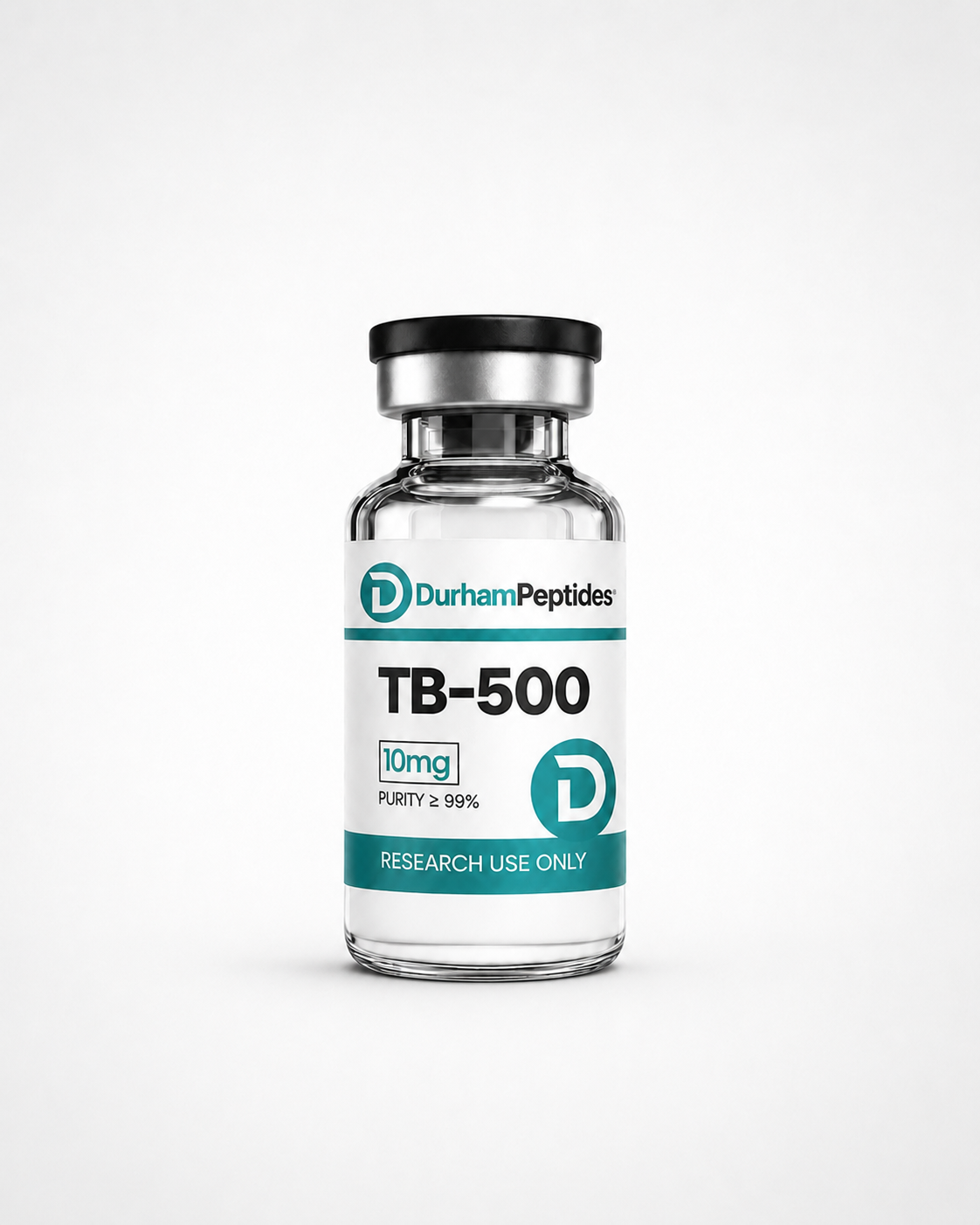
TB-500 thymosin beta-4 fragment tendon ligament connective tissue research peptide Durham Peptides Canada
TB-500's research literature spans multiple tissue types, but its most-developed application area is tendon and ligament research — the connective tissues that link muscle to bone (tendons) and bone to bone (ligaments). This isn't accidental: tendons and ligaments are notoriously slow-healing tissues with limited vascular supply and low cellular turnover, and the specific mechanisms TB-500 has been studied for — actin regulation and cell migration — happen to address some of the bottleneck steps in connective tissue repair research. This article walks through the tendon and ligament angle in detail.
For the standalone TB-500 overview, see What Is TB-500?; for the broader recovery research context, see Healing & Recovery Peptides Explained; for the Wolverine Stack combination logic with BPC-157, see The Wolverine Stack Explained. Nothing here is medical, dosing, or therapeutic guidance.
Why Tendon and Ligament Research Is Hard
A bit of context before getting to TB-500 specifically. Tendon and ligament research is one of the more challenging areas of connective tissue research for reasons that are biologically real:
- Low vascular density. Tendons and ligaments have far less blood supply than muscle or skin. Limited blood supply means slower delivery of repair cells, oxygen, and nutrients to the site of injury — and slower removal of inflammatory mediators.
- Low cellular turnover. Tendon and ligament resident cells (tenocytes, ligamentocytes) divide slowly, which means the natural replacement of damaged tissue happens over months to years, not days to weeks.
- Specific collagen organization. Tendon and ligament collagen is highly organized into parallel fibers (Type I collagen primarily). After injury, the body initially deposits less-organized scar tissue, which has different mechanical properties than the original tissue.
- Mechanical loading complications. Connective tissues are continuously loaded mechanically, which both stresses the repair process and is required for proper tissue maturation.
These properties make connective tissue research a category where mechanistic interventions — compounds that affect specific repair pathways — are particularly interesting. The biology has well-defined bottlenecks, and pathway-level research tools can engage them.
TB-500's Mechanism: Actin Regulation and Cell Migration
TB-500 is a synthetic fragment of Thymosin Beta-4 — a 44-amino-acid peptide naturally present in many tissues that functions primarily through its interaction with G-actin (globular actin), the monomeric form of the cytoskeletal protein actin. The full Thymosin Beta-4 mechanism, and by extension TB-500's investigated mechanism, centers on this actin biology.
Actin and cell migration: Cells move by extending pseudopods or lamellipodia from their leading edge — a process driven by polymerization of actin filaments. The G-actin/F-actin equilibrium (free monomers vs polymerized filaments) is one of the controls on this process. Thymosin Beta-4 binds and sequesters G-actin, regulating the available pool for polymerization. This isn't simply "more actin polymerization" or "less actin polymerization" — it's regulation of the dynamic between the two forms, which research has examined as enabling more responsive and coordinated cell movement in repair contexts.
Why this matters for tendons specifically: Effective tendon repair research involves migration of cells (tenocytes, fibroblasts, possibly stem cells) into the injury site. The slow vascular supply means cells have to travel further and through more challenging tissue than in highly vascularized tissues. A compound that has been studied for enhanced cell migration directly addresses one of the major bottlenecks in tendon repair research.
The Tendon-Specific Research Literature
Published research has examined TB-500 (and Thymosin Beta-4) in tendon-research contexts including:
Investigated effect 1: Tendon outgrowth and tenocyte migration. Chang and colleagues (2011, Journal of Applied Physiology) reported on the investigated effects of BPC-157 on tendon healing involving tendon outgrowth, cell survival, and cell migration — research conducted in tenocyte cultures and the broader tendon-research landscape that has informed how TB-500 has been studied in similar contexts. Cell migration is the relevant mechanistic intersection.
Investigated effect 2: Wound and tissue repair models with connective-tissue emphasis. The Goldstein, Hannappel, and Kleinman review (Trends in Molecular Medicine, 2005) discusses Thymosin Beta-4 as an "actin-sequestering protein that moonlights to repair injured tissues" — a foundational review covering the broader tissue-repair research literature including tendon and ligament contexts. The reviewed evidence shows Thymosin Beta-4 has been studied across multiple connective-tissue research models.
Investigated effect 3: Wound healing acceleration in skin and connective tissue
models. Malinda and colleagues (Journal of Investigative Dermatology, 1999) reported investigated effects of Thymosin Beta-4 on wound healing — work that established Thymosin Beta-4's research credentials in connective-tissue repair before TB-500 (the synthetic fragment) became widely used as the research tool. The skin/dermal connective tissue research from this period informs the broader connective-tissue interest.
Investigated effect 4: Vascular endothelial cell migration and angiogenesis. While angiogenesis is more often associated with BPC-157 in current research (see What Is BPC-157?), Thymosin Beta-4 / TB-500 has also been studied for investigated effects on vascular endothelial cell migration — relevant to the new blood vessel formation that supports tendon repair, where the natively low vascular density is a limiting factor.
Investigated effect 5: Inflammation and tissue remodeling. Some research has examined TB-500's investigated effects on inflammatory mediator expression and tissue-remodeling enzymes (matrix metalloproteinases) in connective-tissue contexts. The interplay between controlled inflammation and remodeling is one of the active research questions in tendon repair specifically.
Why TB-500 Pairs Well with BPC-157 in Connective Tissue Research
The combination logic for the Wolverine Stack (BPC-157 + TB-500) connects directly to the tendon and ligament research case. Tendon repair has two specific bottlenecks — limited vascularity and slow cell mobilization. BPC-157 has been studied for angiogenesis (new blood vessel formation, addressing the vascularity bottleneck); TB-500 has been studied for cell migration (addressing the cell mobilization bottleneck). The mechanisms are complementary precisely because they target different bottleneck steps of the same repair process.
For the formulation-design logic, see The Wolverine Stack 1:1 Ratio; for the broader mechanistic framework, see Healing & Recovery Peptides Explained.
Where TB-500 Sits in Connective Tissue Research vs Other Tissues
A useful framing: TB-500's research literature spans multiple tissue types, but the relative emphasis varies:
Tissue type | Research literature emphasis |
Tendon / ligament | Highest mechanistic relevance — cell migration directly addresses repair bottleneck |
Skin / wound healing | Substantial published research; foundational Malinda et al. work |
Cardiac muscle | Smaller but growing research interest |
Skeletal muscle | Some research, less developed than tendon work |
Vascular endothelium | Cross-cutting research relevant to multiple tissue types |
For research designed around connective tissue specifically — tendons, ligaments, fascia — TB-500's mechanism is most directly relevant. For broader tissue research, the actin-regulation mechanism still applies but the bottleneck-addressing logic is less specifically aligned.
Practical Research Considerations
TB-500 10mg at Durham Peptides is C$79.69 (C$7.97/mg), Janoshik-verified to ≥99% purity by HPLC with mass-spec identity confirmation; 100% synthetic; vegan. Storage: 2–8°C short-term, -20°C long-term, protected from light and moisture; reconstitute in bacteriostatic water. At 43 amino acids, TB-500 is among the larger research peptides in the catalog with standard handling properties.
For researchers studying combination tissue-repair protocols, the Wolverine Stack (5mg BPC-157 + 5mg TB-500) at C$79.99 is the standard 1:1 formulation; for higher-volume tendon-focused research, separate vials of BPC-157 10mg and TB-500 10mg allow independent ratio adjustment.
Frequently Asked Questions
Why is TB-500 specifically studied for tendon and ligament research? Because tendons and ligaments have biology that creates specific repair bottlenecks (low vascular supply, slow cellular turnover), and TB-500's investigated mechanism — actin regulation and cell migration — directly addresses the cell-mobilization bottleneck.
What's TB-500's connection to Thymosin Beta-4? TB-500 is a synthetic fragment of the full 44-amino-acid Thymosin Beta-4 peptide. The fragment retains the actin-binding and migration-regulation properties of the parent compound while being more practical to manufacture and use as a defined research tool.
Is TB-500 better than BPC-157 for tendon research? They target different bottlenecks. TB-500 addresses cell migration; BPC-157 addresses angiogenesis (new blood vessels). Most tendon-research interest is in combining them — which is the rationale behind the Wolverine Stack.
Is the tendon research literature in humans or animal models? Predominantly animal models (rodents, larger animals) and cell-culture models with tenocytes or fibroblasts. The mechanistic research foundation is from these models; human research is much more limited.
Does TB-500 work for ligaments the same way it works for tendons? Conceptually yes — both are dense connective tissues with similar repair bottlenecks (limited vascularity, slow cell turnover). The published literature has somewhat more tendon focus than ligament, but the mechanistic logic applies to both.
Where can I buy TB-500 in Canada? Durham Peptides supplies TB-500 10mg (C$79.69) standalone and in the Wolverine Stack combination with BPC-157 (C$79.99).
Final Thoughts
TB-500's tendon and ligament research is a story about mechanistic fit — the actin-regulation and cell-migration mechanism directly addresses the cell-mobilization bottleneck that makes connective tissue research slow and challenging. The published literature, from Goldstein's foundational reviews through Malinda's wound-healing work and the broader connective-tissue research base, places TB-500 in a specific niche where the mechanism aligns with the biology. For research designed around tendon, ligament, or other dense connective tissue repair, TB-500's actin biology gives it a clear conceptual place.
For the standalone TB-500 overview, see What Is TB-500?; for the combination with BPC-157, see The Wolverine Stack Explained; for the broader recovery research landscape, see Healing & Recovery Peptides Explained.
Selected Research References
- Goldstein AL, Hannappel E, Kleinman HK. Thymosin Beta-4: Actin-Sequestering Protein Moonlights to Repair Injured Tissues. Trends in Molecular Medicine. 2005;11(9):421-429. https://pubmed.ncbi.nlm.nih.gov/16099219/
- Malinda KM, Sidhu GS, Mani H, et al. Thymosin Beta-4 Accelerates Wound Healing. Journal of Investigative Dermatology. 1999;113(3):364-368. https://pubmed.ncbi.nlm.nih.gov/10469335/
- Chang CH, Tsai WC, Lin MS, Hsu YH, Pang JH. The Promoting Effect of Pentadecapeptide BPC 157 on Tendon Healing Involves Tendon Outgrowth, Cell Survival, and Cell Migration. Journal of Applied Physiology. 2011;110(3):774-780. https://pubmed.ncbi.nlm.nih.gov/21030672/
- Crockford D, Turjman N, Allan C, Angel J. Thymosin Beta-4: Structure, Function, and Biological Properties Supporting Current and Future Clinical Applications. Annals of the New York Academy of Sciences. 2010;1194:179-189. https://pubmed.ncbi.nlm.nih.gov/22074294/
All products sold by Durham Peptides are for research and laboratory use only. They are not intended for human or animal consumption, diagnosis, treatment, cure, or prevention of any disease.