

KLOW blend BPC-157 GHK-Cu TB-500 KPV four peptide skin recovery anti-inflammatory research Durham Peptides Canada
KLOW is the most ambitious of the multi-peptide blends in the Durham Peptides catalog — a four-peptide formulationthat combines the established GLOW base (GHK-Cu, BPC-157, TB-500) with KPV as the fourth component. The result is a single research formulation that engages four genuinely different mechanisms in one vial: gene-expression modulation (GHK-Cu), angiogenesis (BPC-157), cell migration (TB-500), and anti-inflammatory signaling (KPV). This article walks through the composition, the mechanistic logic, and how to think about KLOW versus its single-component alternatives.
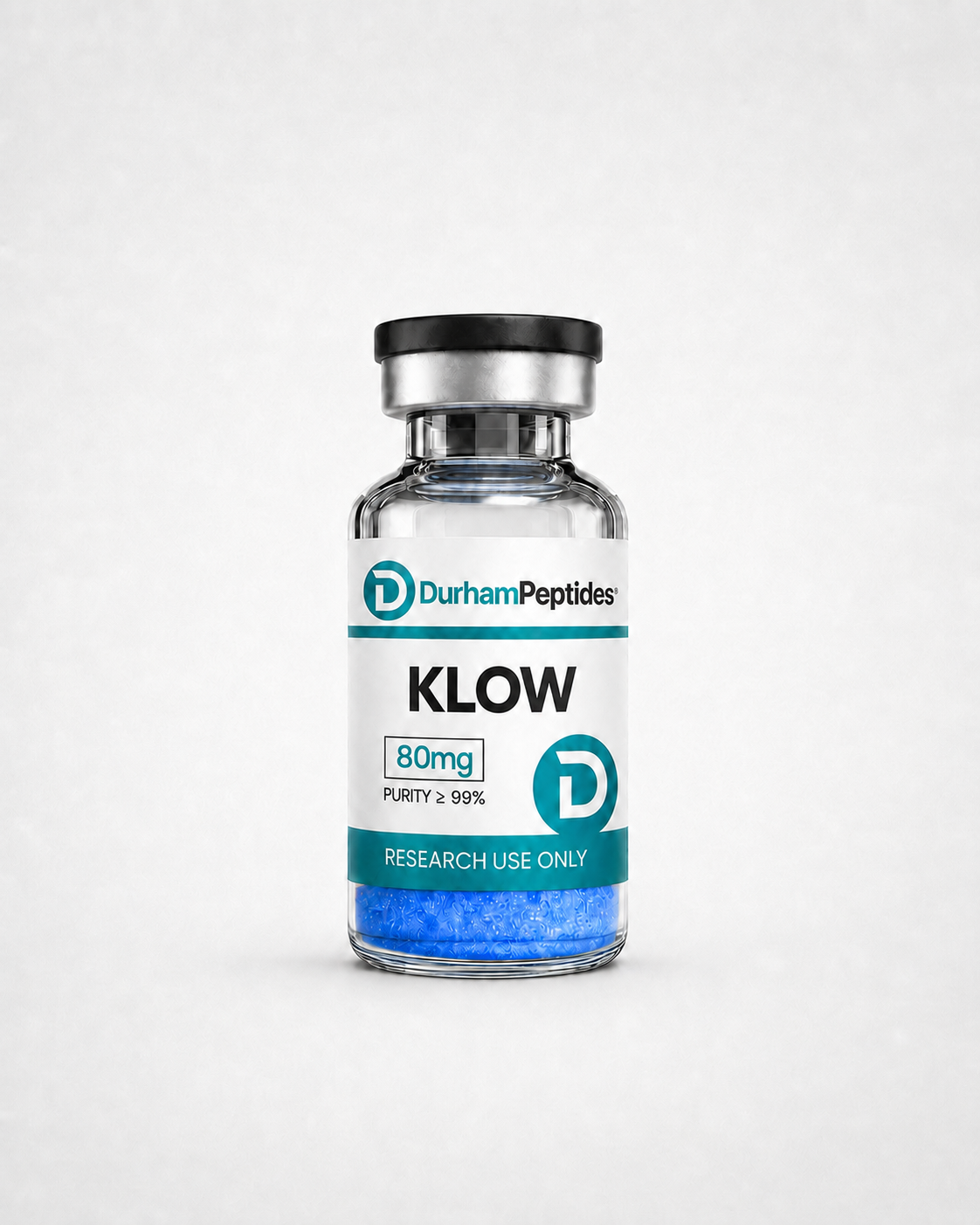
For Canadian researchers, Durham Peptides carries the KLOW Blend (BPC-157 10mg + GHK-Cu 50mg + TB-500 10mg + KPV 10mg) — 80mg (currently subject to availability — use the product page's "Notify When Available" function). Nothing here is medical, dosing, or therapeutic guidance.
The Composition
The KLOW blend contains four research peptides in fixed proportions:
Component | Amount | Primary mechanism |
GHK-Cu | 50 mg | Gene expression, collagen, skin regeneration |
BPC-157 | 10 mg | Angiogenesis, gut & tissue protection |
TB-500 | 10 mg | Cell migration, actin regulation |
KPV | 10 mg | Anti-inflammatory (NF-κB, cytokines) |
Total | 80 mg | Four complementary mechanisms |
The 80mg total is co-lyophilized in a single vial with all four peptides in their stated proportions. This is the same format as the GLOW Blend (70mg three-peptide), extended with the KPV addition.
What the "K" in KLOW Stands For
KLOW = KPV + GLOW. The "K" prefix denotes the KPV addition to the established GLOW three-peptide formulation. This naming reflects the mechanistic relationship between the two blends: KLOW is the GLOW base with an added dedicated anti-inflammatory component.
For the standalone comparison, see GLOW vs KLOW. For the existing KLOW vs GLOW comparison, see KLOW Blend vs GLOW Blend.
The Four Mechanisms in One Vial
The KLOW blend's research interest comes from its mechanistic diversity — four peptides engaging four genuinely different pathways:
1. GHK-Cu — Gene Expression and Collagen Research
The copper tripeptide (50mg in the blend) is the most-researched component, with over 100 published studies across five decades. Studied for collagen I and III synthesis, gene-expression modulation across hundreds of genes, and skin-regeneration pathways. The "anti-aging" anchor of the blend. See Copper Peptides Explained and GHK-Cu for Skin and Hair Research.
2. BPC-157 — Angiogenesis and Tissue Protection
BPC-157 (10mg in the blend) is studied primarily for angiogenesis — the formation of new blood vessels — through VEGFR2 and nitric oxide signaling. Its gastric-juice origin gives it an unusual research breadth that extends from gut protection to musculoskeletal repair. See What Is BPC-157?.
3. TB-500 — Cell Migration
TB-500 (10mg in the blend) — the synthetic Thymosin Beta-4 fragment — is studied for actin regulation and cell migration. Where BPC-157 builds the blood supply, TB-500 mobilizes the repair cells. Complementary, not redundant. See What Is TB-500?.
4. KPV — Anti-Inflammatory Signaling
KPV (10mg in the blend) is the addition that distinguishes KLOW from GLOW. The α-MSH-derived tripeptide is studied for NF-κB pathway modulation, pro-inflammatory cytokine reduction (TNF-α, IL-6, IL-1β), and anti-inflammatory effects in gut and skin research. See What Is KPV?.
Together, these four peptides target distinct mechanisms that have been studied for complementary effects on tissue repair, skin regeneration, and inflammation modulation. See Healing & Recovery Peptides Explained for the underlying mechanism framework.
Why Combine Four Peptides in One Vial?
The case for KLOW over assembling the four peptides separately comes down to three things:
Mechanistic completeness. The four mechanisms — gene expression, angiogenesis, cell migration, anti-inflammation — together address tissue research more comprehensively than any one or two peptides alone. For research designed around the combination, the four-component blend is the formulation that delivers all four mechanisms at established proportions.
Documentation simplification. Four peptides in one vial means one batch, one COA, one reconstitution event — versus four separate batches, COAs, reconstitution events, and stability windows for the alternative. For combination research at the standard ratios, this is a significant practical advantage. See When Do You Actually Need a Peptide Blend?.
Ratio consistency. The KLOW blend's fixed ratios eliminate the mix-it-yourself variability that builds across many reconstitution events with four separate vials. For research that depends on consistent proportions, the pre-formulated blend wins.
KLOW vs Single-Component Alternatives
For researchers weighing KLOW against assembling the four peptides separately, the trade-offs:
Option | Best for |
Studying the four-peptide combination at the standard ratio; simplified documentation; combination research | |
Separate vials (GHK-Cu + BPC-157 + TB-500 + KPV) | Non-standard ratios; isolating individual components in different protocol arms; flexibility |
For the decision framework, see When Do You Actually Need a Peptide Blend?.
What Researchers Examine
- Combined effects of the four mechanisms versus single-component or two/three-component alternatives
- Skin-regeneration and tissue-repair research outcomes
- Anti-inflammatory cytokine modulation in combination protocols
- Per-component verification on a four-peptide COA (each peptide independently identified and quantified)
- Comparison studies versus the three-peptide GLOW formulation
Quality and Storage
Durham Peptides' KLOW blend is supplied as a lyophilized co-formulation, Janoshik-verified to ≥99% purity for each component by HPLC with mass-spec identity for each peptide independently, 100% synthetically manufactured (vegan). Storage: 2–8°C short-term, -20°C long-term, protected from light and moisture; reconstitute in bacteriostatic water.
Because four peptides share the same reconstituted-stability window once dissolved, the KLOW blend is best suited for research that uses the formulation within that window. For the stability framework, see Does Vial Size Affect Stability?and the peptide calculator for reconstitution math.
Frequently Asked Questions
What is the KLOW blend? A four-peptide research formulation combining GHK-Cu 50mg, BPC-157 10mg, TB-500 10mg, and KPV 10mg in a single co-lyophilized 80mg vial.
What does KLOW stand for? KPV + GLOW. The "K" denotes KPV added to the established GLOW three-peptide formulation (GHK-Cu + BPC-157 + TB-500).
Why combine four peptides? Because each engages a distinct mechanism — gene expression (GHK-Cu), angiogenesis (BPC-157), cell migration (TB-500), and anti-inflammation (KPV) — that has been studied for complementary effects on tissue repair and inflammation research.
What is the KLOW blend studied for? The combined effects of the four mechanisms across skin-regeneration, tissue-repair, and inflammation-modulation research models — particularly where all four pathways are relevant to the protocol.
How is KLOW different from GLOW? KLOW adds the fourth peptide KPV — a dedicated anti-inflammatory component — to the established GLOW three-peptide base. See GLOW vs KLOW.
Where can I buy the KLOW blend in Canada? Durham Peptides supplies the KLOW Blend 80mg for laboratory use only, subject to availability.
Final Thoughts
The KLOW blend is the four-mechanism research formulation in the Durham Peptides catalog — combining gene expression, angiogenesis, cell migration, and anti-inflammatory signaling in a single vial. Its research interest is in the combination itself, and its practical advantage over assembling the four peptides separately is simplification: one batch, one COA, one reconstitution. For protocols designed around the four-peptide combination at established ratios, KLOW is the format that delivers it cleanly.
For the GLOW comparison, see GLOW vs KLOW; for the component deep-dives, see Copper Peptides Explained, What Is BPC-157?, What Is TB-500?, and What Is KPV?.
Selected Research References
- Pickart L, Margolina A. Regenerative and Protective Actions of the GHK-Cu Peptide. International Journal of Molecular Sciences. 2018;19(7):1987. https://pubmed.ncbi.nlm.nih.gov/29986520/
- Sikiric P, Seiwerth S, Rucman R, et al. Stable Gastric Pentadecapeptide BPC 157: Novel Therapy in Gastrointestinal Tract. Current Pharmaceutical Design. 2011;17(16):1612-1632. https://pubmed.ncbi.nlm.nih.gov/21548867/
- Goldstein AL, Hannappel E, Kleinman HK. Thymosin Beta-4: Actin-Sequestering Protein Moonlights to Repair Injured Tissues. Trends in Molecular Medicine. 2005;11(9):421-429. https://pubmed.ncbi.nlm.nih.gov/16099219/
- Dalmasso G, Charrier-Hisamuddin L, Nguyen HT, et al. PepT1-Mediated Tripeptide KPV Uptake Reduces Intestinal Inflammation. Gastroenterology. 2008;134(1):166-178. https://pubmed.ncbi.nlm.nih.gov/18061177/
All products sold by Durham Peptides are for research and laboratory use only. They are not intended for human or animal consumption, diagnosis, treatment, cure, or prevention of any disease.