

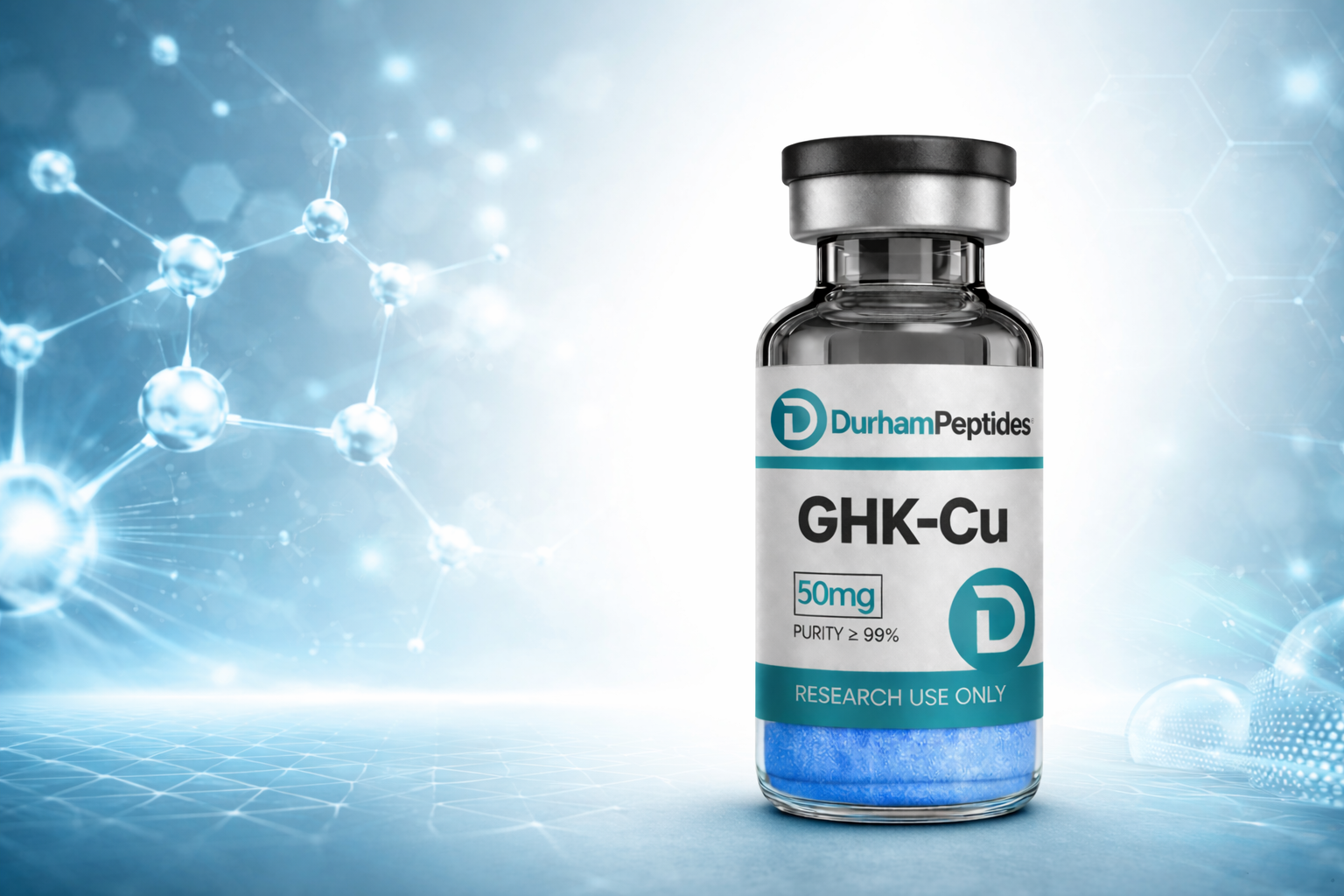
GHK-Cu skin hair collagen copper peptide regeneration research Durham Peptides Canada
Of all the research peptides, GHK-Cu has the deepest connection to skin and hair science — it's the copper tripeptide that launched the entire "copper peptide" category in dermatological research, backed by over 100 published studies across five decades. When researchers search for the science behind copper peptides in skin regeneration, collagen synthesis, and follicle studies, GHK-Cu is the molecule at the center. This article focuses specifically on the skin and hair research dimension of GHK-Cu.
For the broader mechanism, see Copper Peptides Explained; for the buying decision, see Buy GHK-Cu in Canada. Nothing here is medical, dosing, or therapeutic guidance.
What GHK-Cu Is
GHK-Cu is a naturally occurring tripeptide — glycyl-L-histidyl-L-lysine — bound to a copper ion. Its key identity data:
- Sequence: Gly-His-Lys : Cu²⁺
- Molecular formula: C₁₄H₂₃CuN₆O₄
- Molecular weight: 403.92 g/mol
- CAS number: 49557-75-7
GHK occurs naturally in human plasma, and its levels decline with age — an observation that helped drive interest in its role in age-related skin changes. Durham Peptides supplies it in 50mg and 100mg formats.
The Collagen Connection
The single most-studied aspect of GHK-Cu in skin research is its investigated effect on collagen. Collagen is the structural protein that gives skin its firmness and elasticity, and its decline is central to skin aging. GHK-Cu has been studied for stimulating the production of collagen — particularly collagen types I and III — as well as elastin and other components of the skin's extracellular matrix. This collagen-stimulation research is the foundation of GHK-Cu's reputation in the skincare and anti-aging research communities.
The Gene-Expression Mechanism
What makes GHK-Cu especially interesting to researchers is how it's studied to act: not just as a direct building block, but as a modulator of gene expression. Research has examined GHK-Cu's investigated ability to influence the expression of a large number of human genes — studied in the context of resetting age-related gene-expression patterns toward a more youthful profile, and activating pathways involved in tissue remodeling, antioxidant defense (including superoxide dismutase), and wound repair. This positions GHK-Cu as a signaling molecule that may influence the skin's regenerative machinery broadly, rather than acting through a single narrow pathway.
Skin Regeneration and Wound Research
Beyond collagen, GHK-Cu has been studied across skin-regeneration and wound-research models for investigated effects on:
- Skin remodeling and the extracellular matrix
- Wound closure and tissue-repair timelines
- Skin elasticity and barrier-related parameters
- Antioxidant enzyme upregulation (e.g., superoxide dismutase)
- Comparison with other cosmetic peptides studied in skin research (such as Matrixyl and Argireline)
The Hair Research Dimension
GHK-Cu's research extends to hair biology, where it has been investigated for its effects on the hair follicle. Studies have examined its investigated role in follicle stimulation and in pathways relevant to hair growth, drawing on the same tissue-remodeling and gene-expression mechanisms studied in skin. This follicle-research thread is part of why GHK-Cu appears frequently in both skin and hair research contexts.
What Researchers Examine
- Collagen I and III and elastin production pathways
- Copper-dependent gene regulation in skin fibroblasts
- Hair follicle stimulation and growth-related pathways
- Wound healing and scar-remodeling timelines
- Antioxidant enzyme upregulation (SOD, catalase)
- Comparison with cosmetic peptides (Matrixyl, Argireline)
GHK-Cu in Combination: the GLOW Blend
Because GHK-Cu's skin and tissue-remodeling research complements the recovery mechanisms of BPC-157 and TB-500, it's a core component of the Glow Blend (GHK-Cu + BPC-157 + TB-500), which combines gene-expression, angiogenesis, and cell-migration mechanisms in one formulation. For how the blend compares to GHK-Cu alone, see GHK-Cu vs GLOW Blend; for the GLOW/KLOW distinction, see GLOW vs KLOW.
Quality and Storage
Durham Peptides' GHK-Cu is Janoshik-verified to ≥99% purity by HPLC with mass-spec identity confirmation, with proper copper complexation, 100% synthetically manufactured (vegan). Storage: 2–8°C, protected from light and moisture; reconstitute in bacteriostatic water. See How to Read a Janoshik COA and the peptide calculator.
Frequently Asked Questions
What is GHK-Cu studied for in skin research? Primarily collagen synthesis (types I and III), skin remodeling, and gene-expression modulation related to skin regeneration and antioxidant defense.
How does GHK-Cu affect collagen? It's studied for stimulating production of collagen and elastin and other extracellular-matrix components — the basis of its reputation in skin and anti-aging research.
Is GHK-Cu studied for hair? Yes — it's investigated for hair-follicle stimulation and hair-growth-related pathways, drawing on the same tissue-remodeling and gene-expression mechanisms studied in skin.
Why is GHK-Cu called a gene-expression modulator? Because research has examined its investigated ability to influence the expression of many human genes involved in remodeling, repair, and antioxidant defense — acting broadly rather than through one narrow pathway.
Where can I buy GHK-Cu in Canada? Durham Peptides supplies GHK-Cu in 50mg and 100mg formats, Janoshik-verified. See Buy GHK-Cu in Canada.
Is GHK-Cu in the GLOW blend? Yes — it's a core component of the Glow Blend alongside BPC-157 and TB-500.
Final Thoughts
GHK-Cu is the copper peptide at the heart of skin and hair research — studied for collagen and elastin synthesis, broad gene-expression modulation, and follicle pathways, with a research foundation few peptides can match. Whether studied alone or as the anti-aging anchor of the GLOW blend, it remains the reference compound for copper-peptide skin science.
For the underlying mechanism, see Copper Peptides Explained; for the buying decision and the 50mg-vs-100mg choice, see Buy GHK-Cu in Canada and GHK-Cu 50mg vs 100mg. Browse the Anti-Aging & Skin Research Peptides category.
Selected Research References
- Pickart L, Vasquez-Soltero JM, Margolina A. GHK Peptide as a Natural Modulator of Multiple Cellular Pathways in Skin Regeneration. BioMed Research International. 2015;2015:648108. https://pubmed.ncbi.nlm.nih.gov/26236730/
- Pickart L, Margolina A. Regenerative and Protective Actions of the GHK-Cu Peptide. International Journal of Molecular Sciences. 2018;19(7):1987. https://pubmed.ncbi.nlm.nih.gov/29986520/
- Pickart L, Vasquez-Soltero JM, Margolina A. The Effect of the Human Peptide GHK on Gene Expression Relevant to Nervous System Function and Cognitive Decline. Brain Sciences. 2017;7(2):20. https://pubmed.ncbi.nlm.nih.gov/28208612/
All products sold by Durham Peptides are for research and laboratory use only. They are not intended for human or animal consumption, diagnosis, treatment, cure, or prevention of any disease.