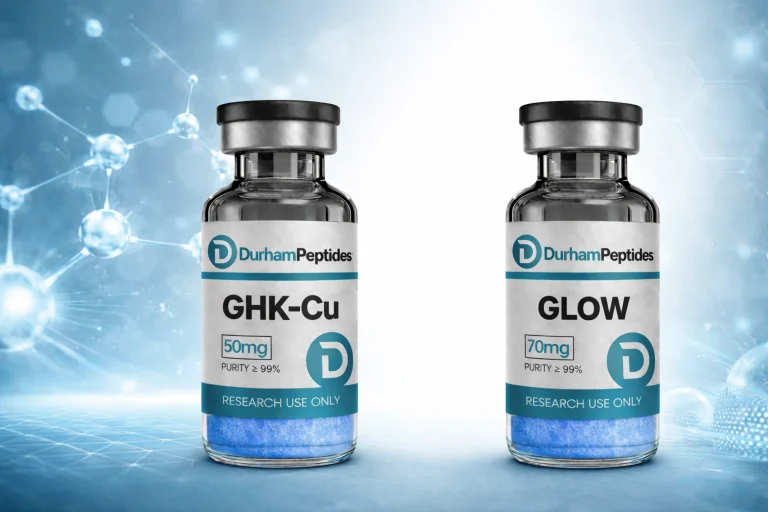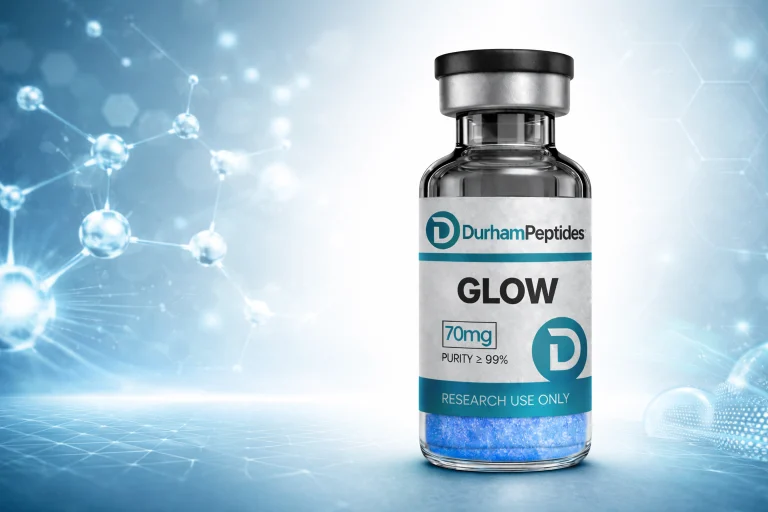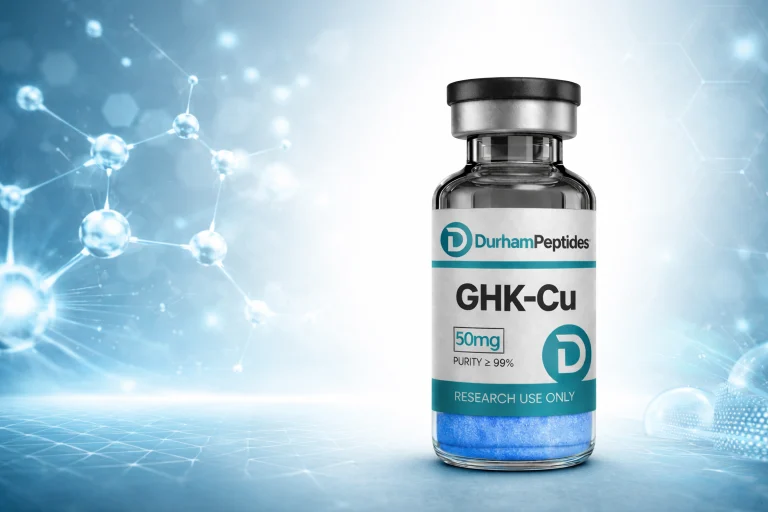

GHK-Cu is one of the most extensively studied peptides in anti-aging research, with over 100 published studies spanning five decades. The GLOW Blend is a multi-peptide formulation that combines GHK-Cu with two additional research peptides — BPC-157 and TB-500. Both are available from Durham Peptides, and researchers frequently ask which option is more appropriate for their work.
This article compares the two products across their composition, mechanisms, and research applications.
What Is GHK-Cu?
GHK-Cu (glycyl-L-histidyl-L-lysine copper) is a naturally occurring tripeptide-copper complex found in human blood plasma, saliva, and urine. It was first identified in 1973 by biochemist Loren Pickart, who observed that plasma from younger donors caused older liver tissue to resume more youthful metabolic activity.
GHK-Cu has a simple structure — just three amino acids bound to a copper(II) ion — but its biological activity is remarkably broad. Studies using the Broad Institute's Connectivity Map have shown that GHK-Cu can influence the expression of over 4,000 human genes, approximately 6% of the human genome.
Plasma levels of GHK-Cu are highest in young adults (approximately 200 ng/mL) and decline significantly with age (approximately 80 ng/mL by age 60). This age-related decline is a central focus of anti-aging research involving this compound.
For a comprehensive overview, see: GHK-Cu: The Anti-Aging Copper Peptide with Over 100 Published Studies.
What Is the GLOW Blend?
The GLOW Blend is a pre-blended formulation containing three peptides in a single vial:
GHK-Cu — 50mg (gene expression modulation, collagen synthesis, antioxidant upregulation)
BPC-157 — 10mg (angiogenesis, growth factor signaling, fibroblast migration)
TB-500 — 10mg (actin polymerization, cell migration, wound healing)
Total content: 70mg per vial.
The formulation was designed for researchers studying multi-pathway approaches to tissue regeneration and skin repair, where the mechanisms of all three compounds may interact. For a full overview, see What Is the GLOW Blend?
Mechanism Comparison
GHK-Cu alone operates primarily at the gene expression level. It signals cells to increase production of collagen, elastin, and antioxidant enzymes while suppressing certain inflammatory and tissue-destructive pathways. It works broadly but indirectly — changing what cells produce rather than directly moving cells or building blood vessels.
The GLOW Blend adds two additional mechanisms on top of GHK-Cu's gene signaling:
BPC-157 adds vascular infrastructure — promoting angiogenesis and VEGF expression, which supports nutrient and oxygen delivery to tissues undergoing repair.
TB-500 adds cell mobility — facilitating the physical migration of cells to repair sites through actin cytoskeleton reorganization.
The result is a formulation that operates on three levels: gene expression (GHK-Cu), vascular support (BPC-157), and cellular movement (TB-500).
When to Choose GHK-Cu Alone
Standalone GHK-Cu is appropriate for researchers who are studying GHK-Cu's specific mechanisms in isolation, need to control for variables by using a single compound, are conducting dose-response studies on GHK-Cu specifically, or are researching GHK-Cu's gene expression modulation independent of other peptide activity.
The standalone product also provides more flexibility — researchers can adjust concentrations and combine GHK-Cu with other compounds at custom ratios.
When to Choose the GLOW Blend
The GLOW Blend is appropriate for researchers who are studying multi-peptide synergy in tissue repair models, want to examine the combined effects of gene signaling plus vascular repair plus cell migration, are working on skin regeneration or wound healing models where multiple repair mechanisms are relevant, or want the convenience of a pre-blended formulation with established component ratios.
Price Comparison
Purchasing the three components individually (GHK-Cu + BPC-157 + TB-500) costs more than the pre-blended GLOW Blend, making the blend a more cost-effective option for researchers who plan to use all three.
Product Specifications
Both products are 99%+ purity, third-party verified by Janoshik Analytical via HPLC and mass spectrometry. Certificates of Analysis are available on our Lab Results page.
For more on the individual components, see: What Is BPC-157? TB-500: The Recovery Peptide Behind the Wolverine Stack
For questions about peptide reconstitution and storage, visit our FAQ.
Selected Research References
- Pickart L, Vasquez-Soltero JM, Margolina A. "GHK Peptide as a Natural Modulator of Multiple Cellular Pathways in Skin Regeneration." Biomed Res Int. 2015. PMID: 26236730
- Pickart L, Margolina A. "Regenerative and Protective Actions of the GHK-Cu Peptide in the Light of the New Gene Data." Int J Mol Sci. 2012. PMID: 24508075
- Pickart L. "The human tri-peptide GHK and tissue remodeling." J Biomater Sci Polym Ed. 2008. PMID: 4762237
- Seiwerth S, et al. "BPC 157 and Standard Angiogenic Growth Factors." Curr Pharm Des. 2018. PMID: 29998800
All products mentioned in this article are sold by Durham Peptides for research and laboratory use only. They are not intended for human or animal consumption, diagnosis, treatment, cure, or prevention of any disease.