
GLOW Blend vs GHK-Cu peptide research comparison Durham Peptides Canada
One of the most frequent questions Durham Peptides receives from researchers in Canada is whether to choose the GLOW Blend or GHK-Cu on its own. Both products are available in our catalog, both are widely studied in the anti-aging research space, and both have distinct advantages depending on the research protocol.
This article answers the question directly: the right choice depends on your research goal. Below we walk through three common research scenarios, explain what GLOW adds beyond GHK-Cu alone, and break down when one product outperforms the other.
For a full product-by-product comparison, see our article on GHK-Cu vs GLOW Blend. This post is focused specifically on the decision itself.
The Short Answer
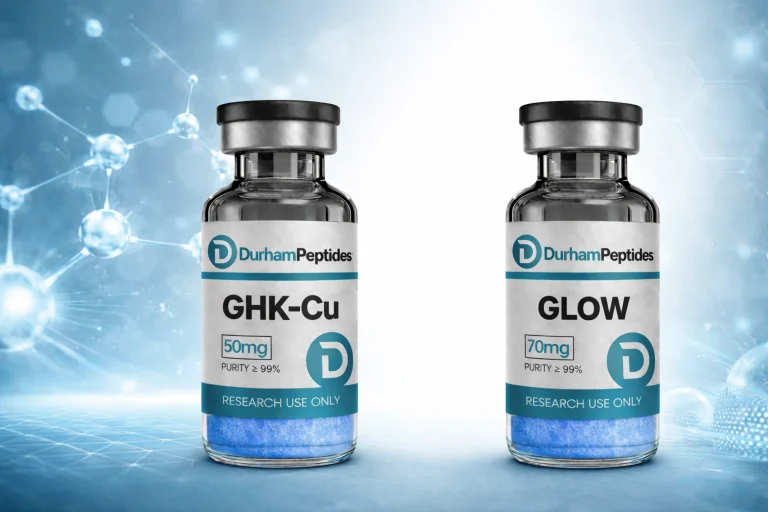
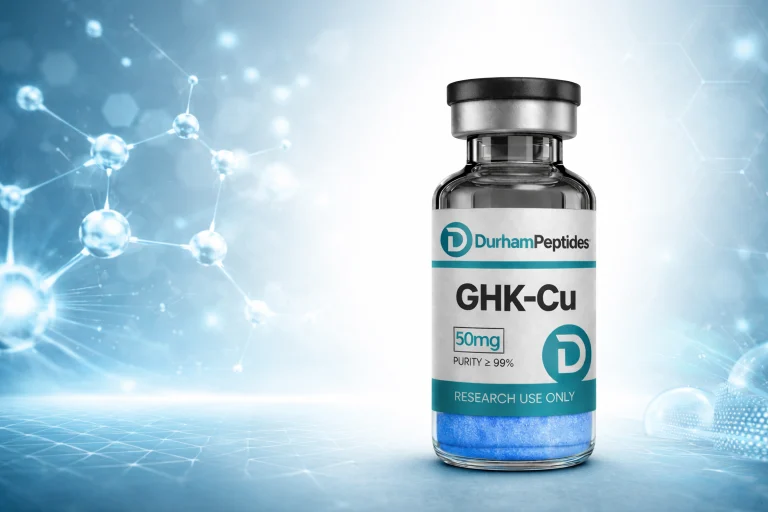
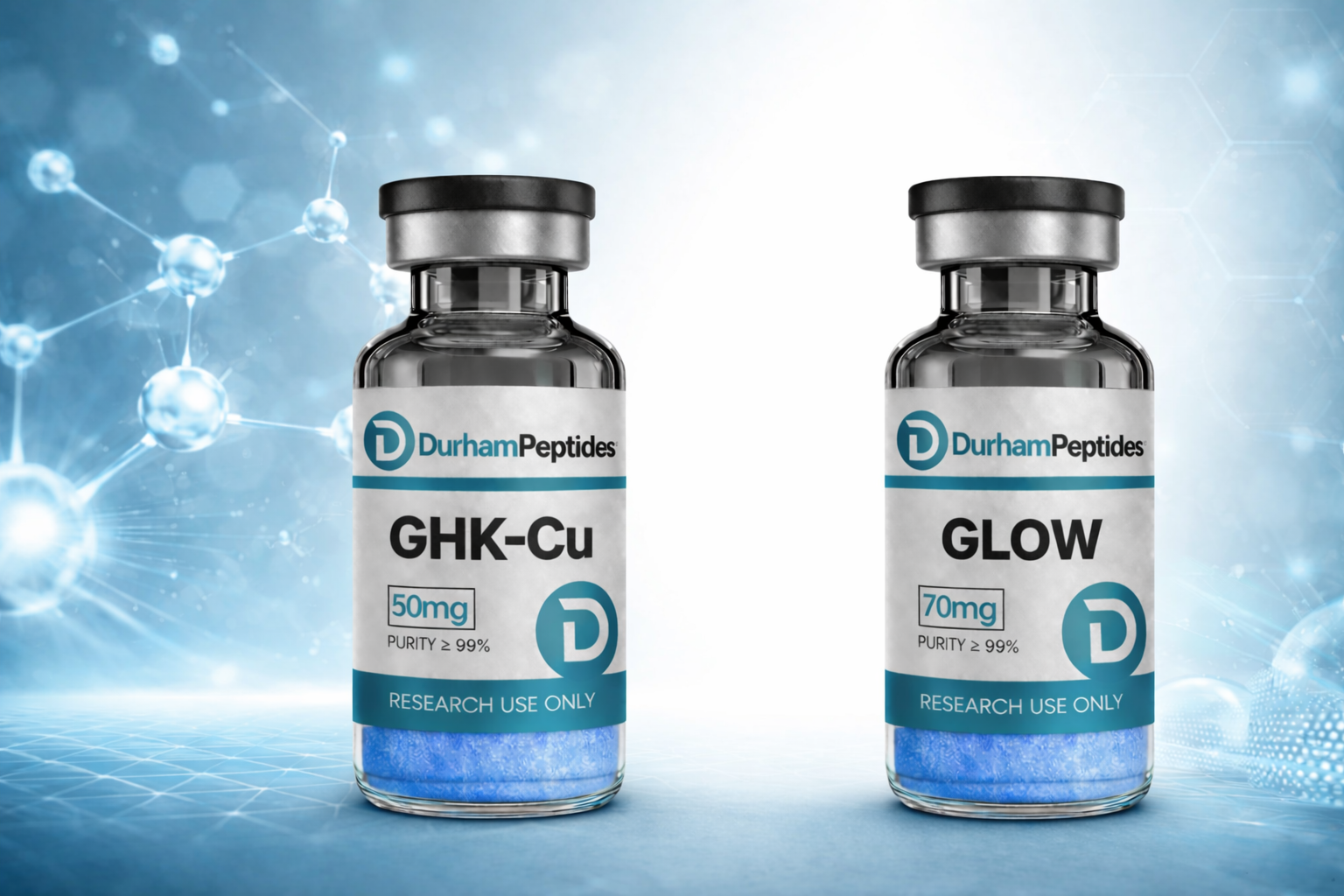
GHK-Cu 50mg is the better choice when the research focus is specifically on copper peptide mechanisms, when budget matters, or when the researcher wants to control the exact dose of copper peptide independently.
The GLOW Blend is the better choice when the research goal involves multiple overlapping pathways — skin regeneration combined with tissue repair and cellular migration — and the researcher prefers a pre-formulated blend over managing three separate vials.
Neither product is categorically "better." They address different research needs.
Scenario 1: Pure Anti-Aging and Skin Regeneration Research
For researchers studying GHK-Cu specifically — its effects on copper-dependent enzymes, collagen synthesis pathways, gene expression changes, or copper transport mechanisms — the standalone GHK-Cu 50mg product is the appropriate choice.
GHK-Cu has been the subject of over 100 published studies spanning five decades of research, and the vast majority of that literature examines GHK-Cu as a single compound. If the research protocol is designed to replicate or extend existing GHK-Cu literature, adding BPC-157 and TB-500 would introduce variables the existing research does not account for.
In this scenario, GHK-Cu alone is the scientifically correct choice. GLOW Blend would actually confound the results.
For more on the research landscape, see our overview of GHK-Cu: The Anti-Aging Copper Peptide.
Scenario 2: Combined Skin Regeneration and Tissue Repair Research
This is where the GLOW Blend becomes the more appropriate choice.
Some research protocols are designed to examine overlapping biological pathways — for instance, studying how copper peptide signaling (GHK-Cu) interacts with growth-factor-mediated tissue repair (BPC-157) and cellular migration mechanisms (TB-500). These protocols benefit from a pre-formulated blend because the three compounds are combined at a researcher-validated ratio and require only a single reconstitution.
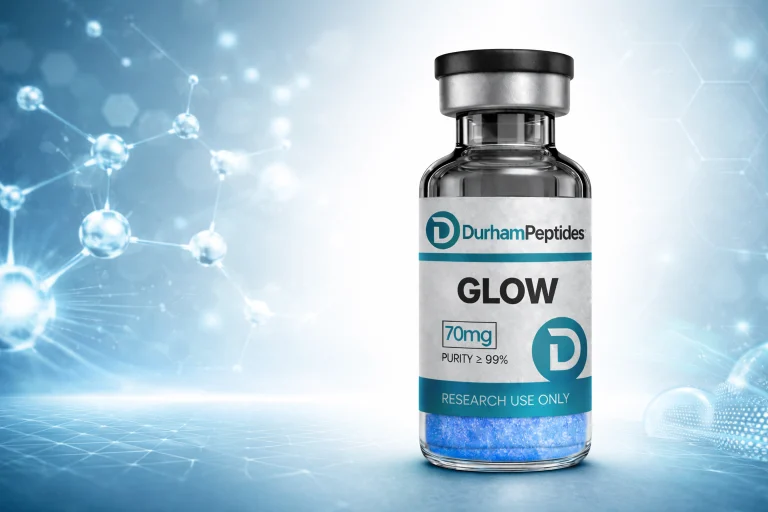
The GLOW Blend contains 50mg GHK-Cu, 10mg BPC-157, and 10mg TB-500 in a single 70mg vial. This is the same ratio that many research protocols have used when studying these compounds in combination.
Running three separate vials is also a valid approach, but it requires three separate reconstitutions, three separate bacteriostatic water measurements, and three separate injection protocols. The blend simplifies the logistics.
Scenario 3: Budget-Conscious Research
For researchers operating with strict budget constraints, the standalone GHK-Cu 50mg at C$55 is the most cost-effective entry into copper peptide research. The GLOW Blend at C$160 offers more total peptide content and more mechanisms but represents a higher per-vial investment.
However, cost per milligram tells a different story. The GLOW Blend's 70mg total for C$160 works out to approximately C$2.29/mg across three compounds. GHK-Cu alone at 50mg for C$55 is C$1.10/mg. If the research budget allows purchasing all three compounds separately (GHK-Cu C$55, BPC-157 C$55, TB-500 C$80 = C$190 total for 70mg), the GLOW Blend is actually slightly cheaper than the separate purchases — and considerably more convenient.
So the budget calculation depends on whether the researcher needs all three compounds or only one.
What the GLOW Blend Adds Beyond GHK-Cu
The GLOW Blend extends GHK-Cu's mechanism of action by introducing two additional
pathways.
BPC-157 — Body Protection Compound-157 — has been extensively studied for its role in angiogenesis (new blood vessel formation), growth factor modulation, and connective tissue repair. In a research protocol focused on skin biology, BPC-157's effects on vascularization complement GHK-Cu's effects on collagen synthesis.
TB-500, the synthetic fragment of Thymosin Beta-4, has been studied for its role in actin regulation, cellular migration, and fibroblast/keratinocyte movement to injury sites. TB-500 contributes a distinct mechanism focused on structural protein dynamics and cellular movement during wound recovery.
Combined, the three compounds address three levels of biology: GHK-Cu at the gene expression level, BPC-157 at the vascular and growth factor level, and TB-500 at the structural and cellular migration level.
What You Lose by Choosing GLOW Over GHK-Cu Alone
There are two trade-offs to the GLOW Blend.
First, the blend contains three compounds at fixed ratios. If a research protocol calls for a different ratio — for example, 50mg GHK-Cu with only 5mg BPC-157 — the blend is not adjustable. In that case, purchasing the compounds separately allows for precise dose control.
Second, when three compounds are combined in a single vial, reconstitution math becomes more complex. A researcher must calculate total peptide content per unit volume across all three compounds. Our article GLOW Blend Reconstitution Math covers this calculation in detail.
For researchers who prefer simplicity over flexibility, the blend's fixed ratios are actually an advantage. For researchers who need protocol-specific dose control, separate vials are better.
Side-by-Side Research Applications
GHK-Cu 50mg is better for:
- Copper peptide mechanism studies
- Gene expression research focused on GHK-Cu's known pathways
- Budget-limited single-compound protocols
- Research replicating existing GHK-Cu literature
- Studies where only one mechanism is being examined
GLOW Blend is better for:
- Multi-pathway skin regeneration research
- Combined tissue repair and anti-aging protocols
- Simplified logistics for three-compound research
- Research where complementary mechanisms are the focus
- Studies comparing single-compound vs multi-compound approaches
Which Researchers Choose Which
In our experience at Durham Peptides, researchers new to the anti-aging peptide space often start with GHK-Cu alone to understand the compound's effects before adding complexity. Once they want to expand into multi-mechanism research, the GLOW Blend becomes the natural next step.
Experienced researchers tend to choose based on the specific experimental question. Researchers with a clear hypothesis about a single mechanism order the single compound. Researchers studying overlapping pathways order the blend.
There is no universally correct choice. The research question dictates the product.
Verification and Quality
Both GHK-Cu 50mg and the GLOW Blend are third-party tested by Janoshik Analytical for purity and identity verification via HPLC and mass spectrometry. Every batch carries a unique verification key that can be checked at the Janoshik verification portal.
Both products are manufactured via Solid-Phase Peptide Synthesis (SPPS) — fully synthetic, 100% vegan, with no animal-derived ingredients. Both ship same-day from our Canadian facility via Canada Post Xpresspost.
Frequently Asked Questions
Is GLOW Blend stronger than GHK-Cu? GLOW Blend is not "stronger" — it contains the same amount of GHK-Cu (50mg) as the standalone product, plus two additional peptides. The distinction is about mechanism breadth, not potency.
Can I make my own GLOW Blend by buying the three compounds separately? Yes. Purchasing GHK-Cu 50mg, BPC-157 10mg, and TB-500 10mg separately gives you the same compounds at the same doses, with the flexibility to adjust ratios. The trade-off is three separate reconstitutions instead of one.
Does the GLOW Blend have published research behind it? Each component — GHK-Cu, BPC-157, and TB-500 — has extensive published research individually. Research specifically on the combined three-peptide formulation is limited. The blend's rationale is based on complementary mechanisms from separate studies of each compound.
Is GHK-Cu alone enough for skin research? For research focused specifically on copper peptide mechanisms, yes — GHK-Cu alone has decades of research behind it and is the gold standard for single-compound skin biology studies. For research examining multiple pathways, a blend approach may be more appropriate.
Which should a beginner researcher start with? Researchers new to the peptide space typically benefit from starting with a single compound. GHK-Cu 50mg is a strong entry point given its extensive literature and lower per-vial cost.
Why does Durham Peptides carry both products? Different research goals require different products. We carry the blend for researchers studying combined pathways and the standalone for researchers focused on single-compound mechanisms.
How long do both products last once reconstituted? Once reconstituted with bacteriostatic water, both products should be stored refrigerated (2-8°C) and used within 28 days. Lyophilized (unopened) shelf life is significantly longer — up to 24 months when stored properly.
Do both products ship from Canada? Yes. Both GHK-Cu and the GLOW Blend ship same-day from Durham Peptides' Ontario facility when orders are placed before 3:00 PM EST, via Canada Post Xpresspost with tracking.
Final Thoughts
The "better" product depends entirely on the research question. GHK-Cu alone is not inferior to the GLOW Blend — it's a different tool for a different job. If the research protocol examines copper peptide biology specifically, GHK-Cu is the right choice. If the protocol examines overlapping regeneration pathways, the GLOW Blend makes more sense.
For researchers who are uncertain which direction their research will take, starting with GHK-Cu 50mg and expanding later is often the most economical path. The compound is inexpensive enough to study on its own, and the GLOW Blend can be added to a subsequent research phase without discarding prior work.
Browse our full anti-aging and skin regeneration research peptide catalog at durhampeptides.ca.
Selected Research References
- Pickart L, Margolina A. Regenerative and Protective Actions of the GHK-Cu Peptide in the Light of the New Gene Data. International Journal of Molecular Sciences. 2018;19(7):1987. https://pubmed.ncbi.nlm.nih.gov/29986520/
- Pickart L, Vasquez-Soltero JM, Margolina A. GHK and DNA: Resetting the Human Genome to Health. BioMed Research International. 2014;2014:151479. https://pubmed.ncbi.nlm.nih.gov/25045669/
- Pickart L, Margolina A. GHK Peptide as a Natural Modulator of Multiple Cellular Pathways in Skin Regeneration. BioMed Research International. 2015;2015:648108. https://pubmed.ncbi.nlm.nih.gov/26236731/
- Seiwerth S, Sikiric P, Rucman R, et al. BPC 157 and Standard Angiogenic Growth Factors. Gastrointestinal Tract Healing, Lessons from Tendon, Ligament, Muscle and Bone Healing. Current Pharmaceutical Design. 2018;24(18):1972-1989. https://pubmed.ncbi.nlm.nih.gov/29998800/
- Chang CH, Tsai WC, Hsu YH, Pang JH. Pentadecapeptide BPC 157 Enhances the Growth Hormone Receptor Expression in Tendon Fibroblasts. Molecules. 2014;19(11):19066-19077. https://pubmed.ncbi.nlm.nih.gov/25415472/
- Vasireddi N, Hahamyan H, Salata MJ, et al. Emerging Use of BPC-157 in Orthopaedic Sports Medicine: A Systematic Review. HSS Journal. 2025. https://pubmed.ncbi.nlm.nih.gov/40756949/
All products mentioned in this article are sold by Durham Peptides for research and laboratory use only. They are not intended for human or animal consumption, diagnosis, treatment, cure, or prevention of any disease.