

KPV Lys-Pro-Val tripeptide alpha-MSH anti-inflammatory gut skin research Durham Peptides Canada
KPV is one of the smallest peptides in the entire research peptide field — just three amino acids — and one of the more mechanistically distinct. Where most anti-inflammatory research peptides act through tissue-repair or immune-modulating pathways, KPV's research story traces back to a much larger molecule: it's the C-terminal fragment of α-
MSH (alpha-melanocyte-stimulating hormone), and it has been studied for retaining the anti-inflammatory properties of the parent hormone without the melanocortin-receptor-mediated pigmentation effects. That separation is what makes KPV a focused research tool rather than a general signaling peptide.
This article is a research-focused overview of KPV — what it is, the α-MSH biology that produced it, the gut and skin research literature that defines its profile, and how it fits the Durham Peptides catalog as a standalone compound and in the KLOW blend. For the existing KLOW-context coverage, see What Is KPV? The Anti-Inflammatory Tripeptide in the KLOW Blend; this post focuses on KPV as a standalone research compound with emphasis on the gut and skin literature. Nothing here is medical, dosing, or therapeutic guidance.
The α-MSH Connection
α-MSH (alpha-melanocyte-stimulating hormone) is a 13-amino-acid peptide hormone with two notable properties: it's a potent regulator of melanocyte activity (the basis of its name), and it has well-documented anti-inflammatory activity. The challenge for research has been that full-length α-MSH carries both effects together — the anti-inflammatory signaling alongside the melanocortin-receptor activity.
KPV — Lys-Pro-Val, the C-terminal tripeptide of α-MSH — was identified as the fragment that retains much of the anti-inflammatory activity of the parent hormone while not driving the melanocortin-receptor-mediated pigmentation effects in the same way. That separation has made KPV a research tool for studying anti-inflammatory pathways in isolation from the broader α-MSH biology.
The Molecular Basics
Durham Peptides' KPV 10mg is a short, well-characterized tripeptide:
- Sequence: Lys-Pro-Val (H-Lys-Pro-Val-OH)
- Molecular formula: C₁₆H₃₀N₄O₄
- Molecular weight: ~342.4 g/mol
- CAS number: 67727-97-3
At three amino acids, KPV is among the smallest research peptides — smaller than the tripeptide-copper complex GHK-Cu once the copper is set aside, and dramatically smaller than peptides like TB-500 (43 amino acids). Its small size is also part of why it has been studied for oral bioavailability in some research models — a property that distinguishes it from the larger peptides in the category.
Research Area 1: Inflammatory Bowel Research
The single most-developed area of KPV research is in inflammatory bowel models. KPV has been studied extensively in models of colitis (particularly DSS- and TNBS-induced colitis in animal models), where research has examined its investigated effects on:
- Pro-inflammatory cytokine reduction — including TNF-α, IL-1β, IL-6, and IL-8 in gut tissue
- NF-κB pathway modulation — a central inflammatory transcription factor
- Colon tissue inflammation markers — including epithelial damage and immune cell infiltration
- Gut barrier function — including studies of intestinal permeability in inflammatory models
Notably, KPV has been studied for uptake via the PepT1 transporter in intestinal epithelial cells, which has been examined as a mechanism for its localized gut activity. This gut-research literature is the foundation of KPV's research reputation.
Research Area 2: Skin and Dermatological Research
KPV's α-MSH heritage also places it in dermatological research, where it has been studied in models of:
- Allergic and contact dermatitis — including investigated effects on inflammation in skin-irritation models
- UV-induced inflammation — given α-MSH's relationship to skin biology
- Mast cell activity — relevant to allergic and inflammatory skin responses
- Wound and skin barrier research — overlapping with the broader tissue-repair literature
This skin angle is part of why KPV is studied alongside GHK-Cu in skin-research contexts and appears in the KLOW four-peptide formulation. For the broader skin-research landscape, see Peptide Research for Skin Health: GHK-Cu, KPV, BPC-157.
Research Area 3: Systemic and Allergic Inflammation Models
Beyond gut and skin, KPV has been studied in broader inflammatory and allergic models — including airway inflammation, food-allergy research, and systemic cytokine modulation. The research thread here is that KPV's anti-inflammatory activity, derived from the α-MSH lineage, has been examined across multiple tissues and inflammation types rather than being narrowly tissue-specific.
Where KPV Fits the Anti-Inflammatory Peptide Category
KPV sits in a small but distinct category of anti-inflammatory research peptides. Its mechanism is different from the others Durham Peptides carries:
- KPV → α-MSH-derived anti-inflammatory; NF-κB and cytokine modulation
- BPC-157 → tissue repair with anti-inflammatory threads; angiogenesis and gut protection
- GHK-Cu → copper-peptide gene-expression modulation including inflammatory pathways
For the head-to-head with BPC-157 in gut research specifically, see KPV vs BPC-157 for Gut Research. For the category overview, see Anti-Inflammatory Peptides Research Overview.
KPV in the KLOW Blend
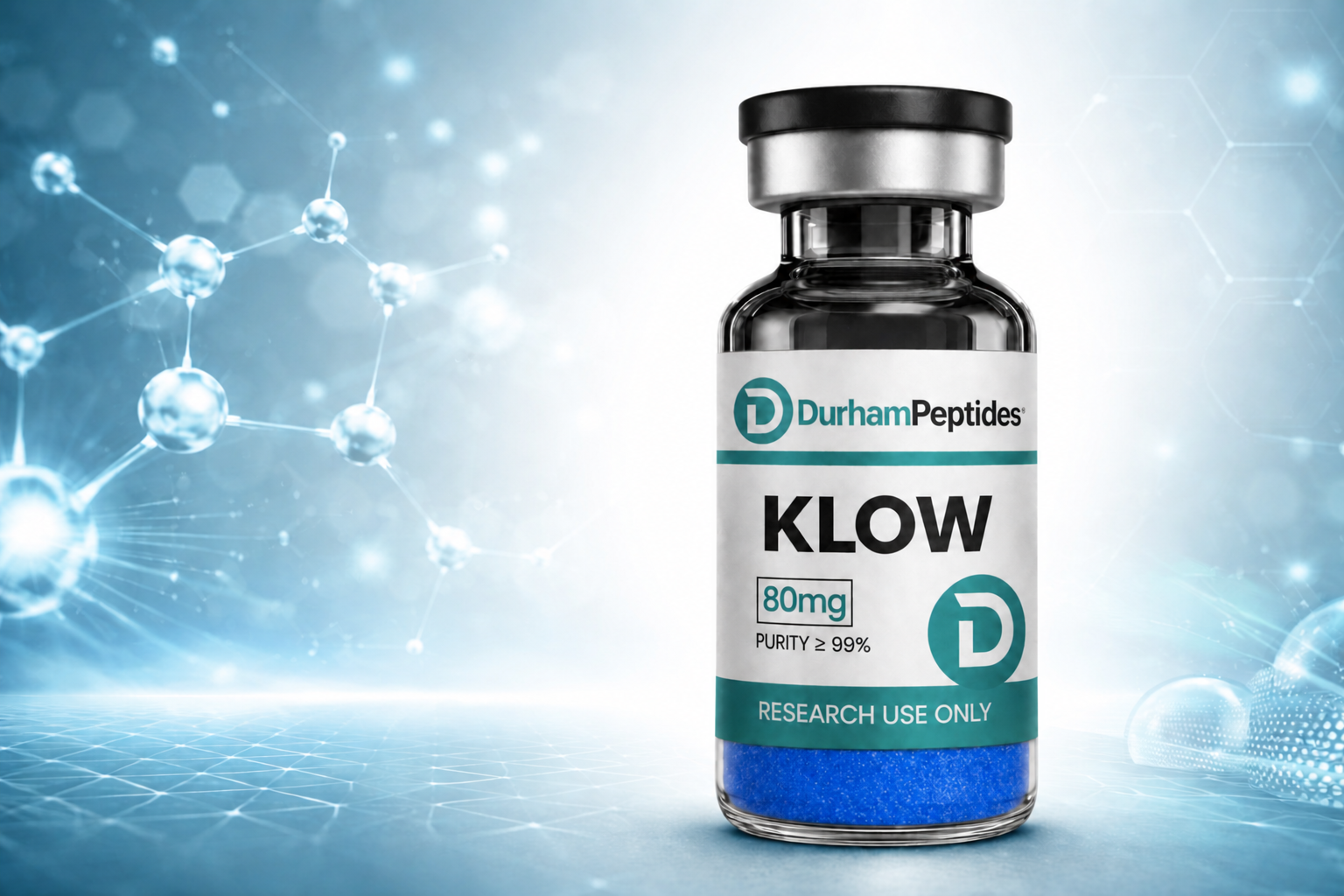
KPV is the fourth peptide that distinguishes the KLOW blend from the GLOW blend. KLOW = KPV + GHK-Cu + BPC-157 + TB-500, where KPV adds dedicated anti-inflammatory signaling to the base three-peptide skin-and-recovery formulation. For the comparison, see GLOW vs KLOW and KLOW Blend vs GLOW Blend.
Quality and Storage
KPV is supplied as a lyophilized peptide, Janoshik-verified to ≥99% purity by HPLC with mass-spec identity confirmation, 100% synthetically manufactured (vegan). Storage: 2–8°C short-term, -20°C long-term, protected from light and moisture; reconstitute in bacteriostatic water. See How to Read a Janoshik COA.
Frequently Asked Questions
What is KPV? A synthetic tripeptide (Lys-Pro-Val) derived from the C-terminal sequence of α-MSH, studied for anti-inflammatory activity in gut, skin, and systemic research models.
Why is KPV studied separately from α-MSH? Because the tripeptide fragment retains much of the anti-inflammatory activity of the parent hormone while not driving the melanocortin-receptor-mediated pigmentation effects in the same way — useful for studying inflammation in isolation.
What is KPV studied for in research? Inflammatory bowel models (DSS/TNBS colitis), skin and dermatological inflammation, NF-κB modulation, cytokine reduction, and gut barrier function.
Is KPV the same as α-MSH? No — KPV is a three-amino-acid fragment (the C-terminal portion) of the full 13-amino-acid α-MSH hormone, studied for the anti-inflammatory subset of α-MSH's activity.
How does KPV differ from BPC-157 in gut research? KPV is studied through α-MSH-derived anti-inflammatory pathways (NF-κB, cytokines); BPC-157 is studied through tissue-repair pathways including angiogenesis and gut-lining protection. See KPV vs BPC-157 for Gut Research.
What is the KLOW blend? KLOW = KPV + GHK-Cu + BPC-157 + TB-500. The KPV addition extends the GLOW skin-and-recovery base with dedicated anti-inflammatory research signaling.
Final Thoughts
KPV occupies a small but distinctive corner of anti-inflammatory peptide research — a three-amino-acid fragment carrying the anti-inflammatory dimension of α-MSH into a focused research tool. Its gut and skin literature, mechanism through cytokine and NF-κB modulation, and role in the KLOW blend make it a meaningful complement to the broader recovery and anti-aging peptide categories.
For the BPC-157 comparison, see KPV vs BPC-157 for Gut Research; for the KLOW context, see GLOW vs KLOW. Browse the full catalog at durhampeptides.ca/category/all-products — see the KPV 10mg product page.
Selected Research References
- Dalmasso G, Charrier-Hisamuddin L, Nguyen HT, et al. PepT1-Mediated Tripeptide KPV Uptake Reduces Intestinal Inflammation. Gastroenterology. 2008;134(1):166-178. https://pubmed.ncbi.nlm.nih.gov/18061177/
- Kannengiesser K, Maaser C, Heidemann J, et al. Melanocortin-Derived Tripeptide KPV Has Anti-Inflammatory Potential in Murine Models of Inflammatory Bowel Disease. Inflammatory Bowel Diseases. 2008;14(3):324-331. https://pubmed.ncbi.nlm.nih.gov/18092346/
- Hiltz ME, Lipton JM. Antiinflammatory Activity of a COOH-Terminal Fragment of the Neuropeptide Alpha-MSH. FASEB Journal. 1989;3(11):2282-2284. https://pubmed.ncbi.nlm.nih.gov/2550304/
- Catania A, Lonati C, Sordi A, Carlin A, Leonardi P, Gatti S. The Melanocortin System in Control of Inflammation. The Scientific World Journal. 2010;10:1840-1853. https://pubmed.ncbi.nlm.nih.gov/20852829/
All products sold by Durham Peptides are for research and laboratory use only. They are not intended for human or animal consumption, diagnosis, treatment, cure, or prevention of any disease.