

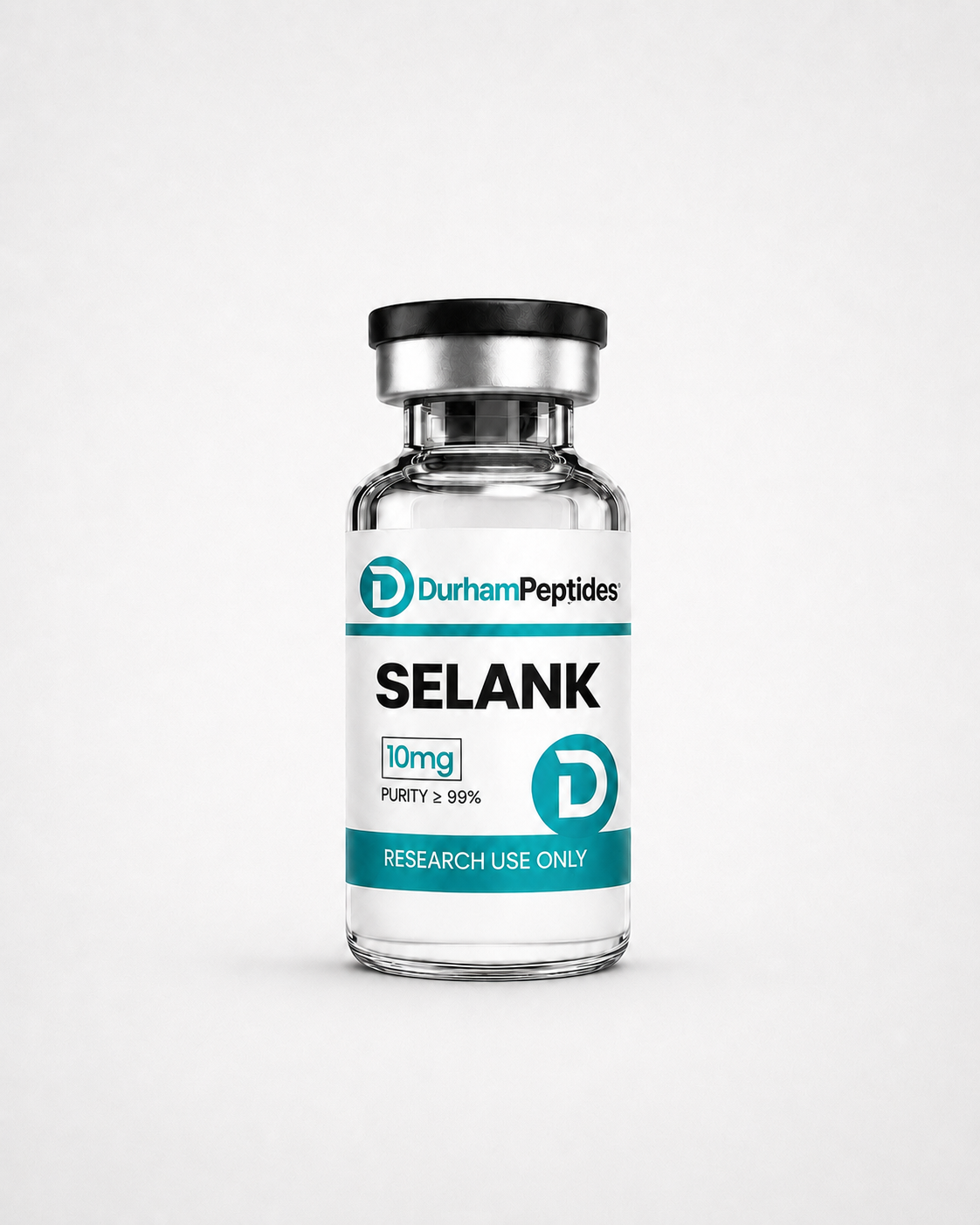
Selank tuftsin analog anxiolytic nootropic BDNF Russian research peptide Durham Peptides Canada
Selank is one of the more distinctive compounds in the broader nootropic research peptide category — a synthetic peptide derived from tuftsin, a naturally-occurring immunopeptide found in the body. Its research story sits at a genuinely unusual intersection: neuropeptide pharmacology, anxiolytic research, and immunopeptide biology, all in one short sequence. Like Semax, it was developed in Russia and has a research literature that's substantial but less well-known in Western contexts than its accumulated decades of work would suggest. This article walks through what Selank is, the mechanisms it's studied for, and how it fits the broader nootropic research landscape.
For Canadian researchers, Durham Peptides carries Selank 10mg. Nothing here is medical, dosing, or therapeutic guidance.
The Origin: A Synthetic Tuftsin Analog
Selank was developed at the Institute of Molecular Genetics of the Russian Academy of Sciences as a synthetic analog of tuftsin — a naturally-occurring four-amino-acid peptide (Thr-Lys-Pro-Arg) cleaved from the immunoglobulin G heavy chain. Tuftsin itself has been studied for immune-stimulating and neurological activities, but it has a notoriously short half-life — making it impractical as a research tool.
Selank addresses this by adding a stabilizing Pro-Gly-Pro extension to the tuftsin sequence, producing a heptapeptide that resists rapid enzymatic degradation. The result is a longer-acting research peptide that retains tuftsin-related biological properties but with the practical stability needed for laboratory research.
This origin places Selank in an unusual conceptual space — it's a "neuropeptide" by its research applications, but it descends from an immunopeptide by structure. That dual lineage is part of what makes its mechanism interesting.
The Molecular Basics
Durham Peptides' Selank 10mg:
- Sequence: Thr-Lys-Pro-Arg-Pro-Gly-Pro (tuftsin + Pro-Gly-Pro stabilizing extension)
- Class: Synthetic heptapeptide
- Type: Tuftsin analog; immunopeptide-derived neuropeptide
At seven amino acids, Selank is a small peptide — comparable in size to Semax (also a 7-amino-acid neuropeptide), but with completely different structural origin.
Research Area 1: Anxiolytic Effects in Animal Models
The most-developed area of Selank research is its investigated anxiolytic effect — anxiety reduction in animal behavioral models. Selank has been studied for its effects in:
- Elevated plus-maze and open-field tests (standard anxiety paradigms in rodent research)
- Conditioned fear paradigms
- Stress-response models
- Comparison with benzodiazepine reference compounds in similar models
The investigated mechanism is distinct from benzodiazepines — Selank doesn't appear to act primarily through GABA-A receptor potentiation in the way benzodiazepines do. Instead, its anxiolytic activity in animal research has been studied in connection with monoaminergic and neurotrophic pathways. This distinctness from the benzodiazepine mechanism is part of why Selank has remained a research compound of interest.
Research Area 2: BDNF and Neurotrophic Signaling
Selank's research extends into BDNF (brain-derived neurotrophic factor) signaling — overlapping with the Semaxliterature. BDNF is a key neurotrophin involved in neuronal survival, growth, and plasticity, and compounds that influence BDNF expression are of interest across cognitive, mood, and neuroprotection research.
Selank has been studied for investigated upregulation of BDNF expression in specific brain regions in animal models, contributing to interest in the compound for nootropic and neuroprotection-adjacent research applications.
Research Area 3: Cognitive and Nootropic Research
Building on the anxiolytic and BDNF threads, Selank has been studied in cognitive research models — including learning and memory paradigms in rodents. The research story here parallels Semax in some respects (both Russian-developed neuropeptides, both with cognitive-research literature) but differs in mechanism and emphasis. Selank's cognitive research has tended to emphasize stress-related cognitive function (cognition under anxiety-relevant conditions) rather than the broader nootropic profile Semax is more associated with.
Research Area 4: Immune-Related Effects
Reflecting its tuftsin origin, Selank has also been studied for immune-related effects — investigated activity on cytokine expression, immune cell function, and the broader question of immunoneuropeptide cross-talk. This thread is less prominent than the anxiolytic and BDNF literature, but it's the link back to Selank's immunopeptide lineage and one of the things that makes it distinctive from purely "neuropeptide" compounds.
What Researchers Examine
- Anxiolytic-like effects in rodent behavioral models (elevated plus-maze, open-field, conditioned fear)
- BDNF expression and neurotrophic signaling
- Monoaminergic neurotransmitter system interactions (serotonergic, dopaminergic)
- Stress-response modulation
- Immunopeptide-related cytokine and immune-cell research
- Comparative studies with benzodiazepines and with related neuropeptides (notably Semax)
Where Selank Fits the Nootropic Peptide Category
Selank sits in the small but distinct category of nootropic research peptides. Its relationship to the other compounds in this space:
- Selank — tuftsin-derived; anxiolytic and BDNF emphasis; immunopeptide lineage
- Semax — ACTH(4-10)-derived; broader nootropic/neuroprotection profile
- PT-141 — melanocortin-receptor-active; centrally-mediated effects in a different research domain (not stocked by Durham Peptides)
For the head-to-head with Semax — the most natural comparison — see Selank vs Semax. For the category overview, see Nootropic Peptides Research Overview.
Quality and Storage
Durham Peptides' Selank is supplied as a 10mg lyophilized peptide, Janoshik-verified to ≥99% purity by HPLC with mass-spec identity confirmation, 100% synthetically manufactured (vegan). Storage: 2–8°C short-term, -20°C long-term, protected from light and moisture; reconstitute in bacteriostatic water. See How to Read a Janoshik COA.
Frequently Asked Questions
What is Selank? A synthetic heptapeptide derived from tuftsin (an immunopeptide) with a stabilizing Pro-Gly-Pro extension, studied primarily for anxiolytic effects in animal models, BDNF signaling, and cognitive-related research.
What does Selank stand for? "Selank" is the research-name designation for the compound — TP-7 or N-acetyl-Thr-Lys-Pro-Arg-Pro-Gly-Pro in its full chemical naming. The stabilizing Pro-Gly-Pro extension on tuftsin produces the practical research compound.
What is Selank studied for? Primarily anxiolytic effects in animal behavioral models, BDNF expression and neurotrophic signaling, cognitive function under stress, and immune-related effects reflecting its immunopeptide origin.
How is Selank different from Semax? Selank is tuftsin-derived with anxiolytic emphasis; Semax is ACTH(4-10)-derived with broader nootropic emphasis. Different molecular origins, different primary research focus, though both have BDNF-related research threads. See Selank vs Semax.
Is Selank similar to benzodiazepines? Its anxiolytic effects are studied in similar behavioral paradigms, but the mechanism appears distinct — Selank doesn't act primarily through GABA-A receptor potentiation the way benzodiazepines do.
Where can I buy Selank in Canada? Durham Peptides supplies Selank 10mg for laboratory use only, Janoshik-verified.
Final Thoughts
Selank occupies an unusual corner of the research peptide field — a synthetic tuftsin analog with a research literature spanning anxiolytic effects, BDNF signaling, cognitive function, and immune biology. Its dual lineage (immunopeptide structure, neuropeptide applications) gives it a distinctive position alongside Semax in the small Russian-developed nootropic peptide category.
For the Semax comparison, see Selank vs Semax; for the broader category, see Nootropic Peptides Research Overview; for Semax specifically, see What Is Semax?. Browse the full catalog at durhampeptides.ca/category/all-products.
Selected Research References
- Kozlovskii II, Danchev ND. The Optimizing Effect of the Synthetic Peptide Selank on a Conditioned Active Avoidance Reflex in Rats. Neuroscience and Behavioral Physiology. 2003;33(7):639-643. https://pubmed.ncbi.nlm.nih.gov/14552538/
- Volkova A, Shadrina M, Kolomin T, et al. Selank Administration Affects the Expression of Some Genes Involved in GABAergic Neurotransmission. Frontiers in Pharmacology. 2016;7:31. https://pubmed.ncbi.nlm.nih.gov/26941640/
- Inozemtseva LS, Karpenko EA, Dolotov OV, et al. Intranasal Administration of the Peptide Selank Regulates BDNF Expression in the Rat Hippocampus In Vivo. Doklady Biological Sciences. 2008;421:241-243. https://pubmed.ncbi.nlm.nih.gov/18841804/
- Najjar VA, Nishioka K. Tuftsin: A Natural Phagocytosis Stimulating Peptide. Nature. 1970;228(5272):672-673. (Foundational reference on the parent peptide.)
All products sold by Durham Peptides are for research and laboratory use only. They are not intended for human or animal consumption, diagnosis, treatment, cure, or prevention of any disease.