

TB-500 thymosin beta-4 cardiac research cardiomyocyte heart repair post-infarction Durham Peptides Canada
TB-500's most-discussed research applications are tendon and ligament repair (the connective tissue thread), recovery research, and the Wolverine Stack combination with BPC-157. But there's a less-publicized research thread that's mechanistically distinct and clinically significant: cardiac research. The 2004 Nature paper by Bock-Marquette and colleagues established Thymosin Beta-4 (and by extension TB-500) in cardiac repair research, and the literature has continued developing across cardiomyocyte biology, post-infarction repair, and broader cardiac tissue research applications. This article focuses on that cardiac research angle specifically.
For the standalone TB-500 overview, see What Is TB-500?; for the tendon-research angle, see TB-500 for Tendon and Ligament Research; for the broader healing framework, see Healing & Recovery Peptides Explained. Nothing here is medical, dosing, or therapeutic guidance.
The Cardiac Research Context
Cardiac repair research has long-standing challenges that distinguish it from research in other tissue types:
- Limited regenerative capacity. Adult mammalian cardiomyocytes have very limited proliferative capacity. Unlike skin, gut lining, or even tendon, the heart largely cannot generate replacement cardiomyocytes after injury — making cardiac repair research mechanistically different from most tissue repair research.
- Post-infarction biology is well-characterized. Myocardial infarction (heart attack) is one of the most-studied tissue injury models in biology. The cellular cascade — ischemic injury, cell death, inflammatory response, scar formation, eventual remodeling — is well-defined.
- Cardiac scar properties matter mechanically. Unlike skin scars, cardiac scar tissue affects mechanical pump function. Scar that's too thin or too remodeled can fail mechanically; scar in the wrong locations can produce arrhythmias.
- Translational research is high-priority. Cardiovascular disease is a leading cause of mortality globally, making cardiac repair research a high-priority research domain.
This is the context in which the Thymosin Beta-4 cardiac research developed.
The Bock-Marquette 2004 Nature Paper
The 2004 paper by Bock-Marquette, Saxena, White, DiMaio, and Srivastava in Nature, titled "Thymosin beta4 activates integrin-linked kinase and promotes cardiac cell migration, survival and cardiac repair," is the foundational reference for Thymosin Beta-4 in cardiac research. Key findings:
Finding 1: Thymosin Beta-4 promotes cardiomyocyte migration. The researchers documented that Thymosin Beta-4 exposure promotes migration of cardiomyocytes and cardiac progenitor cells — extending the actin-regulation mechanism to cardiac cell biology.
Finding 2: Investigated cardiac progenitor cell effects. The paper examined effects on cardiac progenitor cells specifically — a population of interest in cardiac repair research because of their potential to contribute to repair in the absence of robust adult cardiomyocyte proliferation.
Finding 3: Integrin-linked kinase (ILK) activation. The paper provided mechanistic detail on the intracellular pathway — Thymosin Beta-4 activated integrin-linked kinase, which has downstream effects on cell survival signaling. This established a specific molecular mechanism for Thymosin Beta-4's cardiac effects.
Finding 4: Post-infarction cardiac repair improvements. In post-myocardial infarction animal models, Thymosin Beta-4 administration was associated with improved cardiac function recovery, reduced scarring, and improved survival — a striking combination of effects in a research domain where most interventions show limited efficacy.
This paper became a high-impact reference because it demonstrated meaningful cardiac repair effects in a tissue with very limited natural regenerative capacity, opening a research direction that has continued to develop.
Investigated Mechanisms in Cardiac Research
Several mechanisms have been examined in the published Thymosin Beta-4 cardiac research building on the Bock-Marquette foundation:
Mechanism 1: Cardiomyocyte and progenitor cell migration. The actin-regulation mechanism — Thymosin Beta-4's binding of G-actin and regulation of the cytoskeletal polymerization dynamics — applies to cardiac cells as it does to other cell types. Research has examined investigated effects on migration of cardiomyocytes, cardiac progenitor cells, and infiltrating immune cells in injury contexts.
Mechanism 2: Cardiomyocyte survival signaling. ILK activation has downstream effects on cell survival signaling pathways including Akt and other anti-apoptotic mechanisms. Research has examined investigated Thymosin Beta-4 effects on cardiomyocyte survival under ischemic and other stress conditions.
Mechanism 3: Cardiac angiogenesis. Cardiac repair requires new blood vessel formation in the injured area. While angiogenesis is more centrally associated with BPC-157 research, Thymosin Beta-4 has also been studied for investigated angiogenic effects in cardiac contexts, including effects on vascular endothelial cell migration.
Mechanism 4: Epicardium activation. The epicardium (outer layer of the heart) contains progenitor cell populations that can be activated in repair contexts. Research has examined investigated Thymosin Beta-4 effects on epicardial cell biology — a particularly active research thread in cardiac development and repair.
Mechanism 5: Inflammatory phase modulation. Post-infarction repair has an essential but tightly-regulated inflammatory phase. Research has examined investigated effects on inflammatory mediator expression in cardiac tissue, with implications for how inflammation resolves productively versus contributes to fibrosis.
Mechanism 6: Cardiac remodeling and scar properties. Some research has examined investigated effects on the mechanical properties of cardiac scar tissue and the broader cardiac remodeling that occurs in the weeks-to-months window after injury.
TB-500 vs Native Thymosin Beta-4: Cardiac Research Implications
A research-design point: most foundational Thymosin Beta-4 cardiac research used the full 44-amino-acid native peptide. TB-500 is a synthetic fragment that retains the actin-binding properties of the parent peptide. For cardiac research applications:
- TB-500's actin-binding properties are preserved from the parent, supporting the cell migration and cytoskeletal mechanisms central to the cardiac research thread
- The ILK activation mechanism is associated with regions of Thymosin Beta-4 that TB-500 contains, supporting the survival-signaling thread
- Some research questions may benefit from full-length Thymosin Beta-4 for direct replication of the foundational research
For most current research, TB-500 is the practical research tool that's commercially available and supports the established research mechanisms.
For the underlying actin biology and TB-500's mechanism foundation, see What Is TB-500?.
Cardiac Research vs Other TB-500 Research Threads
How cardiac research differs from tendon and recovery research with the same compound:
Property | Cardiac research | Tendon research | General recovery |
Tissue regenerative capacity | Very limited | Limited (better than cardiac) | Variable by tissue |
Primary research question | Repair quality and function recovery | Repair speed and structural quality | Repair speed |
Time horizons | Acute (hours-days) + chronic remodeling (months) | Weeks to months | Days to weeks typical |
Key endpoints | Cardiac function (ejection fraction), scar properties, survival | Tendon mechanical properties, collagen organization | Closure rate, tissue quality |
Research model complexity | High (whole-animal, often surgical injury models) | Moderate (transection or partial injury models) | Variable |
Cardiac research has design and operational complexity meaningfully greater than tendon or general recovery research, reflecting both the tissue's properties and the research stakes.
Combination Research: BPC-157 + TB-500 in Cardiac Contexts
The Wolverine Stack combination is most often discussed in tendon and general recovery contexts, but the same logic — BPC-157 angiogenesis + TB-500 cell migration — applies in cardiac research. Cardiac repair needs both new blood vessels (angiogenesis, addressing the vascular bottleneck) and cell mobilization (addressing cellular migration to the injury site). The combination has been examined in cardiac research, building on the established mechanisms for each component.
For the standalone Wolverine Stack overview, see The Wolverine Stack Explained; for the formulation logic, see The Wolverine Stack 1:1 Ratio.
Practical Research Considerations
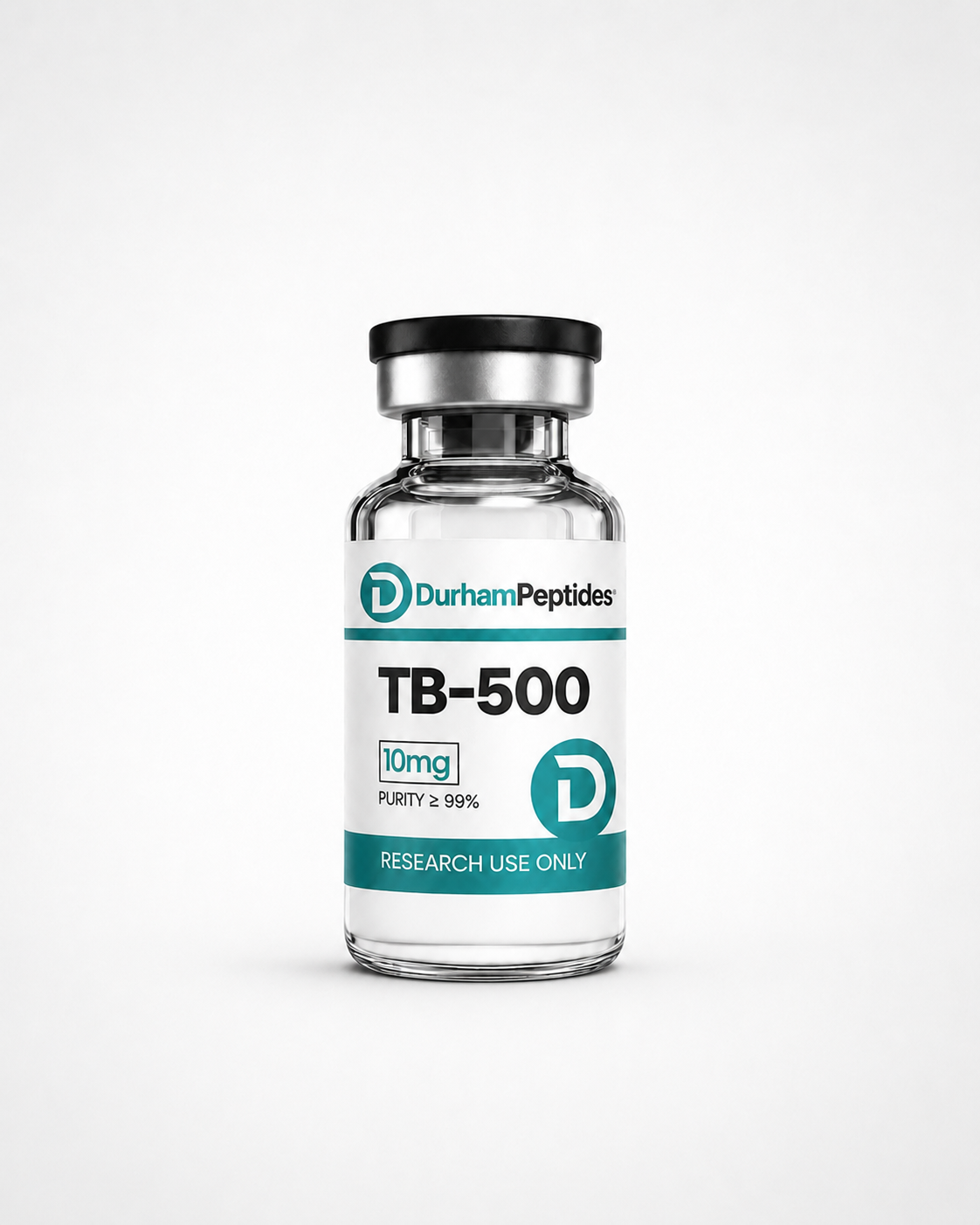
TB-500 10mg at Durham Peptides is C$79.69 (C$7.97/mg), Janoshik-verified to ≥99% purity by HPLC with mass-spec identity confirmation; 100% synthetic; vegan. Storage: 2–8°C short-term, -20°C long-term, protected from light and moisture; reconstitute in bacteriostatic water.
For cardiac research combining the angiogenesis and cell migration mechanisms, see the Wolverine Stack 10mg(C$79.99) or separate vials of BPC-157 and TB-500 for non-1:1 research designs.
Frequently Asked Questions
Is TB-500 actually studied in cardiac research? Yes — the foundational Bock-Marquette 2004 Nature paper established Thymosin Beta-4 (and TB-500 as the commercially-available fragment) in cardiac research, and the literature has continued developing across cardiomyocyte biology, post-infarction repair, and broader cardiac tissue research.
What did the Bock-Marquette 2004 paper establish? Three central findings: Thymosin Beta-4 promotes cardiac cell migration and survival, activates integrin-linked kinase (the specific intracellular mechanism), and improves post-infarction cardiac repair in animal models — making it one of the more striking interventions in a research domain where cardiac regeneration has been historically very limited.
How does cardiac research with TB-500 differ from tendon research? Cardiac tissue has very limited natural regenerative capacity (unlike tendon, which has limited but real regeneration), the research models are more complex (whole-animal surgical injury models are common), and the endpoints involve mechanical heart function and survival in addition to structural repair markers.
Does TB-500 actually regenerate damaged heart tissue? The published research has examined investigated effects on cardiac repair quality, function recovery, and reduced scarring — but cardiac regeneration in the strict sense (replacement of lost cardiomyocytes with new ones) remains an active and challenging research question. Effects on cardiac progenitor cells and resident cell populations are part of the research thread.
Should cardiac research use TB-500 alone or with BPC-157? Most published combination research uses Thymosin Beta-4 / TB-500 alone, but the mechanistic case for combining with BPC-157's angiogenesis mechanism applies in cardiac contexts where both new blood vessel formation and cell migration are needed for repair.
Where can I buy TB-500 in Canada? Durham Peptides supplies TB-500 10mg (C$79.69) standalone and in the Wolverine Stack (C$79.99), both Janoshik-verified.
Final Thoughts
TB-500's cardiac research thread, anchored in the 2004 Bock-Marquette Nature paper, occupies a distinctive position in the broader Thymosin Beta-4 research literature — a tissue research domain where the actin-regulation and cell migration mechanisms address specific bottlenecks (limited regenerative capacity, requirements for cell mobilization to injury sites, post-injury repair quality) that distinguish cardiac biology from most other tissue research. For researchers entering cardiac repair research from the peptide-research direction, the published TB-500 / Thymosin Beta-4 literature provides one of the more developed mechanistic foundations available.
For the standalone TB-500 overview, see What Is TB-500?; for the tendon-specific research, see TB-500 for Tendon and Ligament Research; for the combination logic with BPC-157, see The Wolverine Stack Explained.
Selected Research References
- Bock-Marquette I, Saxena A, White MD, DiMaio JM, Srivastava D. Thymosin Beta-4 Activates Integrin-Linked Kinase and Promotes Cardiac Cell Migration, Survival and Cardiac Repair. Nature. 2004;432(7016):466-472. https://pubmed.ncbi.nlm.nih.gov/15565145/
- Goldstein AL, Hannappel E, Kleinman HK. Thymosin Beta-4: Actin-Sequestering Protein Moonlights to Repair Injured Tissues. Trends in Molecular Medicine. 2005;11(9):421-429. https://pubmed.ncbi.nlm.nih.gov/16099219/
- Crockford D, Turjman N, Allan C, Angel J. Thymosin Beta-4: Structure, Function, and Biological Properties Supporting Current and Future Clinical Applications. Annals of the New York Academy of Sciences. 2010;1194:179-189. https://pubmed.ncbi.nlm.nih.gov/22074294/
- Smart N, Risebro CA, Melville AAD, et al. Thymosin Beta-4 Induces Adult Epicardial Progenitor Mobilization and Neovascularization. Nature. 2007;445(7124):177-182. (Reference on epicardial progenitor cell biology in cardiac repair.)
All products sold by Durham Peptides are for research and laboratory use only. They are not intended for human or animal consumption, diagnosis, treatment, cure, or prevention of any disease.