

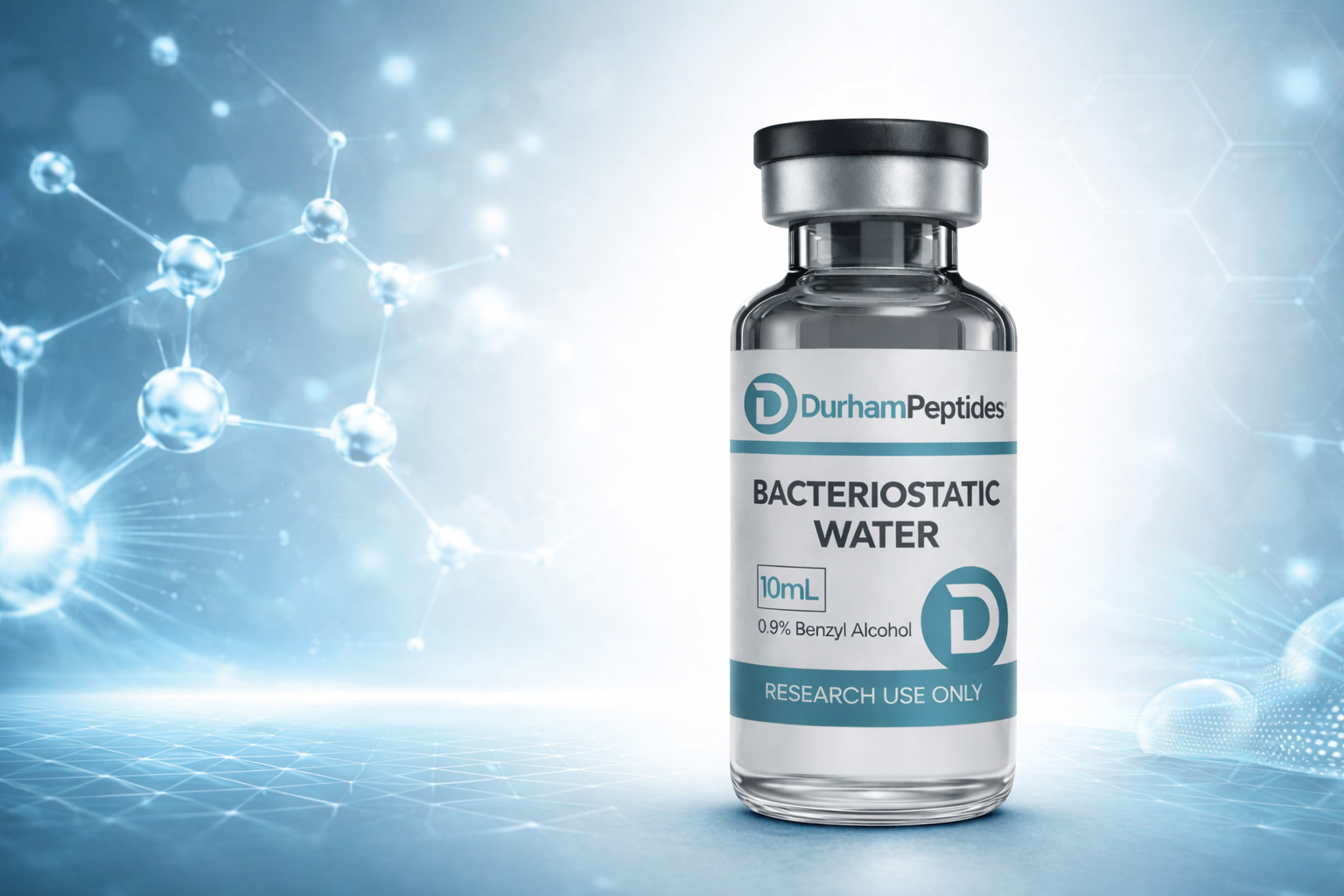
Bacteriostatic water vs sterile water vs acetic acid peptide diluent comparison Durham Peptides Canada
"What should I reconstitute this peptide with?" is one of the most common practical questions in peptide research, and the honest answer is: usually bacteriostatic water, but not always. There are three diluents researchers reach for — bacteriostatic water, plain sterile water, and dilute acetic acid — and each suits a different situation. Choosing the right one affects whether your vial can be used multiple times, whether a stubborn peptide actually dissolves, and how stable your solution stays.
This article compares the three. For the foundational explainer on the most common one, see What Is Bacteriostatic Water?. Nothing here is medical, dosing, or therapeutic guidance.
The Three Diluents at a Glance
Diluent | Contains | Best for | Vial use |
Bacteriostatic water | Sterile water + 0.9% benzyl alcohol | Most peptides, multi-use vials | Multi-use |
Sterile water | Nothing but purified, sterile water | Single-use protocols, benzyl-alcohol-sensitive work | Single-use |
Dilute acetic acid | Water + small % acetic acid | Hard-to-dissolve / hydrophobic peptides | Varies |
Bacteriostatic Water — the Default
Bacteriostatic water is the standard choice for the large majority of peptide reconstitutions. Its 0.9% benzyl alcohol inhibits bacterial growth, which makes multi-dose vials practical — you can draw from a reconstituted vial repeatedly across its stable window without the contamination risk that plain water carries. For any peptide used over days or weeks rather than all at once, bacteriostatic water is the right default. This covers nearly the entire Durham Peptides catalog under typical research protocols. Full detail in What Is Bacteriostatic Water?.
Sterile Water — the Single-Use Option
Plain sterile water is exactly what it sounds like: purified water, sterilized, with no preservative. Without benzyl alcohol it offers no ongoing protection against microbial growth once a vial is opened, so a solution reconstituted with sterile water is intended for single use — reconstitute, use, discard.
When would a researcher choose it over bacteriostatic water? Two main cases: (1) a protocol that uses the entire reconstituted amount in one session, where multi-use protection is irrelevant, and (2) work where the benzyl-alcohol preservative could interfere with the specific research readout or where a preservative-free solution is required by the protocol. Outside those situations, bacteriostatic water's multi-use advantage usually makes it the better pick.
Dilute Acetic Acid — for Stubborn Peptides
Some peptides simply don't dissolve well in neutral water. Hydrophobic peptides, peptides that aggregate, or those with sequences prone to poor aqueous solubility can resist reconstitution in bacteriostatic or sterile water. For these, a dilute acetic acid solution (a small percentage of acetic acid in water) lowers the pH and can help bring an otherwise-stubborn peptide into solution.
This is a less common need — most research peptides dissolve fine in bacteriostatic water — but it's the standard fallback when a peptide won't cooperate. Acetic acid reconstitution is more of a specialist tool than a default; if a peptide dissolves readily in bacteriostatic water, there's no reason to reach for it. When solubility is a known issue for a particular sequence, the product documentation or a solubility reference will usually flag it.
How to Decide
The decision tree is simple:
- Will you use the vial multiple times over a research window? → Bacteriostatic water (the usual answer).
- Will you use the entire reconstituted amount in one session, or does your protocol require preservative-free?→ Sterile water.
- Does the peptide refuse to dissolve in water? → Try dilute acetic acid.
For the overwhelming majority of protocols, the answer is bacteriostatic water — which is why it's what Durham Peptides stocks as the companion to its peptide catalog.
Diluent Volume and Concentration
Whichever diluent you choose, the volume you add sets the final concentration (concentration = peptide mass ÷ diluent volume). This is independent of which diluent you use — switching from bacteriostatic to sterile water doesn't change the math, only the multi-use property. Use the peptide calculator to determine volume for your target concentration, and see Peptide Vial Sizes Explained for how vial size factors in.
Frequently Asked Questions
What's the difference between bacteriostatic water and sterile water? Bacteriostatic water contains 0.9% benzyl alcohol, which inhibits bacterial growth and allows multi-use vials; sterile water has no preservative and is intended for single use.
Can I use sterile water instead of bacteriostatic water? Yes, for single-use protocols or when a preservative-free solution is needed — but you lose the multi-use protection, so the reconstituted solution should be used promptly rather than stored and re-accessed.
When do I need acetic acid to reconstitute a peptide? Only when a peptide won't dissolve adequately in water — typically hydrophobic or aggregation-prone sequences. Most peptides dissolve fine in bacteriostatic water.
Which diluent does Durham Peptides recommend? Bacteriostatic water for the large majority of protocols — it's the field standard and what Durham stocks. See Bacteriostatic Water 10mL.
Does the diluent change the concentration math? No. Concentration depends on peptide mass and the volume of diluent added, not on which diluent you choose.
Is benzyl alcohol a problem for peptides? For most research peptides, no — bacteriostatic water is well tolerated. The exceptions are specific protocols where a preservative-free solution is required, in which case sterile water is used.
Final Thoughts
Three diluents, three jobs: bacteriostatic water for the everyday multi-use majority, sterile water for single-use or preservative-free protocols, and dilute acetic acid for the occasional stubborn peptide that won't dissolve otherwise. For nearly all research, bacteriostatic water is the right default — practical, gentle, and built for the multi-dose vials peptide research relies on.
For the deep dive on the default, see What Is Bacteriostatic Water?; for the reconstitution protocol, see How to Reconstitute Peptides. Stock Bacteriostatic Water 10mL with your next order.
Selected Research References
- United States Pharmacopeia. Bacteriostatic Water for Injection, USP Monograph and Sterile Water for Injection, USP Monograph. Diluent specifications.
- Meyer BK, Ni A, Hu B, Shi L. Antimicrobial Preservative Use in Parenteral Products: Past and Present. Journal of Pharmaceutical Sciences. 2007;96(12):3155-3167. https://pubmed.ncbi.nlm.nih.gov/17722087/
- JPT Peptide Technologies. Peptide Reconstitution and Handling Guidelines. Standard guidance on diluent selection and solubility, including acidic diluents for poorly soluble peptides.
All products sold by Durham Peptides are for research and laboratory use only. They are not intended for human or animal consumption, diagnosis, treatment, cure, or prevention of any disease.