

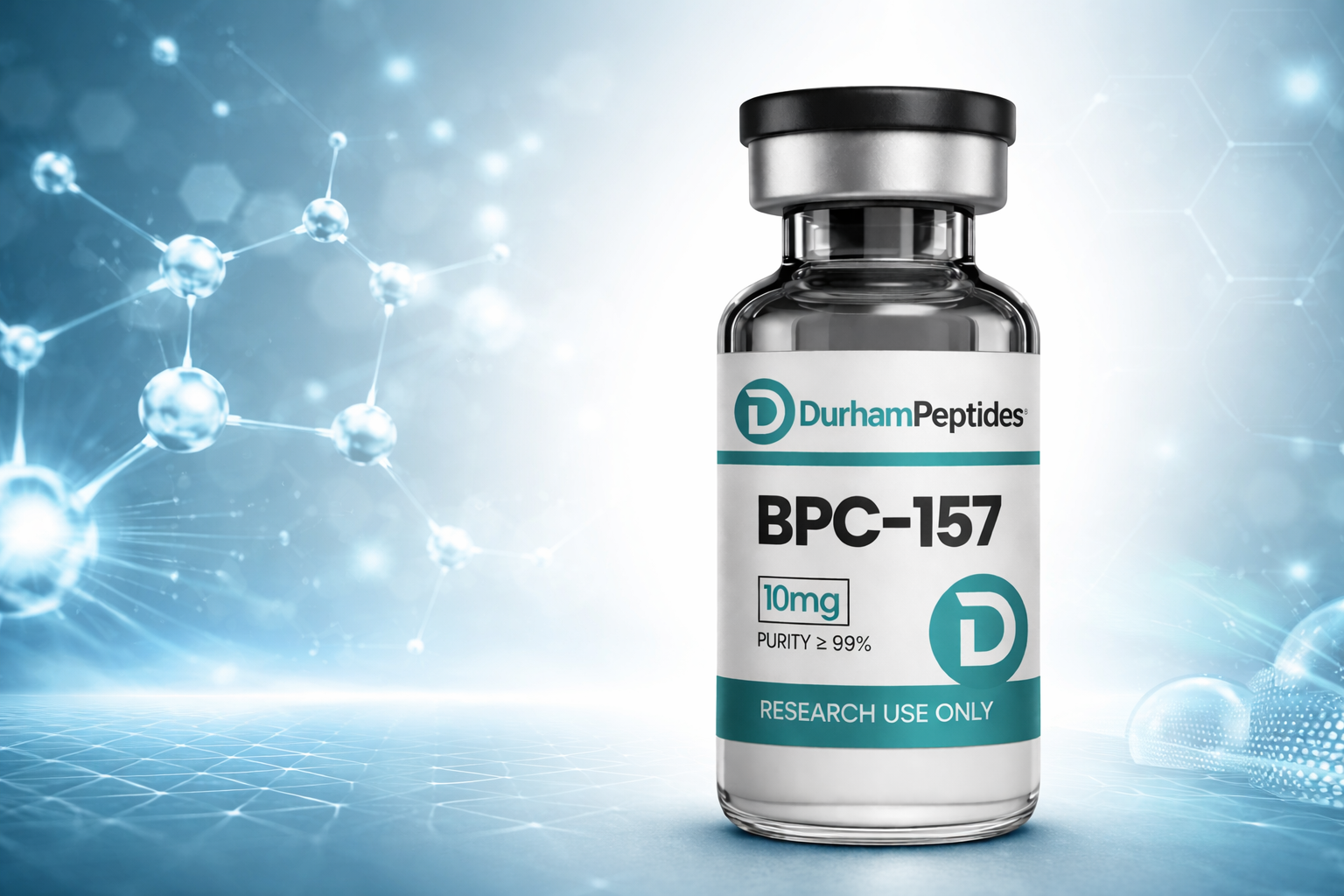
Does BPC-157 expire shelf life reference Durham Peptides Canada
Yes — BPC-157 expires. Like all research peptides, BPC-157 has finite stability that depends heavily on its form (lyophilized vs reconstituted) and storage conditions.
Understanding the actual shelf life ranges helps Canadian researchers plan ordering, storage, and protocol timelines around the practical realities of peptide stability.
This article provides a complete shelf life reference for BPC-157 — how long it lasts lyophilized, how long it lasts reconstituted, what affects stability, and how to know when a vial has reached the end of its practical research life.
For storage temperature specifics, see BPC-157 Storage Temperature Guide: How to Store BPC-157 in the Fridge, Freezer, and Beyond. For broader peptide storage context, see Peptide Storage & Shelf Life: How to Store BPC-157 and Other Research Peptides.
The Quick Answer
Lyophilized BPC-157 (freeze-dried powder, unopened):
- Refrigerated (2-8°C): approximately 12-18 months practical shelf life
- Frozen (-20°C): 24+ months practical shelf life
Reconstituted BPC-157 (after adding bacteriostatic water):
- Refrigerated only (2-8°C): approximately 28 days practical shelf life
These are the standard ranges across the research peptide field, supported by published stability research on lyophilized peptide pharmaceuticals.
Why Lyophilized Form Lasts So Much Longer
The dramatic shelf life difference — 12-18 months lyophilized vs 28 days reconstituted — reflects the chemistry of lyophilization:
Lyophilization removes water. The freeze-drying process removes essentially all water from the peptide. Without water, hydrolysis (the water-driven breakdown of peptide bonds) essentially stops. The peptide can sit stable in the lyophilized form for months to years.
Reconstitution restores water. Adding bacteriostatic water restores the chemical environment where hydrolysis can occur. The peptide is now in solution and subject to all the degradation pathways that water enables.
This is exactly why peptides are sold lyophilized rather than as ready-to-use solutions — the freeze-dried form has dramatically longer shelf life for shipping, storage, and inventory management.
For complete coverage of why lyophilization matters, see Peptide Manufacturing 101: How Research Peptides Are Made From Amino Acids to Vial.
The 12-18 Month Lyophilized Range
For refrigerated lyophilized BPC-157, the practical shelf life is 12-18 months. The variation in this range depends on:
Specific manufacturing. Lyophilization quality, residual moisture levels, and packaging variations can affect stability.
Storage temperature consistency. Refrigerators that maintain steady 2-8°C support longer shelf life than refrigerators with temperature swings.
Light exposure. Some peptides have light-sensitive stability. Standard amber or opaque vials reduce this concern but don't eliminate it entirely.
Manufacturer-stated expiration. Each batch has a specific expiration date that should be respected — typically aligned with the 12-18 month range from manufacturing date.
The published research peptide stability data supports the 12-18 month range as practical for refrigerated lyophilized storage.
The 24+ Month Frozen Range
Frozen storage (-20°C standard) extends the lyophilized shelf life substantially. The 24+ months frozen storage applies to:
- Long-term inventory storage
- Vials that won't be used within the 12-18 month refrigerated window
- Storage of larger orders intended for extended research timelines
Note that "24+ months" is conservative — well-stored lyophilized peptides have demonstrated longer stability in frozen storage in some research contexts. For practical research peptide work, 24+ months is the working reference.
The 28-Day Reconstituted Window
After reconstitution with bacteriostatic water, the practical shelf life shortens to approximately 28 days under refrigeration. This window reflects:
Bacteriostatic preservative effectiveness. The 0.9% benzyl alcohol in bacteriostatic water maintains effectiveness for approximately 28 days post-opening. See How Long Does Bacteriostatic Water Last After Opening?.
Peptide stability in solution. Even with the preservative, the peptide itself degrades faster in solution than in lyophilized form.
Practical research use. The 28-day window aligns conveniently with typical research session frequency, making it a practical working window for most research protocols.
Beyond 28 days, the combination of decreasing preservative effectiveness and increasing peptide degradation makes the vial unreliable for research-grade work.
What Affects Shelf Life
Several factors can shorten the practical shelf life:
Temperature excursions. Sustained exposure outside the recommended ranges accelerates degradation. Brief excursions (research sessions, shipping) are acceptable; extended excursions are not.
Freeze-thaw cycles of reconstituted vials. Never freeze reconstituted BPC-157. Even single freeze-thaw cycles can damage peptides in solution.
Light exposure. Some peptides are light-sensitive. Standard vial materials provide protection, but extended light exposure (sitting on a sunny windowsill, for example) is not recommended.
Contamination during access. Each access introduces brief environmental exposure. Sterile technique (clean injection site on vial septum, fresh sterile syringe) minimizes contamination introduction.
Multiple freeze-thaw of lyophilized vials. Each cycle has minimal impact on lyophilized vials, but cumulative cycles can affect stability. Minimize unnecessary freezer-to-refrigerator transitions.
For complete coverage of common storage mistakes, see Common Peptide Research Mistakes: 12 Errors to Avoid in Canadian Research Protocols.
How to Know if BPC-157 Has Expired
Several signs indicate BPC-157 may be past usable shelf life:
Manufacturer expiration date passed. If the printed expiration date has passed, treat the vial as expired regardless of how it looks.
Time past expected shelf life. Lyophilized vials past 18 months refrigerated (or 24+ months frozen), or reconstituted vials past 28 days.
Visual changes. Discoloration of lyophilized powder (yellowing or browning), cloudiness in reconstituted solution, visible precipitate, or particles floating in solution.
Loss of activity in research observations. Reduced effectiveness in research models compared to previous batches at the same dose — though this can have many causes besides expiration.
When in doubt, discard. The cost of replacement is small compared to the cost of contaminated or degraded peptide affecting research outcomes.
What Happens to Expired BPC-157?
Past the practical shelf life, BPC-157 doesn't suddenly become non-functional — degradation is gradual rather than a cliff. But several things happen progressively:
Reduced potency. The active peptide breaks down into smaller fragments that may have reduced or no biological activity in research models.
Increased impurities. Degradation products accumulate. The sample is no longer ≥99% pure BPC-157 — it's BPC-157 plus an increasing amount of degradation products.
Potential biological effects from degradation products. Some peptide fragments may have their own effects that confound research interpretation.
Reduced reliability. Research consistency across sessions degrades because the actual amount of active BPC-157 per draw becomes variable.
For rigorous research, using BPC-157 past the practical shelf life introduces uncertainty that's difficult to interpret. Fresh material is the conservative practice.
Practical Order Planning
The shelf life characteristics affect ordering strategy:
Active research with regular use. Order quantities you'll use within 12-18 months. Refrigerated lyophilized storage is sufficient. Reconstitute as needed for active research sessions.
Longer-term research timelines. Consider frozen storage for portions of the order that won't be used within 12-18 months. The 24+ month frozen shelf life supports extended planning.
First-time orders. Smaller initial orders to evaluate the supplier and the compound before committing to larger quantities. Returns and replacements are easier with smaller orders.
Inventory management. Document order dates, batch numbers, and reconstitution dates. The documentation framework supports proper FIFO (first-in, first-out) usage. See How to Build a Peptide Research Protocol: Documentation, Tracking, and Reproducibility.
Frequently Asked Questions
Does BPC-157 expire? Yes. Lyophilized BPC-157 lasts approximately 12-18 months refrigerated (or 24+ months frozen). Reconstituted BPC-157 lasts approximately 28 days refrigerated.
How long does BPC-157 last in the fridge? Lyophilized form: approximately 12-18 months. Reconstituted form: approximately 28 days.
How long does BPC-157 last in the freezer? Lyophilized form: 24+ months. Reconstituted form: never freeze.
What's the shelf life of BPC-157 after reconstitution? Approximately 28 days under refrigeration. Beyond that window, both the bacteriostatic preservative effectiveness and the peptide stability decrease enough to compromise research-grade quality.
How long does BPC-157 powder last? Approximately 12-18 months refrigerated, or 24+ months frozen. The lyophilized powder form has dramatically longer shelf life than the reconstituted solution.
Can I use BPC-157 past its expiration date? Not recommended. The conservative practice is to discard expired vials. The combination of reduced potency, increased impurities, and reduced research reliability makes expired material a poor choice for rigorous research.
Does BPC-157 lose potency over time? Yes, gradually. The degradation is gradual rather than sudden, but cumulative degradation makes older material less reliable than fresh material.
What if I forgot when I reconstituted my BPC-157 vial? Discard. Without knowing the reconstitution date, the 28-day window is unknowable. Going forward, label every reconstituted vial directly with the reconstitution date.
Can I check if my BPC-157 is still good? Visual inspection (clear solution, no cloudiness or precipitate) is the practical check. Lab testing would be required for definitive verification, which is impractical for individual research vials.
Does BPC-157 require a specific storage temperature? Yes. Lyophilized: refrigerated (2-8°C) for standard storage, or frozen (-20°C) for long-term. Reconstituted: refrigerated only.
Why does reconstituted BPC-157 expire so much faster? Water enables degradation processes (hydrolysis especially) that the freeze-dried form prevents. Adding water restarts the degradation clock.
How do I know when my lyophilized BPC-157 vial expires? Check the manufacturer expiration date printed on the vial or COA. The practical 12-18 month range applies from the manufacturing date, not from when you received the vial.
Final Thoughts
BPC-157 does expire, and the shelf life ranges reflect real peptide chemistry rather than arbitrary regulatory dates. Lyophilized form lasts 12-18 months refrigerated (24+ months frozen); reconstituted form lasts 28 days refrigerated. Understanding these ranges helps Canadian researchers plan orders, storage, and protocols around the practical realities of peptide stability.
For Canadian researchers, the practical takeaways:
- Lyophilized BPC-157: 12-18 months refrigerated, 24+ months frozen
- Reconstituted BPC-157: 28 days refrigerated only
- The 28-day reconstituted window matches the bacteriostatic water effective window
- Date every reconstituted vial so the 28-day window is trackable
- Discard expired material rather than risk research interpretation problems
For continued reading, see BPC-157 Storage Temperature Guide, BPC-157 Shelf Life and Expiration FAQ, What Is BPC-157?, Bacteriostatic Water Shelf Life After Opening, and Peptide Storage & Shelf Life.
Browse the complete Durham Peptides catalog at durhampeptides.ca/category/all-products. View all Janoshik-verified COAs at durhampeptides.ca/lab-results. Buy BPC-157 10mg with Canadian-domestic shipping and Janoshik-verified quality.
Selected References
- Sikiric P, Seiwerth S, Rucman R, et al. Stable Gastric Pentadecapeptide BPC 157: Novel Therapy in Gastrointestinal Tract. Current Pharmaceutical Design. 2011;17(16):1612-1632. https://pubmed.ncbi.nlm.nih.gov/21548867/
- Manning MC, Chou DK, Murphy BM, Payne RW, Katayama DS. Stability of Protein Pharmaceuticals: An Update. Pharmaceutical Research. 2010;27(4):544-575. https://pubmed.ncbi.nlm.nih.gov/20143256/
- Wang W. Lyophilization and Development of Solid Protein Pharmaceuticals. International Journal of Pharmaceutics. 2000;203(1-2):1-60. https://pubmed.ncbi.nlm.nih.gov/10967427/
- International Council for Harmonisation. ICH Q1A(R2): Stability Testing of New Drug Substances and Products. Standards on pharmaceutical stability testing.
- Pikal MJ, Rigsbee DR. The Stability of Insulin in Crystalline and Amorphous Solids. Pharmaceutical Research. 1997;14(10):1379-1387. Reference on peptide/protein stability in lyophilized form.
- United States Pharmacopeia. USP General Chapter <797>: Pharmaceutical Compounding — Sterile Preparations. Standards on sterile handling and shelf life.
All products sold by Durham Peptides are for research and laboratory use only. They are not intended for human or animal consumption, diagnosis, treatment, cure, or prevention of any disease. This article is informational and does not constitute medical advice