

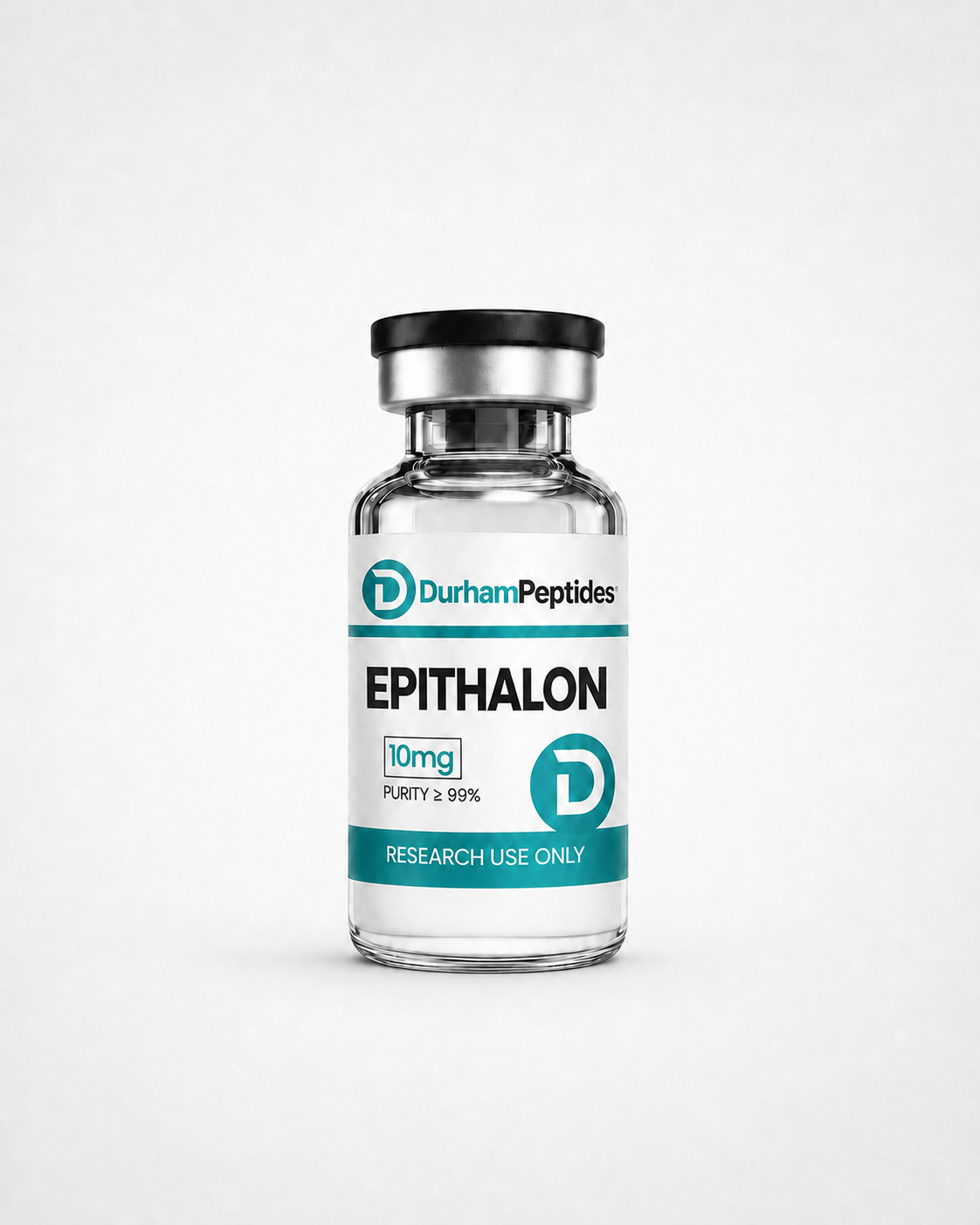
Epithalon melatonin pineal gland circadian rhythm research peptide Khavinson Durham Peptides Canada
Epithalon's research literature is most associated with telomerase activation — the molecular mechanism that occupies the bulk of current Western-language Epithalon research. But there's an older and arguably more biologically fundamental Epithalon research thread that often gets overlooked: the pineal origin and melatonin connection. Epithalon was originally identified from pineal gland extract, the pineal gland is the body's primary melatonin source, and the Khavinson research group documented investigated Epithalon effects on melatonin secretion and circadian rhythm biology in addition to the telomerase work. This article focuses on that pineal-melatonin research thread.
For the standalone Epithalon overview, see What Is Epithalon?; for the telomerase mechanism deep-dive, see Epithalon and Telomerase; for the broader longevity peptide landscape, see The Best Longevity Peptides for Research in Canada. Nothing here is medical, dosing, or therapeutic guidance.
The Pineal Origin: Where Epithalon Comes From
Epithalon (also spelled Epitalon) was developed at the Russian Academy of Sciences by Vladimir Khavinson's research group. The compound was identified through research into epithalamin — a complex of bioactive substances isolated from pineal gland extract. The pineal gland was studied because of its well-documented role in aging biology: pineal function declines progressively with age, and pineal hormones (primarily melatonin, but also other bioactive peptides) have effects on circadian rhythm, immune function, and a range of other systems that decline with aging.
Through painstaking biochemical work, the Khavinson group traced the bioactivity in epithalamin to a small tetrapeptide that they characterized and synthesized as Epithalon — Ala-Glu-Asp-Gly. The synthetic compound was designed to capture the bioactive portion of pineal extract in a defined, reproducible form.
This origin story is important because it explains the bidirectional research interest:
- From the pineal angle: Epithalon was developed because the pineal gland matters for aging biology. The melatonin and circadian connections weren't incidental — they were part of why pineal research was being pursued in the first place.
- From the telomerase angle: The telomerase activation findings emerged from broader investigation of Epithalon's mechanism, becoming the dominant research thread in Western publications.
Both threads are part of Epithalon's actual research story.
Melatonin: The Pineal's Primary Hormone
Before getting into Epithalon-melatonin specifically, the melatonin background:
Melatonin is produced primarily by the pineal gland. Synthesis follows a circadian rhythm — high at night, low during the day — driven by signals from the suprachiasmatic nucleus (the body's master circadian clock) via complex neural pathways.
Melatonin functions extend well beyond sleep. While melatonin is best known for sleep-related effects, its biological roles span:
- Circadian rhythm regulation across multiple physiological systems
- Antioxidant activity (melatonin is one of the body's natural antioxidants)
- Immune function modulation
- Mitochondrial function effects
- Direct cellular effects through specific melatonin receptors plus receptor-independent actions
Melatonin declines with age. Pineal function progressively decreases with aging, with melatonin secretion declining substantially in elderly populations versus young populations. This decline has been studied as one of the components of age-related decline more broadly.
This melatonin biology is the context for Epithalon's pineal-melatonin research thread.
Investigated Epithalon Effects on Melatonin
The Khavinson-group research has documented several investigated Epithalon effects on melatonin biology:
Investigated effect 1: Restored melatonin secretion patterns in aged subjects. Research has examined investigated Epithalon effects on melatonin secretion in elderly populations and aged animal models, with reports of restoration toward younger-pattern melatonin secretion profiles. This is one of the more striking findings in the Russian-language Epithalon research literature.
Investigated effect 2: Circadian rhythm normalization. Beyond melatonin levels themselves, research has examined investigated Epithalon effects on broader circadian rhythm markers — including the timing and amplitude of circadian variations in physiological parameters that typically become dysregulated with aging.
Investigated effect 3: Pineal gland function preservation. Some research has examined investigated Epithalon effects on pineal gland tissue itself — including effects on pineal cell biology and the structural properties of the gland that change with aging.
Investigated effect 4: Sleep-related research endpoints. Given melatonin's well-documented role in sleep biology, research has examined investigated Epithalon effects on sleep-related endpoints in research models, with reports relevant to age-related sleep changes.
Investigated effect 5: Antioxidant and oxidative stress effects. Some of melatonin's effects are mediated by its antioxidant properties. Research has examined whether Epithalon's effects on oxidative stress markers in aging contexts reflect melatonin-mediated mechanisms or operate through other pathways.
The Important Mechanistic Question
A research-design point worth being honest about: it's not always clear from the published literature whether Epithalon's investigated effects on melatonin reflect:
Possibility 1: Epithalon directly stimulating pineal melatonin production, with the various downstream effects flowing from elevated melatonin
Possibility 2: Epithalon producing melatonin-like effects through different mechanisms (potentially independent of actual pineal output), with the melatonin-related findings being correlative rather than causal
Possibility 3: A bidirectional relationship where Epithalon affects multiple aspects of pineal function including but not limited to melatonin
The published research base supports investigated effects on multiple pineal-related endpoints, but the relative weighting of these mechanisms continues to be characterized. For researchers entering this thread, this mechanistic ambiguity is something to be aware of in research design.
Pineal-Melatonin Research vs Telomerase Research with Epithalon
How the two main Epithalon research threads differ in design and focus:
Property | Pineal-melatonin research | Telomerase research |
Primary endpoints | Melatonin levels, circadian markers, sleep endpoints | Telomerase activity, telomere length, hTERT expression |
Research models | In vivo (humans, animals), with circadian/sleep measurement | Cell culture (telomerase activity), in vivo (longer-term aging studies) |
Time horizons | Hours to weeks (circadian patterns) | Weeks to months (telomere effects) |
Translation context | Sleep biology, age-related circadian dysfunction | Cellular aging biology, telomere biology |
Russian-language emphasis | Substantial | Substantial |
Western-language emphasis | Smaller | Larger (current dominant thread) |
Researchers can design protocols engaging either thread depending on the research question. Some protocols engage both — examining how Epithalon's pineal and telomerase effects interact in aging biology research.
For the telomerase mechanism deep-dive, see Epithalon and Telomerase.
Where Epithalon Sits in the Broader Circadian Research Landscape
Circadian rhythm research uses a variety of compounds and approaches:
Compound or approach | Mechanism |
Melatonin (direct) | Direct receptor activation; replacement-style approach |
Melatonin receptor agonists (e.g., ramelteon, agomelatine) | Selective melatonin receptor activation |
Bright light therapy | Suprachiasmatic nucleus stimulation via retina |
Epithalon | Pineal-mediated approach; investigated stimulation of endogenous melatonin |
Other circadian-active compounds | Various indirect mechanisms |
Epithalon's distinctive position is being a pineal-targeted research approach rather than a direct melatonin-replacement approach. Whether this distinction has practical research implications depends on the specific research question and how endogenous-vs-exogenous melatonin biology is framed in the protocol.
The Aging-Research Bridge
The pineal-melatonin and telomerase Epithalon research threads converge in aging research broadly. Both address aspects of aging biology:
- Pineal decline is part of age-related endocrine decline
- Telomere attrition is one of the recognized hallmarks of aging
- Circadian rhythm dysregulation is documented in aging and connects to broader metabolic and cellular biology
- Melatonin decline parallels other age-related hormonal declines
Aging research designs that examine multiple hallmarks simultaneously may benefit from Epithalon's multi-thread research base — engaging both the telomere/cellular biology dimension and the pineal/circadian/melatonin dimension through a single compound.
For the broader longevity research context, see The Best Longevity Peptides for Research in Canada; for the alternative longevity research mechanisms, see MOTS-c vs Epithalon.
Practical Research Considerations
Epithalon 10mg at Durham Peptides is C$65.99 (C$6.60/mg), Janoshik-verified to ≥99%
purity by HPLC with mass-spec identity confirmation; 100% synthetic; vegan. Storage: 2–8°C short-term, -20°C long-term, protected from light and moisture; reconstitute in bacteriostatic water.
For research bridging the pineal-melatonin and telomerase Epithalon research threads, no other research compound provides the same pineal-mediated approach. Researchers studying broader aging biology may combine Epithalon with longevity research compounds engaging other hallmarks — NAD+ for the NAD+/sirtuin angle, MOTS-c for the mitochondrial-AMPK angle.
Frequently Asked Questions
Why is Epithalon connected to melatonin research? Because Epithalon was originally identified from pineal gland extract, and the pineal gland is the body's primary melatonin source. The Khavinson-group research that developed Epithalon examined effects on melatonin biology alongside the telomerase findings.
Does Epithalon directly stimulate melatonin production? Published research has examined investigated effects on melatonin secretion patterns and circadian biology, but the precise mechanism — direct pineal stimulation vs indirect effects — is still being characterized in the literature.
How does the melatonin research thread differ from the telomerase research thread? Pineal-melatonin research examines circadian rhythm, sleep biology, and pineal function endpoints over hours-to-weeks time horizons. Telomerase research examines telomerase activity, telomere length, and cellular aging biology over weeks-to-months horizons. Two different research threads engaging different aging biology dimensions.
Is the Epithalon-melatonin research mostly in Russian-language publications? A substantial portion of the foundational research is in Russian-language publications, reflecting the Russian Academy of Sciences research origin. Western-language publications have focused more on the telomerase angle, though the pineal-melatonin research has growing international interest.
Can Epithalon be combined with other longevity research compounds? Many research designs combine Epithalon (pineal/telomere axis) with other longevity compounds engaging different aging hallmarks — NAD+ for the NAD+/sirtuin angle, MOTS-c for mitochondrial biology. The multi-mechanism approach to aging research benefits from compounds engaging different hallmarks.
Where can I buy Epithalon in Canada? Durham Peptides supplies Epithalon 10mg (C$65.99), Janoshik-verified, for laboratory use only.
Final Thoughts
Epithalon's pineal-melatonin research thread is the older and more biologically fundamental of the two main Epithalon research threads — anchored in the compound's actual origin from pineal extract and the broader pineal/circadian/melatonin biology that motivated Khavinson's research program in the first place. While Western-language publications have emphasized the telomerase mechanism, the pineal-melatonin angle is a distinct research thread with its own published literature and design considerations. For research designed around circadian rhythm, age-related pineal decline, or melatonin biology specifically, Epithalon provides a research tool with a genuinely distinctive mechanistic position — the only research compound with this specific pineal-mediated approach to circadian biology.
For the standalone overview, see What Is Epithalon?; for the telomerase mechanism deep-dive, see Epithalon and Telomerase; for the comparison to MOTS-c's mitochondrial approach, see MOTS-c vs Epithalon; for the broader longevity research landscape, see The Best Longevity Peptides for Research in Canada.
Selected Research References
- Khavinson VK, Bondarev IE, Butyugov AA. Epithalon Peptide Induces Telomerase Activity and Telomere Elongation in Human Somatic Cells. Bulletin of Experimental Biology and Medicine. 2003;135(6):590-592. https://pubmed.ncbi.nlm.nih.gov/14523499/
- Anisimov VN, Khavinson VK. Peptide Bioregulation of Aging: Results and Prospects. Biogerontology. 2010;11(2):139-149. https://pubmed.ncbi.nlm.nih.gov/19690988/
- Korkushko OV, Khavinson VK, Shatilo VB, Antonyk-Sheglova IA. Peptide Geroprotector Epithalamin and Its Synthetic Analog Epithalon Restore the Pineal Gland Function in Aged People. Bulletin of Experimental Biology and Medicine. (Reference on pineal function restoration research.)
- Reiter RJ, Tan DX, Galano A. Melatonin: Exceeding Expectations. Physiology. 2014;29(5):325-333. (Reference on broader melatonin biology beyond sleep.)
All products sold by Durham Peptides are for research and laboratory use only. They are not intended for human or animal consumption, diagnosis, treatment, cure, or prevention of any disease.