

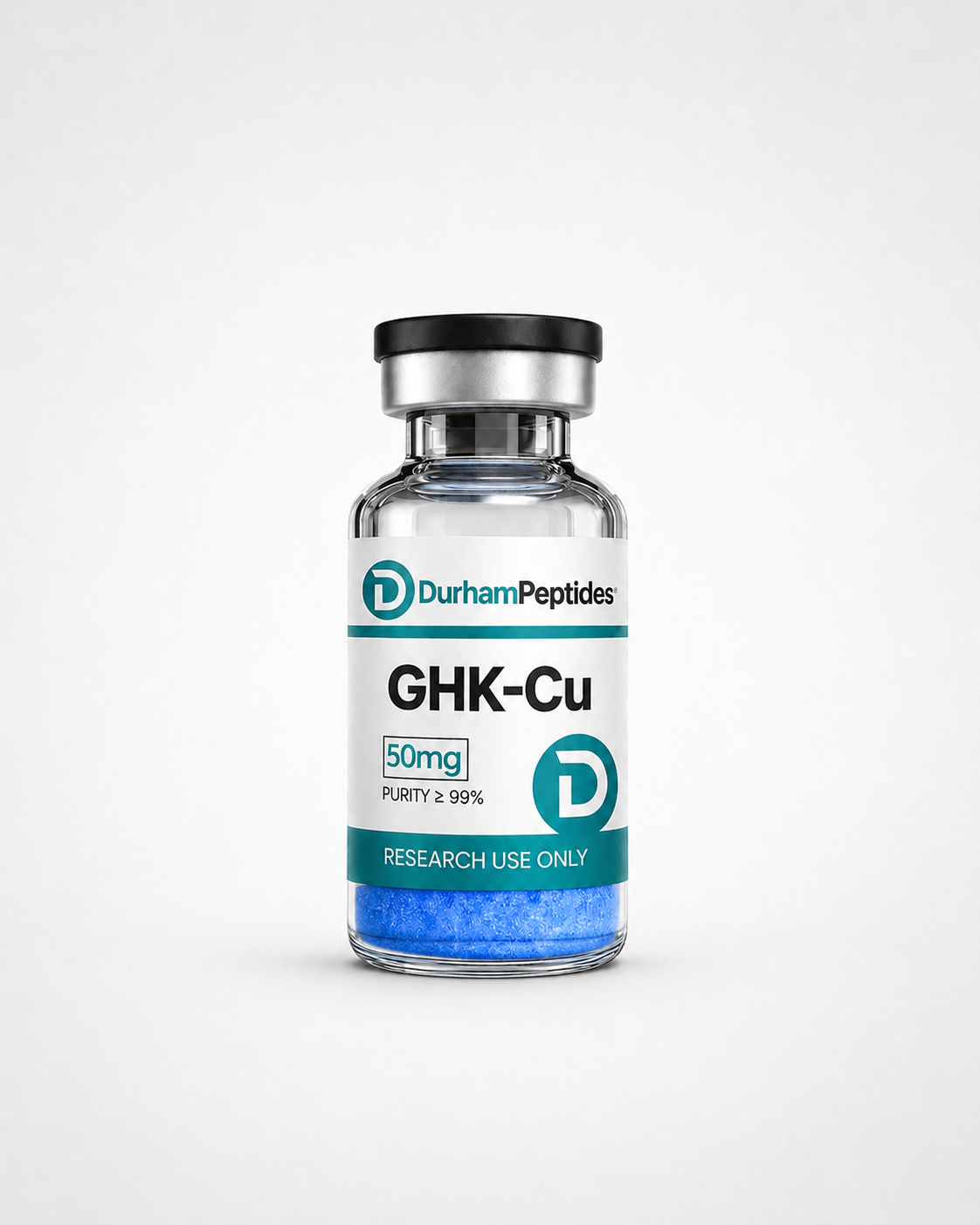
GHK-Cu wound healing copper peptide tissue repair research Pickart Durham Peptides Canada
GHK-Cu has multiple research application threads — skin biology, hair follicle research, anti-inflammation, anti-aging — but the foundational research application that established the entire copper peptide research field is wound healing. Loren Pickart's original copper-peptide research in the 1970s and 1980s, which led to the identification of GHK-Cu's unique properties, was anchored in tissue repair and wound research. This origin story matters because it explains why GHK-Cu research has the breadth it does: every other application thread (skin aging, hair, inflammation) developed out ofthe foundational wound healing research base. This article focuses on the wound healing thread specifically.
For the standalone GHK-Cu overview, see What Is GHK-Cu?; for the copper peptide chemistry foundation, see Copper Peptides Explained; for the hair-specific research, see GHK-Cu for Hair Research. Nothing here is medical, dosing, or therapeutic guidance.
The Pickart Origin Story
Loren Pickart, working in the 1970s, identified that human plasma fraction from young donors had tissue-repair properties that fractions from older donors lacked. Through painstaking biochemical isolation, Pickart's research traced this activity to a small tripeptide that he characterized as glycine-histidine-lysine (Gly-His-Lys) — a fragment of larger proteins released during tissue injury. The key insight followed: this tripeptide preferentially bound copper, and the copper-peptide complex (GHK-Cu) had biological activity that the metal-free peptide did not.
This foundational research established several things:
- GHK-Cu has its origin in injured tissue itself — it's not a synthetic novelty, it's a fragment naturally released during injury and tissue repair
- The copper component is mechanistically essential — GHK-Cu's biological activity is meaningfully different from GHK alone
- The compound has substantial cell-biology effects — early Pickart work documented effects on a wide range of cellular processes related to tissue repair
The wound healing research foundation gave GHK-Cu its scientific credibility before the skin-aging and hair applications became prominent.
Why Wound Healing Research Is Mechanistically Complex
Wound healing is one of the most-studied processes in biology because it requires many cellular mechanisms working in coordinated sequence:
Phase 1: Hemostasis — Platelet aggregation and clot formation to stop bleeding. (Minutes to hours.)
Phase 2: Inflammation — Neutrophil and macrophage recruitment to clear debris and pathogens. Necessary but needs to resolve at the right time. (Hours to days.)
Phase 3: Proliferation — Fibroblast proliferation, new collagen deposition, new blood vessel formation (angiogenesis), epithelial cell migration to close the wound. (Days to weeks.)
Phase 4: Remodeling — Collagen reorganization, scar maturation, gradual return toward original tissue mechanics. (Weeks to months.)
A compound studied for wound healing research has to engage multiple of these phases productively, or at minimum not disrupt them. Compounds that affect one phase poorly (delayed inflammation resolution, excessive scarring, impaired angiogenesis) produce worse outcomes overall even if they accelerate one specific phase.
This is the context in which GHK-Cu's multi-mechanism research interest takes shape: it's been studied across multiple wound healing phases, not just one.
Investigated GHK-Cu Effects Across Wound Healing Phases
Published research has examined investigated GHK-Cu effects across multiple wound healing biology phases:
Phase 2 — Inflammation: GHK-Cu has been studied for investigated anti-inflammatory effects, including modulation of TNF-α, IL-6, and NF-κB pathway activity. In wound healing context, the relevant question is whether this helps inflammation resolve productively (a research positive) or interferes with the necessary inflammatory phase (a research concern). The published data suggests modulation rather than suppression.
For the inflammation deep-dive, see GHK-Cu and Inflammation: TNF-α, IL-6, NF-κB Modulation.
Phase 3 — Proliferation:
This is where most GHK-Cu wound healing research concentrates:
- Collagen synthesis stimulation. Research has examined investigated effects on Type I and Type III collagen synthesis — the structural proteins that fill the wound bed in the proliferation phase.
- Fibroblast proliferation and migration. GHK-Cu has been studied for investigated effects on fibroblast behavior — the cells that produce the new collagen matrix.
- Angiogenesis. Research has examined investigated effects on new blood vessel formation, which is essential for delivering oxygen and nutrients to the proliferating wound tissue. This is mechanistically distinct from but complementary to BPC-157's angiogenesis research thread.
- Glycosaminoglycan (GAG) synthesis. GAGs are the gel-like matrix components of healing tissue. Some research has examined investigated GHK-Cu effects on GAG production.
Phase 4 — Remodeling:
- Matrix metalloproteinase (MMP) modulation. MMPs remodel the wound matrix. Research has examined investigated GHK-Cu effects on MMP expression and tissue inhibitors of metalloproteinases (TIMPs), influencing how the wound matrix matures.
- Scar formation modulation. Some research has examined whether GHK-Cu treatment affects scar appearance and mechanical properties of healed tissue — relevant to the broader wound-quality research question.
Why the Copper Component Matters in Wound Healing
The copper in GHK-Cu isn't decorative — it's mechanistically engaged in wound healing biology through several copper-dependent enzymes:
- Lysyl oxidase is a copper-dependent enzyme that crosslinks collagen fibrils during wound healing. Crosslinking determines the mechanical strength of healed tissue. Copper availability influences lysyl oxidase function.
- Superoxide dismutase (Cu/Zn SOD) is a copper-zinc enzyme that handles oxidative stress in healing tissue. Wound environments generate significant oxidative stress; copper-dependent antioxidant defense matters.
- Cytochrome c oxidase in mitochondria is copper-dependent, affecting cellular energy production needed for the proliferative phase.
These connections explain why copper peptide research is its own research category distinct from peptide research generally — the copper component engages distinct enzymatic biology that affects wound healing outcomes.
For the copper-peptide chemistry foundation, see Copper Peptides Explained.
The Research Bridge to Skin, Hair, and Anti-Aging
Once the wound healing research established GHK-Cu's effects on collagen, fibroblasts, angiogenesis, and tissue matrix biology, the research naturally extended to:
- Skin aging research — Skin aging involves the same biological systems wound healing engages (collagen, fibroblasts, matrix, oxidative stress) but on slower time scales. See GHK-Cu for Skin and Hair Research.
- Hair follicle research — Hair biology shares mesenchymal cell populations with wound healing research, and the dermal papilla has fibroblast-related characteristics. See GHK-Cu for Hair Research.
- Anti-inflammatory research — The inflammation modulation thread extends from wound healing into systemic anti-inflammatory research questions. See GHK-Cu and Inflammation.
Understanding wound healing as the foundational application explains why GHK-Cu has such breadth of secondary applications.
Practical Research Considerations
Durham Peptides supplies GHK-Cu in two formats:
- GHK-Cu 50mg at C$54.99 (C$1.10/mg)
- GHK-Cu 100mg at C$94.69 (C$0.95/mg)
For wound healing research, which often involves substantial milligram quantities, the 100mg vial captures meaningful per-mg savings (~14% cheaper per milligram). See GHK-Cu 50mg vs 100mg. Both formats are Janoshik-verified to ≥99% purity with mass-spec identity, 100% synthetic, vegan.
For combination wound healing research bridging GHK-Cu with the angiogenesis (BPC-157) and cell migration (TB-500) mechanisms, see the Glow Blend and Inside the GLOW Blend.
Frequently Asked Questions
Why is wound healing the foundational GHK-Cu research application? Because Loren Pickart's original copper peptide research in the 1970s and 1980s was anchored in tissue repair and wound healing. The compound was identified in human plasma fractions for its tissue-repair activity, and the wound healing research established GHK-Cu's scientific credibility before skin, hair, and other applications developed.
What wound healing phases does GHK-Cu engage? Research has examined investigated effects across inflammation (modulation rather than suppression), proliferation (collagen synthesis, fibroblast biology, angiogenesis, GAG synthesis), and remodeling (MMP modulation, scar formation). Multi-phase engagement is part of the research interest.
Why does the copper specifically matter in wound healing? Because several wound-healing-relevant enzymes are copper-dependent: lysyl oxidase (collagen crosslinking, mechanical tissue strength), superoxide dismutase (antioxidant defense), cytochrome c oxidase (cellular energy production). The copper component engages this distinct enzymatic biology.
Is GHK-Cu specifically researched in chronic wounds? Some research has examined GHK-Cu in chronic wound contexts (diabetic ulcers, pressure ulcers, etc.) where standard wound healing biology is impaired. The mechanistic logic — multi-phase engagement, copper-dependent enzyme support — extends from acute to chronic wound research.
How does the wound healing research connect to GHK-Cu's other applications? The collagen, fibroblast, angiogenesis, and matrix biology established by wound healing research extends naturally to skin aging (same systems, slower timescales), hair (mesenchymal cell biology shared), and anti-inflammatory (inflammation modulation thread). Wound healing is the foundation.
Where can I buy GHK-Cu in Canada? Durham Peptides supplies GHK-Cu 50mg (C$54.99) and GHK-Cu 100mg(C$94.69), both Janoshik-verified.
Final Thoughts
GHK-Cu's wound healing research is the foundational application that established the entire copper peptide research field. Loren Pickart's original work in the 1970s-1980s identified GHK-Cu in injured tissue itself, established the copper component as mechanistically essential, and documented effects across multiple wound healing phases — collagen synthesis, fibroblast biology, angiogenesis, matrix remodeling. Every other GHK-Cu research thread (skin aging, hair, inflammation) developed out of this wound healing foundation. For researchers entering GHK-Cu research from any direction, the wound healing literature is the conceptual base that ties the broader research field together.
For the standalone overview, see What Is GHK-Cu?; for the copper-peptide chemistry, see Copper Peptides Explained; for the hair-specific extension, see GHK-Cu for Hair Research; for the inflammation extension, see GHK-Cu and Inflammation.
Selected Research References
- Pickart L, Margolina A. Regenerative and Protective Actions of the GHK-Cu Peptide. International Journal of Molecular Sciences. 2018;19(7):1987. https://pubmed.ncbi.nlm.nih.gov/29986520/
- Pickart L, Vasquez-Soltero JM, Margolina A. GHK Peptide as a Natural Modulator of Multiple Cellular Pathways in Skin Regeneration. BioMed Research International. 2015;2015:648108. https://pubmed.ncbi.nlm.nih.gov/26236730/
- Maquart FX, Pickart L, Laurent M, Gillery P, Monboisse JC, Borel JP. Stimulation of Collagen Synthesis in Fibroblast Cultures by the Tripeptide-Copper Complex Glycyl-L-Histidyl-L-Lysine-Cu2+. FEBS Letters. 1988;238(2):343-346. (Foundational copper-peptide collagen research from Pickart's era.)
- Sciumè G, Le Bideau J, Gokel GW, et al. Copper Tripeptide GHK-Cu and Tissue Repair: A Review. Journal of Biological Inorganic Chemistry. (Reference on copper-peptide wound healing research consolidation.)
All products sold by Durham Peptides are for research and laboratory use only. They are not intended for human or animal consumption, diagnosis, treatment, cure, or prevention of any disease.