

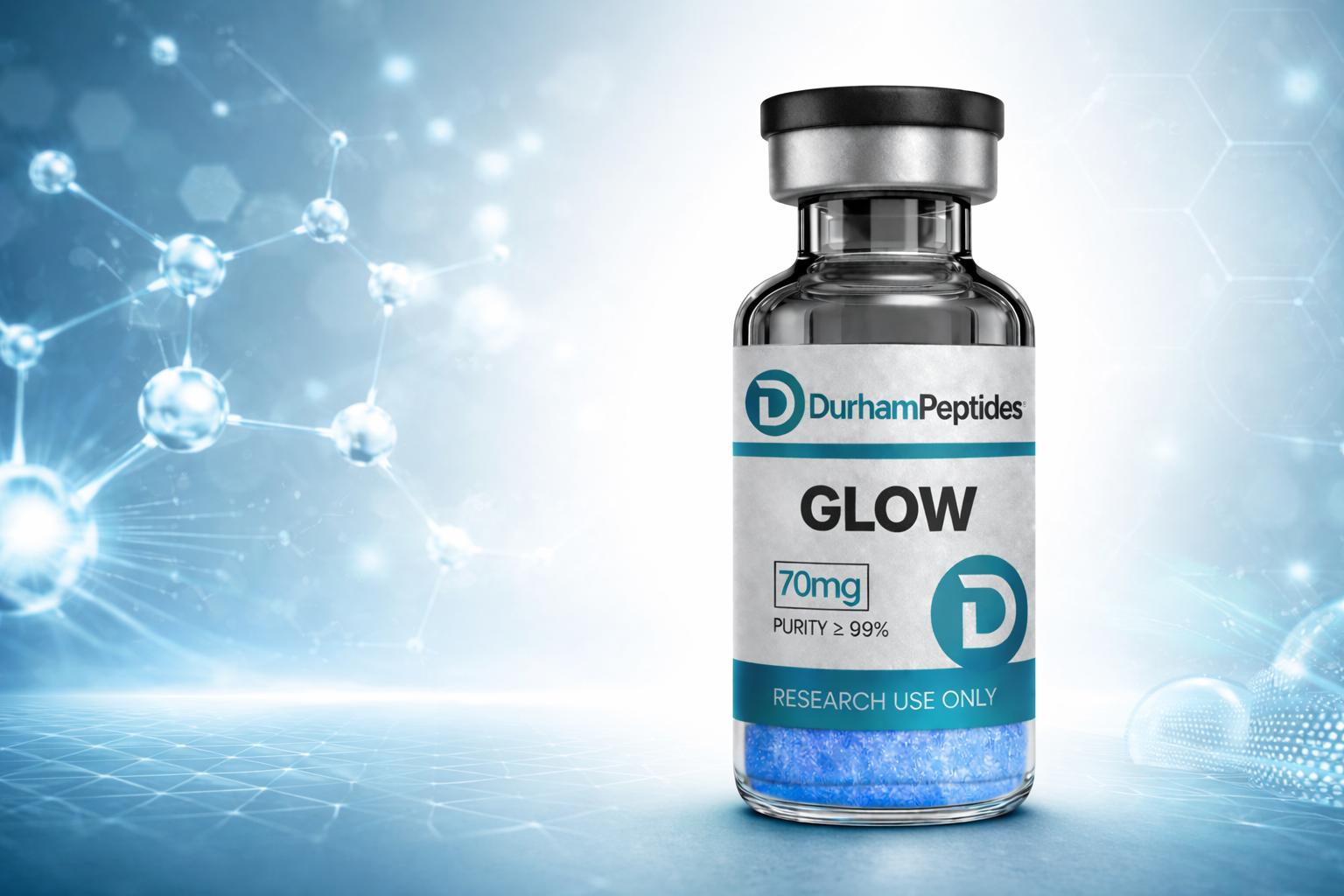
Is GLOW better than GHK-Cu direct comparison Durham Peptides Canada
Is GLOW Blend better than GHK-Cu alone? The honest answer: it depends on the research
question. GHK-Cu alone provides single-mechanism research focus through gene expression modulation — the most extensively studied research peptide mechanism in the entire field. GLOW Blend combines GHK-Cu with BPC-157 and TB-500 for multi-mechanism research that addresses three complementary pathways simultaneously. Neither is universally "better" — they address different research approaches.
This article gives the direct answer to the "is GLOW better than GHK-Cu" question Canadian researchers keep asking. The framing throughout is research literature observation — these are research peptides studied in published preclinical and clinical research, not therapeutic recommendations.
For the foundational comparison context, see GHK-Cu vs GLOW Blend: Which Has the Most Research Support?. For GLOW Blend composition specifically, see GLOW Blend Composition: Why GHK-Cu + BPC-157 + TB-500 Work Together.
The Direct Answer
GLOW is "better" when the research question benefits from multi-mechanism
coverage. Three complementary pathways (GHK-Cu's gene expression modulation, BPC-157's angiogenesis, TB-500's cell migration) engaged simultaneously provide research data that single-mechanism peptides can't produce.
GHK-Cu alone is "better" when the research question requires single-mechanism focus. Studying gene expression modulation specifically benefits from isolating that mechanism rather than confounding it with additional pathways.
Neither answer is universally correct. The choice is research-question-specific.
When GLOW Wins
The multi-mechanism approach has specific research advantages:
1. Multi-pathway anti-aging research. Aging biology involves multiple cellular processes — gene expression changes, vascular degradation, tissue maintenance disruptions. Single-mechanism research addresses one pathway at a time; multi-mechanism research engages multiple pathways simultaneously, which can be closer to the actual biological reality of aging.
2. Comprehensive skin biology research. Skin tissue benefits from all three GLOW mechanisms: gene expression (collagen, elastin), angiogenesis (vascular support), cell migration (wound healing and tissue maintenance). Research focused on skin biology specifically may benefit from all three.
3. Cost efficiency. Buying GLOW Blend (70mg total: 50mg GHK-Cu + 10mg BPC-157 + 10mg TB-500) costs less than buying each component separately. The combination formulation provides cost efficiency for researchers who would use all three components anyway.
4. Convenience. Single vial, single reconstitution, single draw per session delivers proportional amounts of all three peptides. Simpler than managing three separate vials.
5. Combined-mechanism research design. Some research questions are explicitly about how mechanisms interact. Multi-mechanism formulations support these research designs directly.
When GHK-Cu Alone Wins
The single-mechanism approach has its own research advantages:
1. Mechanism-focused research. Studying gene expression modulation specifically requires isolating that mechanism. Adding BPC-157 and TB-500 introduces confounding variables that make mechanism-focused interpretation harder.
2. The most extensively studied peptide research mechanism. GHK-Cu has over 100 published studies spanning five decades — substantially more than BPC-157 (mostly preclinical) or TB-500. Research building on the GHK-Cu literature benefits from the depth of that specific compound's research base.
3. Single-pathway research designs. Some research protocols specifically need to engage one biological pathway. Multi-mechanism formulations don't fit those designs.
4. Lower cost per mg. GHK-Cu is the most affordable peptide per mg in the Durham Peptides catalog due to its simple three-amino-acid structure. For research that only needs gene expression mechanism, the single peptide is more cost-efficient than the multi-peptide combination.
5. Maximum flexibility. Buying single peptides separately allows researchers to combine them at different ratios than the GLOW formulation provides, or to use them at different times in research protocols.
The Mechanism Comparison
Mechanism | GHK-Cu Alone | GLOW Blend (3 peptides) |
Gene expression modulation | ✓ (GHK-Cu) | ✓ (GHK-Cu component) |
Angiogenesis | ✗ | ✓ (BPC-157 component) |
Cell migration | ✗ | ✓ (TB-500 component) |
Single-mechanism focus | ✓ | ✗ (multi-mechanism by design) |
Mechanism interaction research | Limited | ✓ |
The mechanism difference is exactly what makes the comparison non-trivial. GLOW isn't "GHK-Cu plus extras" — it's a multi-mechanism research tool that addresses different research questions than GHK-Cu alone.
For deep mechanism context, see GHK-Cu: The Anti-Aging Copper Peptide with Over 100 Published Studies, What Is BPC-157?, and TB-500: The Recovery Peptide Behind the Wolverine Stack.
Cost Comparison
Practical pricing comparison for Canadian researchers:
GHK-Cu 50mg alone — The most affordable peptide per mg in the Durham Peptides catalog. 50mg vial provides extensive research material for single-mechanism research.
GLOW Blend 70mg — 50mg GHK-Cu + 10mg BPC-157 + 10mg TB-500 in a single combination vial. Higher total price than GHK-Cu alone (because it contains additional peptides) but lower than buying GHK-Cu 50mg + BPC-157 10mg + TB-500 10mg separately.
The cost efficiency comparison:
- If research only needs GHK-Cu: GHK-Cu alone is cheaper
- If research needs all three peptides: GLOW is cheaper than buying separately
- If research needs different ratios than GLOW provides: separate vials offer flexibility
For broader pricing context, see Peptide Pricing in Canada and Why Some Peptides Cost More Than Others.
Research Base Comparison
GHK-Cu has the most extensive research base of any peptide in the Durham Peptides catalog — over 100 published studies spanning five decades. Research includes cell culture, animal models, and human clinical studies. Particularly extensive literature in skin biology and wound healing.
GLOW Blend doesn't have its own clinical research base as a formulation — it's a combination of three individually studied peptides. The research support comes from each component's individual literature plus the broader literature on multi-mechanism approaches in research peptide work.
For Canadian researchers prioritizing depth of published research support, GHK-Cu's individual research base is unmatched. For researchers prioritizing multi-mechanism research design, GLOW's formulation rationale draws from all three components' literature.
The "Better" Question Resolved
To answer "is GLOW better than GHK-Cu" definitively requires knowing the research question:
Single-mechanism gene expression research? GHK-Cu alone is better — more focused, lower cost, deeper individual research base.
Multi-mechanism anti-aging research? GLOW is better — addresses three pathways simultaneously, cost-efficient combination.
Skin biology research? Either can work — GHK-Cu for focused collagen/elastin research, GLOW for combined skin biology + tissue repair + vascular support.
Recovery research? GLOW's BPC-157 and TB-500 components are more directly relevant than GHK-Cu alone. Consider also Wolverine Stack (BPC-157 + TB-500 without GHK-Cu) or KLOW Blend (all of GLOW plus KPV for anti-inflammatory).
First-time anti-aging peptide research? GHK-Cu alone makes a good starting point — single mechanism, single peptide to learn, lowest cost per mg.
For complete comparison context, see GHK-Cu vs GLOW Blend, KLOW Blend vs GLOW Blend, and Peptide Stacking Guide: The Science Behind Combination Research Protocols.
Quality Considerations
Both GHK-Cu 50mg and GLOW Blend 70mg at Durham Peptides share the same quality framework:
- Manufactured via Solid-Phase Peptide Synthesis with synthetic amino acids
- No animal-derived materials
- Independent third-party testing by Janoshik Analytical
- ≥99% HPLC purity per component peptide
- Mass spectrometry identity confirmation
- Verifiable Janoshik unique keys
For complete quality framework coverage, see How to Verify Peptide Quality and What Is HPLC Testing for Peptides?.
Frequently Asked Questions
Is GLOW better than GHK-Cu? Depends on the research question. GLOW addresses three mechanisms simultaneously; GHK-Cu alone focuses on one mechanism with the deepest individual research base. Match the choice to research approach.
Is GHK-Cu better than GLOW Blend? Same answer reversed. For single-mechanism focused research, yes. For multi-mechanism research, no. Different research approaches.
What's the difference between GLOW and GHK-Cu? GLOW combines GHK-Cu with BPC-157 (angiogenesis) and TB-500 (cell migration). GHK-Cu alone is just the single tripeptide working through gene expression modulation. Different research approaches addressed.
Is GLOW just GHK-Cu plus extras? Functionally no — GLOW is a multi-mechanism research tool engaging three complementary pathways. The "extras" (BPC-157 and TB-500) bring entirely different mechanisms, not just additional GHK-Cu effect.
Which is cheaper, GLOW or GHK-Cu? GHK-Cu alone has lower total price. GLOW costs more total but provides three peptides for less than buying separately. Cost-efficiency depends on whether research needs all three components.
Which has more research? GHK-Cu has the more extensive individual research base (over 100 published studies). GLOW as a formulation doesn't have its own clinical research; the research support comes from each component's individual literature.
Can I make my own GLOW Blend from separate vials? Yes — buy separate vials of GHK-Cu, BPC-157, and TB-500. The combination formulation provides cost-efficiency and convenience but isn't required for combined research.
Which is better for skin research specifically? Either can work. GHK-Cu alone for focused collagen/elastin research; GLOW for combined skin biology including tissue repair and vascular support components.
Which is better for first-time peptide research? GHK-Cu alone — single peptide is simpler to learn, has the lowest cost per mg, and has the deepest research base for understanding peptide research outcomes.
Are both vegan? Yes. Both manufactured via SPPS with synthetic amino acids — no animal-derived materials. See Vegan Peptides.
Should I use GLOW if I already have BPC-157 and TB-500? Probably not — if you already have BPC-157 and TB-500, buying GLOW means paying for duplicate quantities. Just adding GHK-Cu to your existing stack accomplishes the same research goal more cost-effectively.
What about KLOW vs GLOW? KLOW adds KPV (anti-inflammatory) to the GLOW formulation. Four mechanisms vs three. See KLOW Blend vs GLOW Blend.
Final Thoughts
The "is GLOW better than GHK-Cu" question doesn't have a universal answer — it depends on what research question is being addressed. Multi-mechanism research benefits from GLOW; single-mechanism research benefits from GHK-Cu alone. Both are legitimate research peptide options addressing different research approaches.
For Canadian researchers, the practical takeaways:
- GLOW (3 peptides) for multi-mechanism research
- GHK-Cu alone for single-mechanism focus on gene expression modulation
- GHK-Cu has the deeper individual research base; GLOW combines three individually researched peptides
- Cost efficiency favors GHK-Cu alone for single-mechanism research; favors GLOW for multi-component research
- Same quality framework applies to both — Janoshik third-party testing, ≥99% HPLC purity
For continued reading, see GHK-Cu vs GLOW Blend, GLOW Blend Composition, BPC-157 vs GHK-Cu, GHK-Cu: The Anti-Aging Copper Peptide, and Peptide Stacking Guide.
Browse the complete Durham Peptides catalog at durhampeptides.ca/category/all-products. View all Janoshik-verified COAs at durhampeptides.ca/lab-results.
Selected Research References
- Pickart L, Margolina A. Regenerative and Protective Actions of the GHK-Cu Peptide in the Light of the New Gene Data. International Journal of Molecular Sciences. 2018;19(7):1987. https://pubmed.ncbi.nlm.nih.gov/29986520/
- Sikiric P, Seiwerth S, Rucman R, et al. Stable Gastric Pentadecapeptide BPC 157: Novel Therapy in Gastrointestinal Tract. Current Pharmaceutical Design. 2011;17(16):1612-1632. https://pubmed.ncbi.nlm.nih.gov/21548867/
- Goldstein AL, Hannappel E, Sosne G, Kleinman HK. Thymosin β4: A Multi-Functional Regenerative Peptide. Expert Opinion on Biological Therapy. 2012;12(1):37-51. https://pubmed.ncbi.nlm.nih.gov/22142325/
- Pickart L, Vasquez-Soltero JM, Margolina A. The Human Tripeptide GHK and Tissue Remodeling. Journal of Biomaterials Science, Polymer Edition. 2008;19(8):969-988. https://pubmed.ncbi.nlm.nih.gov/18644225/
- Chang CH, Tsai WC, Lin MS, Hsu YH, Pang JH. The Promoting Effect of Pentadecapeptide BPC 157 on Tendon Healing. Journal of Applied Physiology. 2011;110(3):774-780. https://pubmed.ncbi.nlm.nih.gov/21030672/
- Crockford D, Turjman N, Allan C, Angel J. Thymosin Beta-4: Structure, Function, and Biological Properties. Annals of the New York Academy of Sciences. 2010;1194:179-189. https://pubmed.ncbi.nlm.nih.gov/20536467/
All products sold by Durham Peptides are for research and laboratory use only. They are not intended for human or animal consumption, diagnosis, treatment, cure, or prevention of any disease. This article is informational and does not constitute medical advice.