

KPV inflammatory bowel disease IBD colitis tripeptide PepT1 research Durham Peptides Canada
KPV's research literature spans skin biology, systemic inflammation, and gut research — but the single most-developed and most-distinctive KPV research application is in inflammatory bowel disease (IBD) specifically. The 2008 Dalmasso et al.
Gastroenterology paper, which characterized KPV's anti-inflammatory mechanism in intestinal contexts through the PepT1 transporter, anchors a research thread that's both mechanistically interesting and clinically relevant to the IBD research field. This article focuses on the IBD application thread specifically.
For the standalone KPV overview, see What Is KPV?; for the skin-specific research, see KPV for Skin Research; for the comparison to BPC-157 in gut contexts, see KPV vs BPC-157 for Gut Research. Nothing here is medical, dosing, or therapeutic guidance.
Inflammatory Bowel Disease: The Research Context
Inflammatory bowel disease (IBD) is the umbrella term for chronic inflammatory conditions of the gastrointestinal tract, primarily including ulcerative colitis (typically limited to the colon) and Crohn's disease (which can affect any part of the GI tract). Both involve dysregulated immune responses to gut contents, sustained inflammation in the gut wall, and progressive tissue damage. The research field is substantial because:
- The current treatment landscape has limitations. Standard treatments (corticosteroids, immunomodulators, biologics like anti-TNF antibodies) have efficacy ceilings and side-effect profiles that motivate continued research into alternative approaches.
- The mechanistic biology is well-characterized but the pathways are numerous. IBD research involves multiple inflammatory pathways (NF-κB, TNF-α, IL-6, IL-1β, IL-17, and many others), epithelial barrier biology, microbiota interactions, and immune cell biology.
- Research models are established. DSS (dextran sulfate sodium)-induced colitis, TNBS (trinitrobenzene sulfonic acid) colitis, and various transgenic models provide standardized research models for testing intervention compounds.
This is the context in which KPV's IBD research thread takes shape.
The Dalmasso 2008 Gastroenterology Paper
The landmark Dalmasso et al. paper, "PepT1-mediated tripeptide KPV uptake reduces intestinal inflammation," published in Gastroenterology in 2008, is the foundational reference for KPV's IBD research. Key findings of the paper:
Finding 1: KPV is transported into intestinal cells via PepT1. PepT1 is a peptide transporter expressed on intestinal epithelial cell membranes. It evolved to transport dietary di- and tripeptides for nutritional purposes, but small peptide drugs (including KPV) can use it as an uptake mechanism. The paper documented PepT1-mediated KPV uptake into intestinal cells.
Finding 2: PepT1 expression is altered in IBD. The paper noted that PepT1 expression patterns shift in inflammatory intestinal contexts, with implications for how KPV would be taken up in inflamed vs healthy intestine.
Finding 3: KPV reduces inflammatory markers in colitis models. The researchers examined KPV in DSS-induced colitis (a standard IBD research model). KPV exposure was associated with reduced inflammatory markers, reduced histological inflammation severity, and improved markers of intestinal barrier function.
Finding 4: The anti-inflammatory mechanism involves NF-κB pathway modulation. The paper provided mechanistic detail on the intracellular consequences of KPV uptake, including effects on NF-κB pathway activation — a central inflammatory transcription factor active in IBD.
This paper established KPV's research credentials in IBD specifically and provided the mechanistic story (PepT1 uptake + NF-κB modulation) that subsequent IBD-related KPV research has built on.
The α-MSH Origin and Why IBD Research Specifically
To understand why KPV would be active in intestinal anti-inflammation specifically, you need to remember KPV's molecular origin. KPV is the C-terminal tripeptide fragment of α-MSH (alpha-melanocyte-stimulating hormone), one of the body's natural anti-inflammatory peptides. α-MSH itself has been studied across many anti-inflammatory contexts including intestinal inflammation. KPV inherits the anti-inflammatory portion of α-MSH's biology while being small enough to be transported by PepT1 — a combination that's particularly well-suited to intestinal research applications.
For the broader α-MSH connection, see What Is KPV?; for the skin-research extension of α-MSH biology, see KPV for Skin Research.
Investigated Effects in IBD Research Models
Building from the Dalmasso 2008 foundation, subsequent published research has examined KPV across multiple IBD research aspects:
Investigated effect 1: DSS colitis models. DSS-induced colitis is the most-used IBD research model. KPV has been studied across multiple DSS colitis studies, with reported investigated effects on histological inflammation severity, weight loss (a standard colitis severity marker), and inflammatory cytokine levels in colonic tissue.
Investigated effect 2: TNBS colitis models. TNBS-induced colitis is a different IBD research model that engages somewhat different immune mechanisms than DSS. Research has examined KPV in TNBS models with similar reported anti-inflammatory effects.
Investigated effect 3: Pro-inflammatory cytokine reduction. Multiple studies have examined investigated KPV effects on TNF-α, IL-6, IL-1β, and other pro-inflammatory cytokines in inflamed intestinal tissue — directly relevant to the cytokine biology that drives IBD pathology.
Investigated effect 4: Intestinal barrier function. Some research has examined investigated KPV effects on tight junction proteins (claudins, occludins) and broader intestinal barrier function — relevant because compromised barrier function is part of IBD pathology.
Investigated effect 5: Localized vs systemic effects. A research design feature: KPV's small size (3 amino acids) and PepT1-mediated uptake make it suitable for orally-delivered research designs targeting intestinal tissue locally. This is distinct from systemic anti-inflammatory approaches and aligns the research tool with the location of IBD pathology.
Why KPV's Size Specifically Matters for Gut Research
A research-design point worth highlighting: KPV is one of the smallest research peptides (3 amino acids — Lys-Pro-Val). This small size has specific implications for intestinal research:
- PepT1 transport. PepT1 specifically transports di- and tripeptides. KPV's tripeptide structure is exactly what PepT1 evolved to transport, making intestinal uptake efficient.
- Stability advantages. Small peptides generally have different stability profiles than larger peptides. KPV's chemical stability is reasonable for research handling and oral-research-context use.
- Local tissue concentration. Small peptides can achieve higher local tissue concentrations relative to their administered dose, particularly when the target tissue (intestine) is also the uptake site (via PepT1).
This combination of small size, PepT1 uptake, and α-MSH-derived anti-inflammatory mechanism makes KPV a research tool particularly well-suited to intestinal anti-inflammatory research compared to most other small peptides.
KPV vs Other IBD Research Compounds
A useful contextual framing: the broader IBD-research compound landscape includes a range of approaches:
Compound class | Research approach |
KPV (tripeptide) | Small peptide, PepT1 uptake, NF-κB modulation, α-MSH-derived anti-inflammation |
BPC-157 | Gut-native pentadecapeptide, broader recovery/repair research thread |
Biologic antibodies (anti-TNF, etc.) | Targeted single-cytokine neutralization |
5-ASA compounds | Salicylate-based, primarily for ulcerative colitis |
Corticosteroids | Broad immunosuppression |
JAK inhibitors | Intracellular signaling inhibition |
KPV's distinctive position is being a small natural-origin peptide with documented mechanism, transporter-mediated uptake, and multi-pathway anti-inflammatory effects — different from any of the other approaches in fundamental ways.
For the head-to-head with BPC-157 (the other peptide-class compound with substantial IBD research), see KPV vs BPC-157 for Gut Research.
Practical Research Considerations
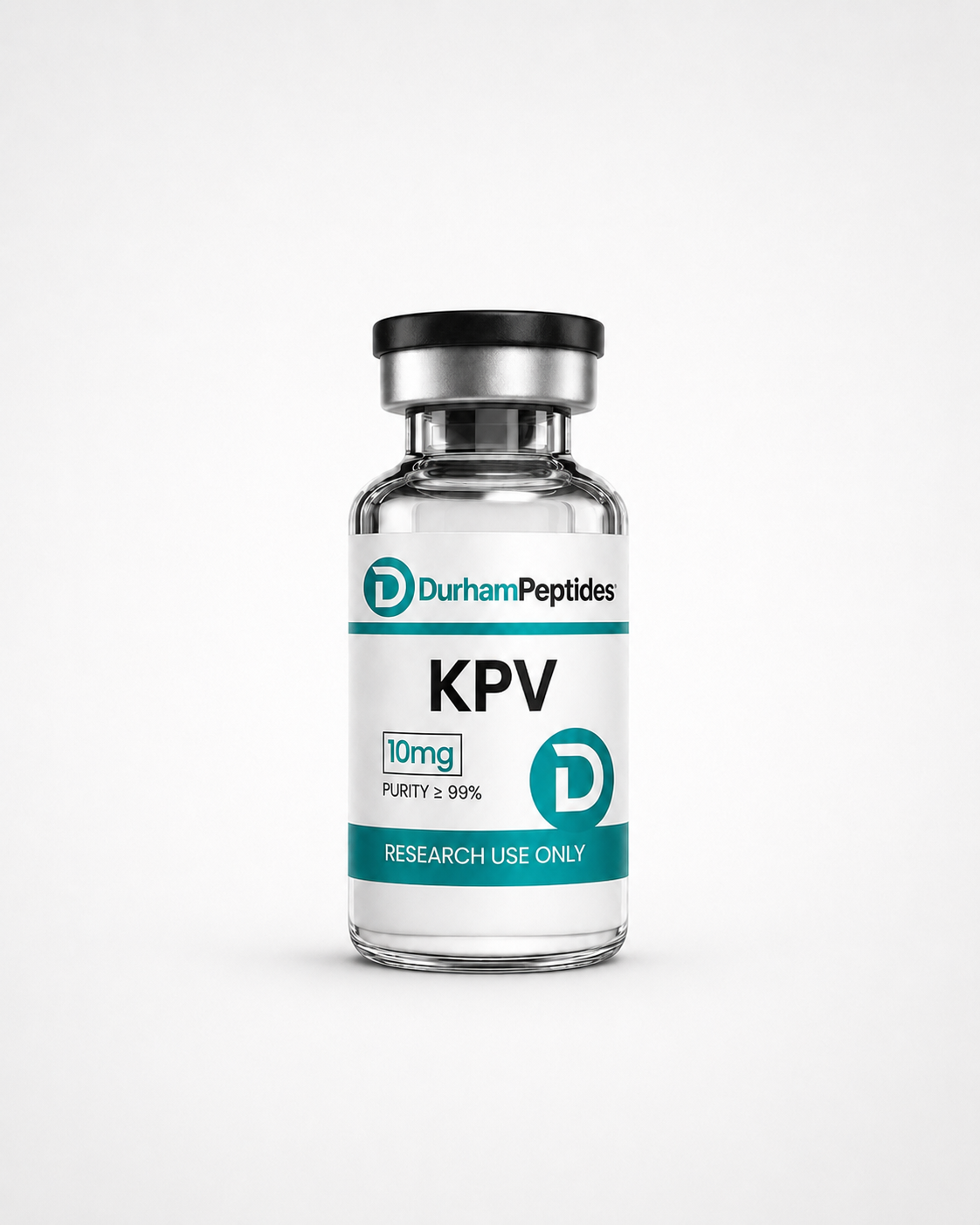
KPV 10mg at Durham Peptides is C$45.99 (C$4.60/mg), Janoshik-verified to ≥99% purity by HPLC with mass-spec identity confirmation; 100% synthetic; vegan. Storage: 2–8°C short-term, -20°C long-term, protected from light and moisture; reconstitute in bacteriostatic water.
For combination IBD research bridging KPV's anti-inflammatory mechanism with BPC-157's gut-protection mechanism, BPC-157 10mg or BPC-157 20mg are the natural catalog companions. KPV is also a component of the KLOW Blend — though KLOW's design is more skin-research focused than IBD-research focused.
Frequently Asked Questions
Is KPV studied for inflammatory bowel disease specifically? Yes — IBD is the most-developed KPV research application area, anchored on the 2008 Dalmasso et al. Gastroenterology paper that characterized KPV's PepT1-mediated uptake and anti-inflammatory effects in intestinal contexts.
What is PepT1 and why does it matter for KPV research? PepT1 is a peptide transporter expressed on intestinal epithelial cells, evolved to transport dietary di- and tripeptides. KPV's tripeptide structure is exactly what PepT1 transports, enabling efficient intestinal uptake — particularly relevant for research targeting intestinal tissue locally.
Does KPV affect NF-κB signaling? Yes — research has examined investigated KPV effects on NF-κB pathway activation, which is a central inflammatory transcription factor in IBD pathology. NF-κB modulation is part of the mechanistic story for KPV's anti-inflammatory effects in intestinal contexts.
How does KPV compare to BPC-157 in IBD research? Both compounds have gut research applications but through different mechanisms. KPV is the α-MSH-derived anti-inflammatory tripeptide with PepT1-mediated intestinal uptake; BPC-157 is the gut-native pentadecapeptide with broader tissue-repair and recovery research thread. See KPV vs BPC-157 for Gut Research.
Are there KPV-based clinical trials in IBD? Research is primarily in animal models and cell culture as of the current published literature. Clinical research is more limited than the preclinical research base. The mechanistic foundation is established but clinical translation is still developing.
Where can I buy KPV in Canada? Durham Peptides supplies KPV 10mg (C$45.99), Janoshik-verified, and as a component of the KLOW Blend.
Final Thoughts
KPV's inflammatory bowel disease research is the most-developed application area for this α-MSH-derived tripeptide, anchored on the landmark 2008 Dalmasso et al. Gastroenterology paper. The combination of small-peptide structure, PepT1-mediated intestinal uptake, α-MSH-derived anti-inflammatory mechanism, and NF-κB pathway modulation places KPV in a distinctive research-tool position in IBD biology. For researchers entering the IBD-anti-inflammatory peptide research space, KPV's mechanism and research base are well-characterized enough to support clean research designs, with a foundational reference paper that defines the mechanistic logic of the entire research thread.
For the standalone KPV overview, see What Is KPV?; for the skin-research thread, see KPV for Skin Research; for the BPC-157 comparison in gut contexts, see KPV vs BPC-157 for Gut Research.
Selected Research References
- Dalmasso G, Charrier-Hisamuddin L, Nguyen HT, Yan Y, Sitaraman S, Merlin D. PepT1-Mediated Tripeptide KPV Uptake Reduces Intestinal Inflammation. Gastroenterology. 2008;134(1):166-178. https://pubmed.ncbi.nlm.nih.gov/18061177/
- Kannengiesser K, Maaser C, Heidemann J, et al. Melanocortin-Derived Tripeptide KPV Has Anti-Inflammatory Potential in Murine Models of Inflammatory Bowel Disease. Inflammatory Bowel Diseases. 2008;14(3):324-331. https://pubmed.ncbi.nlm.nih.gov/18092346/
- Hiltz ME, Lipton JM. Antiinflammatory Activity of a COOH-Terminal Fragment of the Neuropeptide Alpha-MSH. FASEB Journal. 1989;3(11):2282-2284. https://pubmed.ncbi.nlm.nih.gov/2550304/
- Catania A, Lonati C, Sordi A, Carlin A, Leonardi P, Gatti S. The Melanocortin System in Control of Inflammation. The Scientific World Journal. 2010;10:1840-1853. https://pubmed.ncbi.nlm.nih.gov/20852829/
All products sold by Durham Peptides are for research and laboratory use only. They are not intended for human or animal consumption, diagnosis, treatment, cure, or prevention of any disease.