

NAD+ sirtuins SIRT1 SIRT3 longevity research coenzyme enzyme relationship Durham Peptides Canada
NAD+ is the most-studied longevity-research coenzyme. Sirtuins are the most-studied longevity-research enzyme family. The reason they appear in the same conversation so often isn't coincidence — it's biology. Sirtuins literally cannot function without NAD+. They consume NAD+ as a substrate for every reaction they catalyze, which means NAD+ availability is the rate-limiting factor for sirtuin activity in the cell. This article goes deep on the relationship: what sirtuins do, how NAD+ powers them, and why this coenzyme-enzyme partnership is one of the central mechanisms in modern longevity research.
For the standalone NAD+ overview, see What Is NAD+?; for the NAD-precursor comparison, see NAD+ vs NMN vs NR; for the broader longevity research landscape, see The Best Longevity Peptides for Research in Canada. Nothing here is medical, dosing, or therapeutic guidance.
What Sirtuins Are
Sirtuins are a family of enzymes — specifically, NAD+-dependent deacetylases and ADP-ribosyltransferases. That's a mouthful, so let's unpack it.
Deacetylation is a chemical reaction in which an acetyl group (a small two-carbon chemical tag) is removed from a target molecule. Many proteins in the cell — including histones (the proteins that DNA wraps around), transcription factors, and metabolic enzymes — carry acetyl groups as regulatory marks. Acetylation and deacetylation act as molecular on/off switches for these proteins' activity. Sirtuins are the enzymes that perform the "off" reaction (deacetylation) on a wide range of targets.
NAD+-dependent means sirtuins require NAD+ as a co-substrate to perform
deacetylation. They don't just use NAD+ as a cofactor that catalyzes the reaction and gets regenerated — they actually consume NAD+ in each reaction, breaking it down to nicotinamide plus other products. This consumption is critical: it means the more sirtuins work, the more NAD+ gets used up.
Seven sirtuins, different locations and targets. Mammals have seven sirtuin family members (SIRT1 through SIRT7), each with a specific cellular location and set of substrate proteins:
Sirtuin | Cellular location | Notable functions in research |
SIRT1 | Nucleus, cytoplasm | Most-studied; metabolic regulation, stress response, autophagy, mitochondrial biogenesis |
SIRT2 | Cytoplasm, nucleus | Cytoskeletal regulation, cell cycle |
SIRT3 | Mitochondria | Mitochondrial protein deacetylation; energy metabolism; antioxidant defense |
SIRT4 | Mitochondria | ADP-ribosyltransferase; glutamine metabolism |
SIRT5 | Mitochondria | Desuccinylation, demalonylation (related to but distinct from deacetylation) |
SIRT6 | Nucleus | DNA repair, telomere maintenance, glucose metabolism |
SIRT7 | Nucleolus | Ribosomal RNA transcription, protein synthesis |
Together, sirtuins regulate a remarkable breadth of cellular processes — from metabolism to stress response to DNA repair. Their collective activity has been studied as central to
multiple recognized hallmarks of aging.
How NAD+ Powers Sirtuin Activity
The mechanistic relationship is concrete. For each deacetylation reaction:
- Sirtuin binds an acetylated target protein (substrate)
- Sirtuin also binds NAD+
- The deacetylation reaction proceeds, consuming the NAD+
- The products are the deacetylated target protein, nicotinamide (NAM, the recycled portion of NAD+), and 2'-O-acetyl-ADP-ribose (a side product)
Two things follow from this mechanism:
NAD+ availability limits sirtuin activity. If NAD+ levels in a cell fall, sirtuin activity falls proportionally — even if all the sirtuins, all the substrates, and all the regulatory cofactors are present. The cell can have everything it needs except enough NAD+ and sirtuin activity will be constrained.
NAD+ levels change throughout life. This is the longevity research connection. NAD+ levels have been documented to decline with age across multiple tissues in published research. The decline is one of the more reproducible findings in cellular aging biology. As NAD+ falls, sirtuin activity falls. As sirtuin activity falls, the cellular processes sirtuins regulate (metabolic regulation, mitochondrial function, DNA repair, stress response) become less well-controlled. This is the conceptual through-line connecting NAD+ decline to age-related cellular decline.
The Research Thread: NAD+ Restoration and Sirtuin Activation
This is where the research interest in NAD+ supplementation and its precursors (NMN, NR) comes from. The investigated logic is:
- NAD+ levels decline with age
- NAD+ availability rate-limits sirtuin activity
- Sirtuin activity is central to multiple aging-related cellular processes
- Therefore, restoring NAD+ levels has been studied for restoring sirtuin activity and engaging downstream cellular processes that benefit from sirtuin function
The published research literature on NAD+ supplementation (and its precursors) has examined this chain at multiple steps — measuring NAD+ levels, measuring sirtuin activity, measuring downstream effects on mitochondrial function, metabolic markers, and aging-related endpoints in animal and cell-culture models. The breadth of the research thread reflects the breadth of sirtuin function.
For the NAD-precursor comparison and how different NAD+ boosting strategies relate, see NAD+ vs NMN vs NR.
SIRT1 and SIRT3: The Most-Studied Sirtuins in NAD+ Research
While all seven sirtuins are NAD+-dependent, two get the bulk of the NAD+ research attention:
SIRT1 — the metabolic master regulator. SIRT1 is the most-studied sirtuin in the longevity context. It deacetylates PGC-1α (a major regulator of mitochondrial biogenesis), FOXO transcription factors (stress response, autophagy), p53 (cell cycle, apoptosis), and dozens of other targets. SIRT1 activity has been studied as central to the cellular response to caloric restriction — one of the most robust pro-longevity interventions across model organisms. NAD+ availability driving SIRT1 activity is the central mechanistic story in much of NAD+ longevity research.
SIRT3 — the mitochondrial regulator. SIRT3 is located inside mitochondria and deacetylates many mitochondrial proteins, including enzymes of the TCA cycle, oxidative phosphorylation machinery, and antioxidant defenses. Mitochondrial NAD+ availability driving SIRT3 activity has been studied as foundational to mitochondrial quality control, energy metabolism, and oxidative stress resistance in aging research. This is the SIRT3 connection to mitochondrial aging biology specifically.
The other sirtuins (SIRT2, 4, 5, 6, 7) are well-studied but less centrally in the NAD+-supplementation research thread.
The 5-Amino-1MQ Connection
This is where the broader NAD+ research landscape connects to another compound in the Durham Peptides catalog. 5-Amino-1MQ is a small-molecule NNMT inhibitor — and NNMT (nicotinamide N-methyltransferase) is the enzyme that methylates nicotinamide for excretion, removing it from the NAD+ salvage pool. The same nicotinamide that sirtuin reactions produce as a byproduct.
So there's a system-level loop: sirtuin reactions consume NAD+ and produce nicotinamide. The nicotinamide either gets recycled back into NAD+ via the salvage pathway, or gets methylated by NNMT and excreted. If NNMT is overactive, nicotinamide gets pulled out of the system faster than it can be recycled — depleting the NAD+ pool, reducing sirtuin activity, and creating the cellular state the longevity research is trying to address.
This is why 5-Amino-1MQ, despite being a small molecule not a peptide, appears alongside NAD+ in the longevity research category. The two compounds engage the same metabolic axis from different directions — NAD+ supplementation adds material to the pool; 5-Amino-1MQ inhibits the enzyme that's removing material from the pool. For the standalone framework, see What Is 5-Amino-1MQ?.
Practical Research Considerations
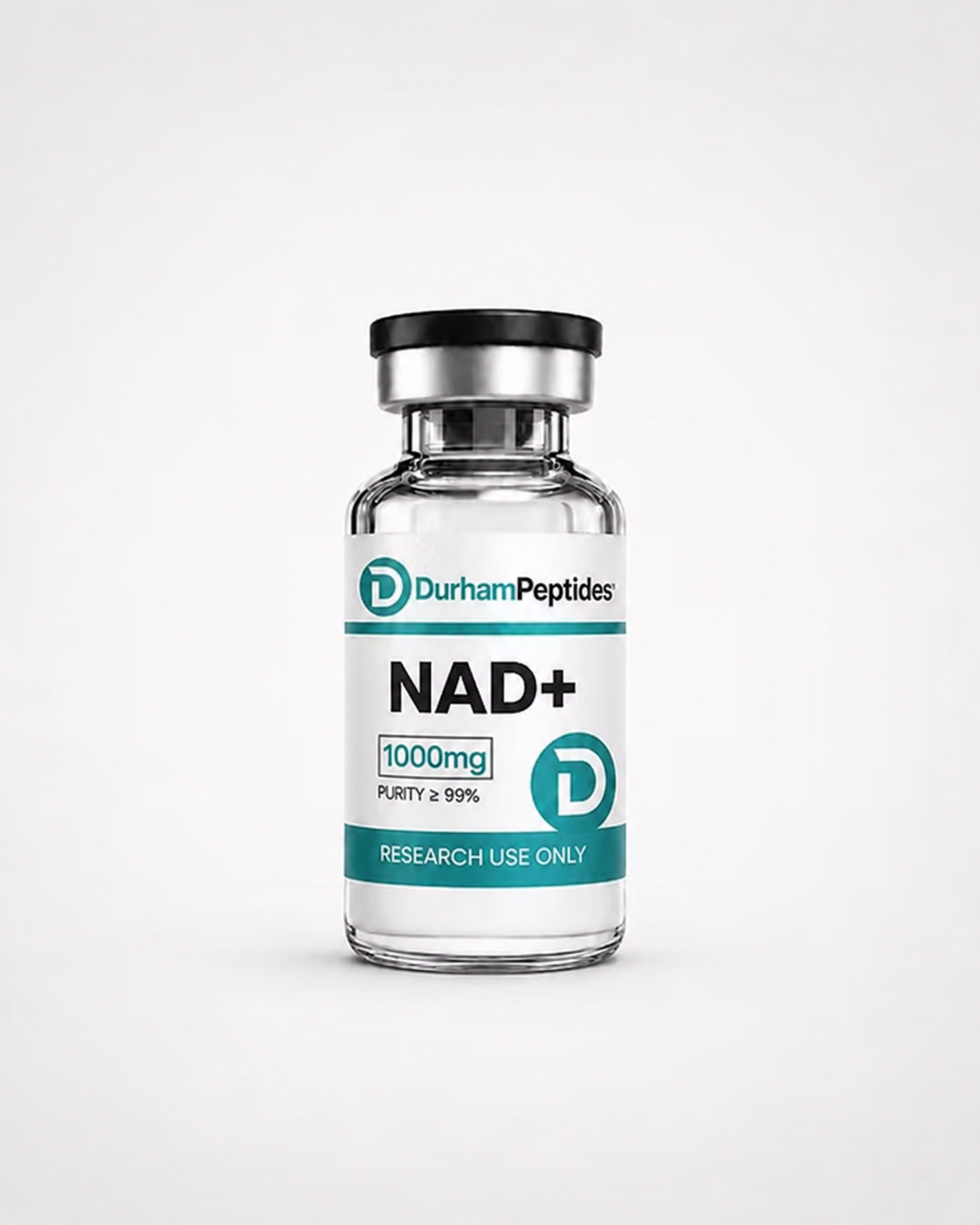
Durham Peptides supplies NAD+ in two formats:
- NAD+ 500mg at C$114.99 (C$0.230/mg)
- NAD+ 1000mg at C$165.00 (C$0.165/mg)
For the vial-size decision, see NAD+ 500mg vs 1000mg; for when the larger format is the right call, see The NAD+ Research Budget.
Janoshik-verified to ≥99% purity, mass-spec identity confirmation, 100% synthetic. Standard storage protocols apply.
Frequently Asked Questions
What's the connection between NAD+ and sirtuins? Sirtuins are NAD+-dependent enzymes — they consume NAD+ as a substrate for every reaction they catalyze. NAD+ availability rate-limits sirtuin activity. As NAD+ levels decline with age, sirtuin activity declines too.
Which sirtuin is most studied with NAD+ research? SIRT1 (the metabolic master regulator, nuclear/cytoplasmic) and SIRT3 (the mitochondrial regulator) get the most NAD+-research attention. The other sirtuins are well-studied but less centrally tied to NAD+ supplementation research.
Does NAD+ supplementation actually increase sirtuin activity? Published research has examined investigated effects of NAD+ supplementation and precursors (NMN, NR) on sirtuin activity in cell-culture and animal models, with reported effects on NAD+ levels and downstream sirtuin-dependent processes. The research thread is well-developed but research in humans is more limited.
What's the connection between sirtuins and aging? Sirtuins regulate processes central to multiple recognized hallmarks of aging — metabolic regulation, mitochondrial function, DNA repair, stress response, autophagy. The "sirtuins and longevity" research connection rests on this breadth of regulatory function.
Why does 5-Amino-1MQ come up alongside NAD+? Because 5-Amino-1MQ inhibits NNMT — the enzyme that methylates nicotinamide for excretion, removing it from the NAD+ salvage pool. NAD+ supplementation adds to the pool; 5-Amino-1MQ slows removal. Different mechanisms on the same metabolic axis.
Where can I buy NAD+ in Canada? Durham Peptides supplies NAD+ 500mg (C$114.99) and NAD+ 1000mg(C$165.00) — both Janoshik-verified, for laboratory use only.
Final Thoughts
The NAD+ and sirtuin relationship is one of the cleanest examples of a coenzyme-enzyme partnership in modern longevity research — the enzymes (sirtuins) literally cannot function without the coenzyme (NAD+), and NAD+ availability rate-limits sirtuin activity across multiple cellular processes central to aging biology. The age-related decline in NAD+ levels translates into age-related decline in sirtuin activity, which translates into less-well-regulated metabolic, mitochondrial, and stress-response biology. This mechanistic chain is the conceptual scaffold for NAD+ supplementation research, and understanding it explains why NAD+ has such a central place in current longevity research.
For the standalone NAD+ overview, see What Is NAD+?; for the NAD-precursor comparison, see NAD+ vs NMN vs NR; for the related 5-Amino-1MQ pathway, see What Is 5-Amino-1MQ?; for the broader longevity peptide landscape, see The Best Longevity Peptides for Research in Canada.
Selected Research References
- Imai S, Guarente L. NAD+ and Sirtuins in Aging and Disease. Trends in Cell Biology. 2014;24(8):464-471. https://pubmed.ncbi.nlm.nih.gov/24786309/
- Verdin E. NAD+ in Aging, Metabolism, and Neurodegeneration. Science. 2015;350(6265):1208-1213. https://pubmed.ncbi.nlm.nih.gov/25540137/
- Houtkooper RH, Pirinen E, Auwerx J. Sirtuins as Regulators of Metabolism and Healthspan. Nature Reviews Molecular Cell Biology. 2012;13(4):225-238. https://pubmed.ncbi.nlm.nih.gov/22395773/
- Covarrubias AJ, Perrone R, Grozio A, Verdin E. NAD+ Metabolism and Its Roles in Cellular Processes during Ageing. Nature Reviews Molecular Cell Biology. 2021;22(2):119-141. https://pubmed.ncbi.nlm.nih.gov/33353981/
- López-Otín C, Blasco MA, Partridge L, Serrano M, Kroemer G. The Hallmarks of Aging. Cell. 2013;153(6):1194-1217. https://pubmed.ncbi.nlm.nih.gov/23746838/
All products sold by Durham Peptides are for research and laboratory use only. They are not intended for human or animal consumption, diagnosis, treatment, cure, or prevention of any disease.