

Selank stress response HPA axis cortisol tuftsin analog research peptide Durham Peptides Canada
Selank's research literature is most often discussed in anxiolytic terms — anxiety reduction in research models like the elevated plus-maze and conditioned-fear paradigms. But there's a more specific and mechanistically interesting research thread within that broader category: stress response research, which examines how Selank affects the HPA (hypothalamic-pituitary-adrenal) axis, cortisol regulation, and stress-induced behavioral and physiological responses. This is a distinct research angle from generic anxiolytic research, with its own published literature and specific research design considerations.
For the standalone Selank overview, see What Is Selank?; for the comparison to Semax, see Selank vs Semax; for the broader nootropic peptide category, see Nootropic Peptides Research Overview. Nothing here is medical, dosing, or therapeutic guidance.
The HPA Axis: The Body's Stress Response System
The hypothalamic-pituitary-adrenal (HPA) axis is the body's central stress-response system. Briefly:
- Stress signals reach the hypothalamus
- The hypothalamus releases CRH (corticotropin-releasing hormone)
- CRH stimulates the anterior pituitary to release ACTH (adrenocorticotropic hormone)
- ACTH stimulates the adrenal glands to release cortisol (and other glucocorticoids)
- Cortisol produces the physiological stress response (mobilizing energy, modulating immune function, affecting behavior)
- Cortisol also feeds back negatively on the hypothalamus and pituitary, regulating the system
This axis is central to virtually all stress research — both acute stress responses and chronic stress effects. Compounds that affect the HPA axis at any point in this cascade have implications for stress-response research broadly.
Where Selank Fits in Stress Response Research
Selank's mechanism in stress-response research is distinct from anxiolytic compounds that act primarily through GABA-A receptor potentiation (the benzodiazepine pathway). Research has examined investigated Selank effects on multiple stress-related endpoints:
Investigated effect 1: Stress-induced behavioral models. Selank has been studied in research models of acute and chronic stress — including restraint stress, social defeat stress, and various other stress-induction paradigms. The reported research base extends beyond simple anxiety paradigms into research designed around stress responses specifically.
Investigated effect 2: Cortisol and HPA axis dynamics. Some research has examined investigated Selank effects on cortisol/corticosterone levels in stressed animal models. The HPA axis modulation thread is an active research angle, though the mechanism details are still being characterized.
Investigated effect 3: Stress-induced cognitive function. A particularly interesting research line: Selank's investigated effects on cognitive function under stress conditions — research that examines cognitive performance in animals subjected to stressors, with and without Selank exposure. This connects the anxiolytic and cognitive research threads through the stress angle.
Investigated effect 4: GABAergic gene expression in stress contexts. Research has examined investigated Selank effects on expression of genes involved in GABAergic neurotransmission — relevant to stress because GABAergic signaling is one of the brain's primary inhibitory systems modulating stress responses. See What Is Selank? for the broader GABAergic gene expression context.
Investigated effect 5: Stress-related immune effects. Reflecting Selank's tuftsin origin (an immunopeptide), research has also examined investigated Selank effects on stress-related immune dysregulation — connecting stress research to immunopeptide biology in ways most other neuropeptides don't.
The Tuftsin Connection: Why Stress Research Fits Selank Specifically
The tuftsin origin of Selank matters here. Tuftsin is an immunopeptide — a four-amino-acid peptide cleaved from immunoglobulin G that has investigated effects on immune cell function. Chronic stress is known to produce immune dysregulation as a downstream consequence of sustained HPA axis activation. A research compound that's both anxiolytic (engaging the stress-response side) and immunomodulatory (engaging the immune-consequence side) has unique research interest for examining how stress affects immune function — and vice versa.
Most neuropeptides engage either the stress side or the cognitive side; Selank uniquely engages both, plus an immunopeptide thread. This combination makes it a research-distinctive tool for stress research specifically.
For the underlying Selank biology, see What Is Selank?.
Research Design Considerations for Stress Models
Researchers designing stress-response protocols using Selank face several specific considerations:
Acute vs chronic stress models. Selank has been studied in both contexts, but the mechanisms and outcomes differ. Acute stress models examine immediate stress-induced behavioral and physiological responses; chronic stress models examine sustained stress effects on neural plasticity, HPA axis dysregulation, and downstream consequences.
Behavioral vs physiological endpoints. Some stress research focuses on behavioral outcomes (anxiety-related behavior, social interaction, cognitive function); other research focuses on physiological outcomes (cortisol/corticosterone levels, HPA axis reactivity, immune markers). Selank has been studied across both endpoint types.
Stress paradigm selection. Different stress paradigms (restraint, social defeat, chronic mild stress, predator exposure) engage different aspects of the stress-response system. The choice of paradigm shapes what aspects of Selank's investigated effects are visible in the research outcomes.
Comparison standards. Selank's stress research can compare against placebo, against benzodiazepines (the standard anxiolytic comparison), or against other Russian-developed neuropeptides like Semax. Each comparison answers different research questions.
Stress-Cognition Interaction Research
One of the more interesting research design areas for Selank specifically is the stress-cognition interaction — how stress affects cognitive function, and whether anxiolytic compounds preserve cognitive performance under stress. Research has examined Selank in models combining stress induction with cognitive task performance, providing data on cognitive function in stressed states rather than baseline cognitive enhancement. This is a more sophisticated research question than either pure anxiolytic research or pure nootropic research, and Selank's dual research thread is suited for it.
Practical Research Considerations
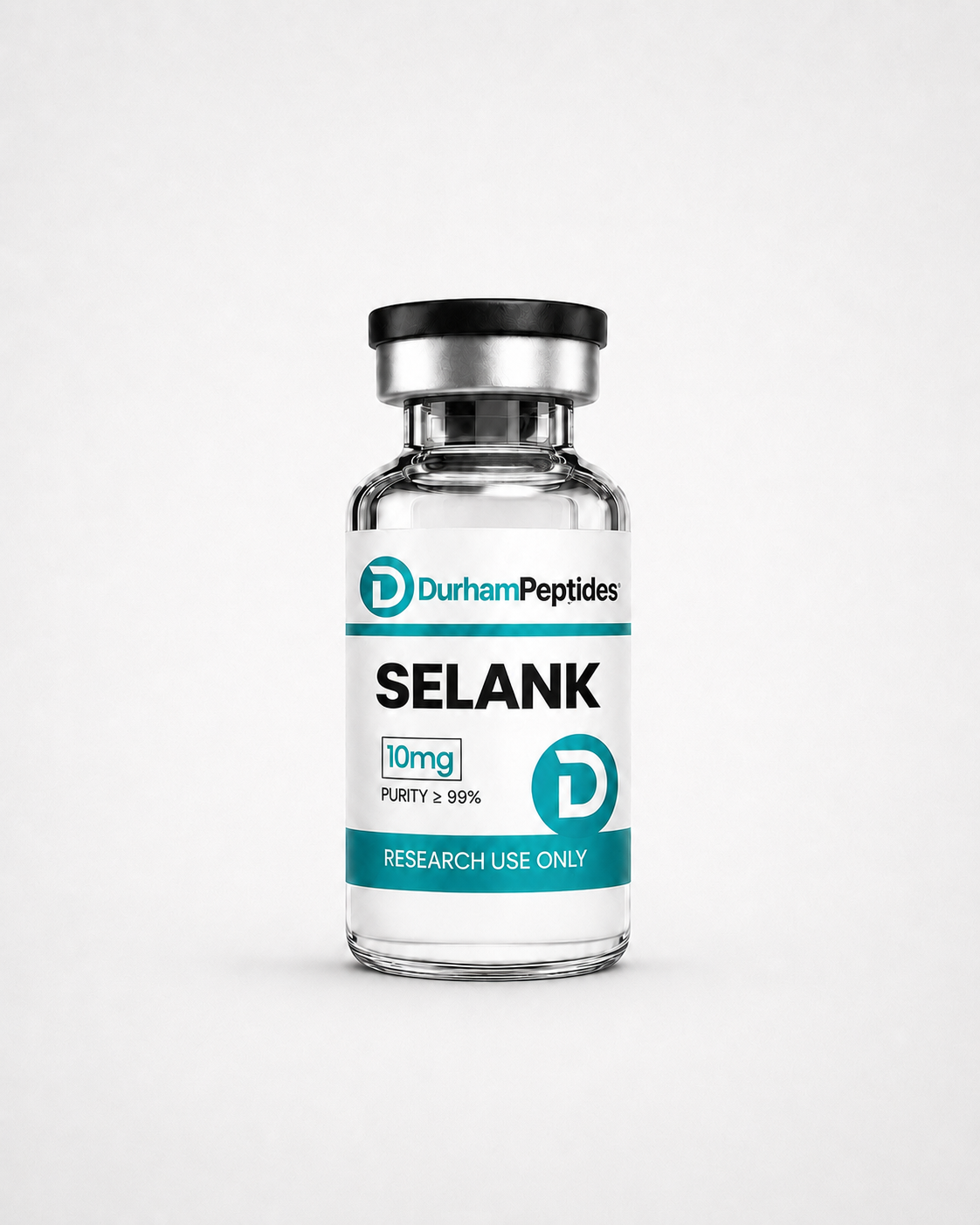
Selank 10mg at Durham Peptides is C$54.99 (C$5.50/mg), Janoshik-verified to ≥99% purity by HPLC with mass-spec identity confirmation; 100% synthetic; vegan. Storage: 2–8°C short-term, -20°C long-term, protected from light and moisture; reconstitute in bacteriostatic water.
For stress-research protocols comparing Selank to Semax, see Selank vs Semax. For broader stress-and-recovery research that overlaps with other peptide categories, GHK-Cu and the broader skin/anti-aging peptide category have anti-inflammatory research threads that intersect with chronic-stress research at the systemic-inflammation level.
Frequently Asked Questions
What's the difference between stress research and anxiety research with Selank?
Anxiety research focuses on specific behavioral endpoints (elevated plus-maze, conditioned fear). Stress research examines broader physiological and behavioral responses to stressors — HPA axis dynamics, cortisol regulation, stress-induced cognition, immune effects. Stress research is the broader category that includes anxiety as one aspect.
Does Selank affect cortisol levels? Some research has examined investigated Selank effects on cortisol/corticosterone in stressed animal models. The HPA axis modulation thread is an active research area though the mechanism details continue to be characterized.
How does Selank's mechanism differ from benzodiazepines in stress research? Benzodiazepines act primarily through GABA-A receptor potentiation; Selank's mechanism involves multiple pathways including monoaminergic systems and BDNF, with investigated effects on GABAergic gene expression (rather than direct GABA-A receptor binding). Different mechanistic routes.
What's unique about Selank for stress research specifically? Selank uniquely combines anxiolytic, neurotrophic (BDNF), and immunopeptide (tuftsin origin) research threads. Chronic stress affects all three systems, making Selank's multi-mechanism profile relevant in ways most single-mechanism anxiolytics aren't.
Can Selank be used for stress-cognition interaction research? Yes — this is one of the more sophisticated research questions Selank suits well, examining cognitive function in stressed states rather than either pure anxiolytic or pure nootropic research questions in isolation.
Where can I buy Selank in Canada? Durham Peptides supplies Selank 10mg (C$54.99), Janoshik-verified, for laboratory use only.
Final Thoughts
Selank's stress response research thread is mechanistically richer than the generic anxiolytic framing suggests. The combination of investigated effects on HPA axis dynamics, GABAergic gene expression, BDNF, and immune function — all rooted in the tuftsin origin — gives Selank a unique research profile for stress-related research questions. For researchers designing protocols that engage stress responses, HPA axis biology, or stress-cognition interactions, Selank's multi-thread research base supports more nuanced research designs than simple anxiolytic compounds do.
For the standalone Selank overview, see What Is Selank?; for the Semax comparison, see Selank vs Semax; for the broader Russian neuropeptide context, see Nootropic Peptides Research Overview.
Selected Research References
- Kozlovskii II, Danchev ND. The Optimizing Effect of the Synthetic Peptide Selank on a Conditioned Active Avoidance Reflex in Rats. Neuroscience and Behavioral Physiology. 2003;33(7):639-643. https://pubmed.ncbi.nlm.nih.gov/14552538/
- Volkova A, Shadrina M, Kolomin T, et al. Selank Administration Affects the Expression of Some Genes Involved in GABAergic Neurotransmission. Frontiers in Pharmacology. 2016;7:31. https://pubmed.ncbi.nlm.nih.gov/26941640/
- Inozemtseva LS, Karpenko EA, Dolotov OV, et al. Intranasal Administration of the Peptide Selank Regulates BDNF Expression in the Rat Hippocampus In Vivo. Doklady Biological Sciences. 2008;421:241-243. https://pubmed.ncbi.nlm.nih.gov/18841804/
- Sollertinskaya TN, Shorokhov MV. Comparative Characteristics of the Effects of Selank and Tactivin on Selective and Generalized Forms of Learning in Lower Monkeys. Zhurnal Vysshei Nervnoi Deiatel'nosti Imeni I P Pavlova. 2010. (Reference on Selank stress-cognition interaction research.)
All products sold by Durham Peptides are for research and laboratory use only. They are not intended for human or animal consumption, diagnosis, treatment, cure, or prevention of any disease.