

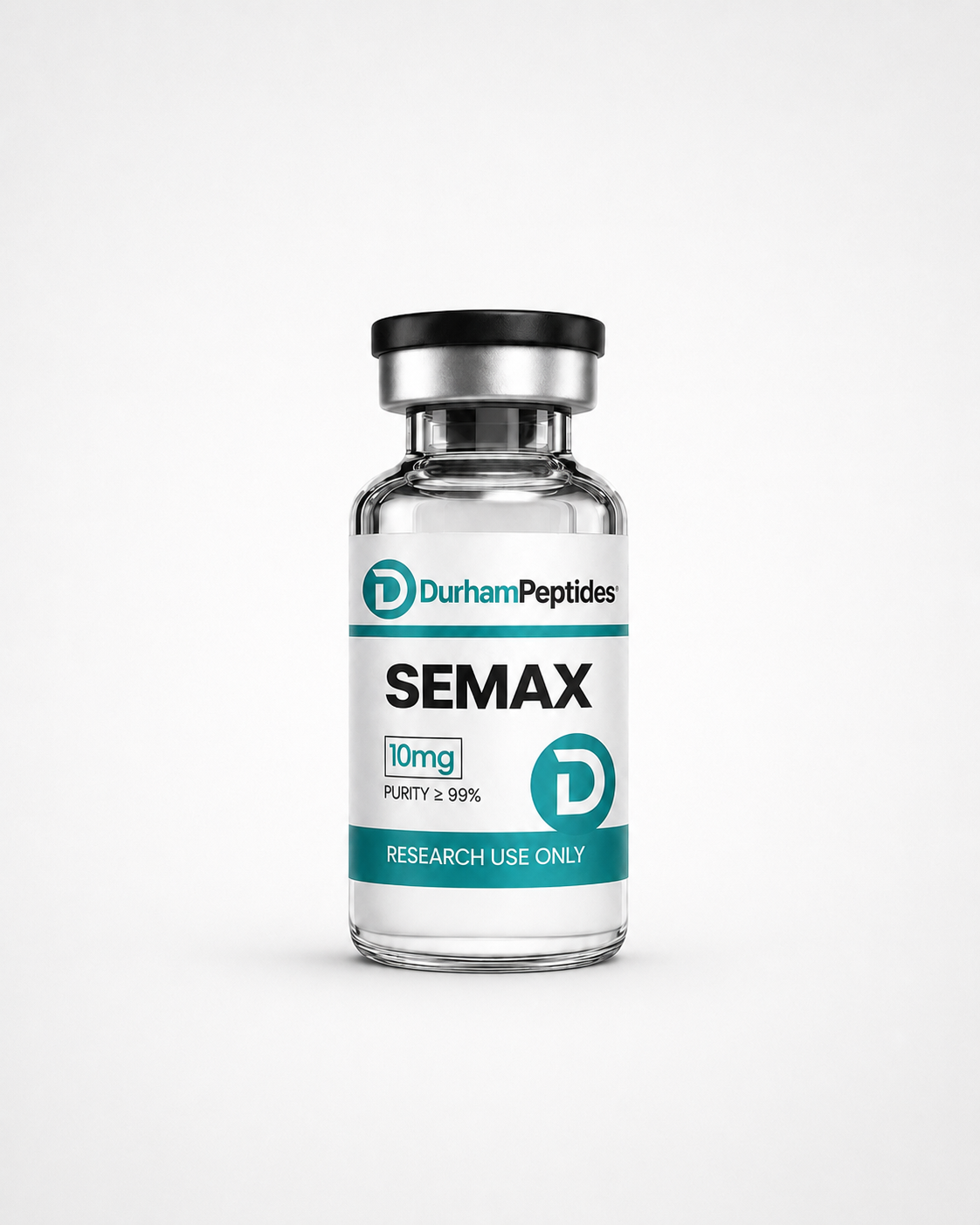
Semax stroke neuroprotection BDNF ACTH 4-10 analog cerebrovascular research Durham Peptides Canada
Semax is most commonly discussed as a nootropic research peptide — the cognitive-enhancement angle. But Semax's original and most extensive Russian-language research literature centers on a different application entirely: stroke and neuroprotection research. The compound was developed at the Russian Academy of Sciences specifically for cerebrovascular research applications, and the Russian-language clinical research base in stroke contexts predates the nootropic literature that's more visible in Western discussion. This article focuses on the neuroprotection angle.
For the standalone Semax overview, see What Is Semax?; for the comparison to Selank, see Selank vs Semax; for the broader nootropic category, see Nootropic Peptides Research Overview. Nothing here is medical, dosing, or therapeutic guidance.
The Origin: ACTH(4-10) and Neuroprotection
Semax was developed at the Institute of Molecular Genetics, Russian Academy of Sciences, by a team led by Nikolai Myasoedov. The compound's structural origin is ACTH(4-10) — the central seven-amino-acid fragment of adrenocorticotropic hormone. ACTH has well-documented effects beyond its adrenal-stimulating role, including investigated neuroprotective effects on brain tissue under stress conditions.
Native ACTH(4-10) carries the neuroprotective fragment but has a notoriously short half-life. The Semax design adds a stabilizing Pro-Gly-Pro extension plus an N-terminal methionine modification, producing a heptapeptide that resists rapid enzymatic degradation while retaining the parent fragment's neuroprotective properties.
Sequence: Met-Glu-His-Phe-Pro-Gly-Pro (modified ACTH(4-10)) Class: Synthetic ACTH(4-10) analog Original research focus: Stroke, cerebral ischemia, and neuroprotection
The compound entered Russian clinical research specifically for cerebrovascular applications. The nootropic angle that's now widely discussed emerged later as the research base expanded.
The Russian Stroke Research Literature
Semax has accumulated decades of Russian-language clinical research in stroke and ischemic brain injury contexts. The published research has examined investigated effects on:
- Ischemic stroke recovery models. Both acute-stroke research (the hours-to-days window after ischemic injury) and recovery-phase research (the weeks-to-months window of post-stroke recovery)
- Cerebral ischemia in animal models. Foundational mechanistic research on neuroprotection under various ischemic conditions
- Neurological function endpoints in both human clinical contexts and animal models — including motor function, cognitive function, and broader neurological assessment endpoints
- Cerebrovascular research more broadly — including conditions adjacent to stroke
The published Russian research base on Semax in stroke contexts is substantial, though much of it remains in Russian-language journals with limited translation to English-language research databases. For Western researchers, this can make the literature harder to access than for compounds with more concentrated English-language publication. For research-integrity considerations, see Peptide Research Ethics and Reproducibility.
The Investigated Mechanisms
Several mechanisms have been examined in the Semax neuroprotection literature:
Mechanism 1: BDNF (Brain-Derived Neurotrophic Factor) modulation. The most-studied mechanism in the modern Semax literature. Research has examined investigated Semax effects on BDNF expression in brain tissue — BDNF being a key neurotrophin involved in neuronal survival, synaptic plasticity, and recovery from neural injury. Compounds that modulate BDNF have direct relevance to stroke recovery and neuroprotection research.
Mechanism 2: Monoaminergic neurotransmitter system effects. Research has examined investigated Semax effects on serotonergic, dopaminergic, and noradrenergic systems. These neurotransmitter pathways have multiple connections to stroke recovery, including effects on neurological function endpoints in stroke research models.
Mechanism 3: Anti-inflammatory effects in CNS contexts. Some research has examined Semax's investigated effects on neuroinflammatory markers — relevant to stroke because ischemic injury produces a sustained inflammatory response that affects subsequent recovery.
Mechanism 4: Effects on antioxidant defense and oxidative stress. Stroke and ischemic injury involve substantial oxidative stress. Some research has examined Semax's investigated effects on antioxidant defense gene expression and oxidative stress markers in brain tissue.
Mechanism 5: Direct neurotrophic effects. Research has examined investigated Semax effects on neuronal survival and outgrowth in cell-culture and animal models — independent of BDNF but related to the broader neurotrophic signaling research thread.
How Stroke Research Differs from Nootropic Research
Researchers designing stroke-research protocols vs nootropic protocols face different design considerations even with the same compound:
Consideration | Stroke / neuroprotection research | Nootropic research |
Primary endpoints | Neurological function, recovery markers, BDNF expression, neuronal survival | Cognitive function tests, learning, memory, attention |
Research models | Stroke models, ischemia/reperfusion models, neuronal injury models | Cognitive task paradigms in healthy or impaired models |
Time horizons | Acute (hours-days) and recovery (weeks-months) phases | Typically shorter cognitive assessment windows |
Translation context | Clinical stroke research | Healthy cognition or specific cognitive deficits |
Russian vs Western literature | Russian literature is the foundational base | Western literature has grown more recently |
The same Semax compound supports both research lines; what changes is the research question and how outcomes are measured.
Selank vs Semax in the Neuroprotection Context
Worth a contextual point: Selank is the other major Russian-developed neuropeptide in current research, with primary research focus on anxiolytic effects rather than neuroprotection. Both compounds have BDNF-related research threads (overlapping mechanism) but differ in their primary research emphasis. For the head-to-head, see Selank vs Semax. For Selank's stress-response specific angle, see Selank for Stress Response Research (Post 126 in this batch).
Practical Research Considerations
Semax 10mg at Durham Peptides is C$45.00 (C$4.50/mg), Janoshik-verified to ≥99% purity by HPLC with mass-spec identity confirmation; 100% synthetic; vegan. Storage: 2–8°C short-term, -20°C long-term, protected from light and moisture; reconstitute in bacteriostatic water.
For Russian-research-replication protocols, Semax is one of the more accessible Russian-developed research compounds in the Canadian market.
Frequently Asked Questions
What is Semax originally developed for? Stroke and cerebrovascular research at the Russian Academy of Sciences. The nootropic application emerged later as the research base expanded. The original developmental focus was neuroprotection.
What's the connection between Semax and ACTH? Semax is a stabilized analog of ACTH(4-10), the central seven-amino-acid fragment of adrenocorticotropic hormone. ACTH(4-10) carries the neuroprotective properties of ACTH without the adrenal-stimulating effects of the full hormone.
What mechanisms does Semax engage in neuroprotection research? Primarily BDNF expression modulation, monoaminergic neurotransmitter effects, anti-inflammatory effects in CNS contexts, and direct neurotrophic effects on neuronal survival. Multiple parallel mechanisms.
Is most Semax stroke research in Russian or English? The foundational stroke research base is in Russian-language publications. English-language research, including more mechanism-focused recent work, has grown but is smaller than the Russian-language base.
How is Semax research for stroke different from research for nootropic effects?
Different research questions, endpoints, and models. Stroke research examines neurological function recovery, BDNF expression in injury contexts, neuronal survival; nootropic research examines cognitive function, learning, memory in different research models.
Where can I buy Semax in Canada? Durham Peptides supplies Semax 10mg (C$45.00), Janoshik-verified, for laboratory use only.
Final Thoughts
Semax's stroke and neuroprotection research thread is its original and most-developed research focus — predating the nootropic discussion that's more visible in current Western contexts. The ACTH(4-10) origin, the investigated BDNF mechanism, and the substantial Russian-language clinical literature together make Semax one of the more research-anchored compounds in the cerebrovascular and neuroprotection categories. For researchers replicating Russian stroke-research protocols or examining ACTH-fragment-based neuroprotection mechanisms, Semax remains the canonical research tool.
For the standalone overview, see What Is Semax?; for the Selank comparison, see Selank vs Semax; for the broader nootropic-peptide context, see Nootropic Peptides Research Overview.
Selected Research References
- Dergunova LV, Dmitrieva VG, Filippenkov IB, et al. The Effect of Semax on the Expression of Genes Involved in Neurogenesis and Apoptosis in Rat Brain. Genes. 2014. https://pubmed.ncbi.nlm.nih.gov/24708833/
- Dolotov OV, Karpenko EA, Inozemtseva LS, et al. Semax, an Analog of Adrenocorticotropin (4-10), Binds Specifically and Increases Levels of Brain-Derived Neurotrophic Factor. Journal of Neurochemistry. 2006;97(s1):82-86. https://pubmed.ncbi.nlm.nih.gov/16996040/
- Medvedeva EV, Dmitrieva VG, Povarova OV, et al. Effect of Semax and Its C-Terminal Fragment Pro-Gly-Pro on the Expression of VEGF Family Genes and Their Receptors in Experimental Focal Ischemia of the Rat Brain. Journal of Molecular Neuroscience. 2013;49(2):328-333. https://pubmed.ncbi.nlm.nih.gov/22744636/
- Ashmarin IP, Nezavibatko VN, Levitskaya NG, et al. Design and Investigation of an ACTH(4-10) Analog Lacking D-amino Acids and Hydrophobic Radicals. Neuroscience Research Communications. 1995. (Foundational Russian publication on Semax development.)
All products sold by Durham Peptides are for research and laboratory use only. They are not intended for human or animal consumption, diagnosis, treatment, cure, or prevention of any disease.