
In a peptide market dominated by compounds focused on recovery, weight management, and skin health, MOTS-c occupies a unique position. It's not derived from gastric juice like BPC-157, it's not a synthetic hormone analog like semaglutide, and it's not found in general circulation like Thymosin Beta-4. MOTS-c is encoded within mitochondrial DNA — making it fundamentally different from virtually every other peptide on the market.
This distinction has made MOTS-c one of the most discussed compounds in the longevity and biohacking communities, with researchers particularly interested in its potential role as an "exercise mimetic" and metabolic regulator.
What Is MOTS-c?
MOTS-c stands for Mitochondrial Open Reading Frame of the 12S rRNA Type-C. It is a 16-amino-acid peptide with the sequence MRWQEMGYIFYPRKLR and a molecular weight of 2174.69 g/mol.
What makes MOTS-c remarkable is its origin. Nearly all peptides used in research are encoded in nuclear DNA — the DNA found in the cell nucleus. MOTS-c is one of a small family of peptides encoded within mitochondrial DNA, the separate genome that exists inside mitochondria (the cell's energy-producing organelles). This family is known as mitochondrial-derived peptides (MDPs), and MOTS-c was first identified and characterized in 2015 by a research team at the University of Southern California.
The discovery was significant because it demonstrated that mitochondrial DNA does more than just encode components of the electron transport chain — it also produces signaling peptides that can influence metabolism throughout the entire body.
Why Is MOTS-c Generating Interest?
The research interest in MOTS-c centers on several key areas.
AMPK Activation: MOTS-c has been studied for its ability to activate AMP-activated protein kinase (AMPK), often called the body's "master metabolic switch." AMPK activation is associated with increased glucose uptake, fatty acid oxidation, and improved cellular energy balance. Many pharmaceutical and nutraceutical interventions — including metformin and exercise itself — work partly through AMPK activation, which is why MOTS-c has drawn comparisons as a potential "exercise mimetic."
Metabolic Regulation: The original 2015 paper by Lee et al. in Cell Metabolism demonstrated that MOTS-c administration in mice was associated with reduced age-dependent and high-fat-diet-induced insulin resistance in preclinical models. The researchers found that MOTS-c regulated skeletal muscle metabolism and improved glucose homeostasis.
Age-Related Decline: Research has shown that endogenous MOTS-c levels — the amount the body naturally produces — decline with age. This age-related decline parallels the decline in mitochondrial function that is considered a hallmark of aging. Some researchers hypothesize that restoring MOTS-c levels could counteract certain aspects of metabolic aging, though this remains under investigation.
Exercise Connection: A 2016 study published in Cell Metabolism found that MOTS-c levels increased in skeletal muscle in response to exercise, and that MOTS-c translocated to the nucleus in response to metabolic stress. This finding positioned MOTS-c as a potential molecular link between exercise and its metabolic benefits.
How MOTS-c Differs from Other Peptides
Most peptides in the research market act on specific receptors or tissue types. Semaglutide activates GLP-1 receptors. BPC-157 is studied in connective tissue models. GHK-Cu acts on skin fibroblasts. MOTS-c operates at a more fundamental level — it's a mitochondrial signal that appears to influence whole-body metabolic regulation.
This systemic mechanism is part of what makes MOTS-c attractive to longevity researchers. Rather than targeting a single pathway, MOTS-c is studied for its potential to influence the broader metabolic landscape through mitochondrial signaling.
The Broader MDP Family
MOTS-c is not the only mitochondrial-derived peptide under investigation. Humanin, discovered in 2001, was the first MDP identified and has been studied for neuroprotective properties. The SHLP (Small Humanin-Like Peptides) family includes six additional MDPs with various studied functions. Together, these peptides represent a growing field of research suggesting that mitochondrial DNA plays a more active role in cellular signaling than previously understood.
Key Specifications
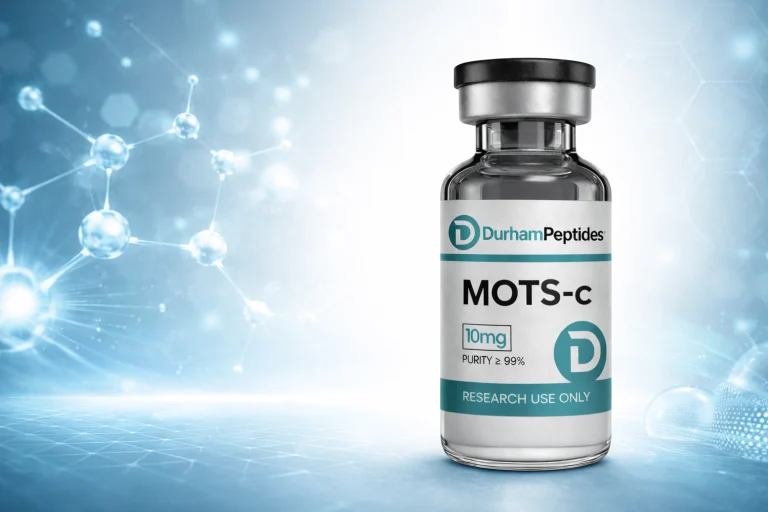
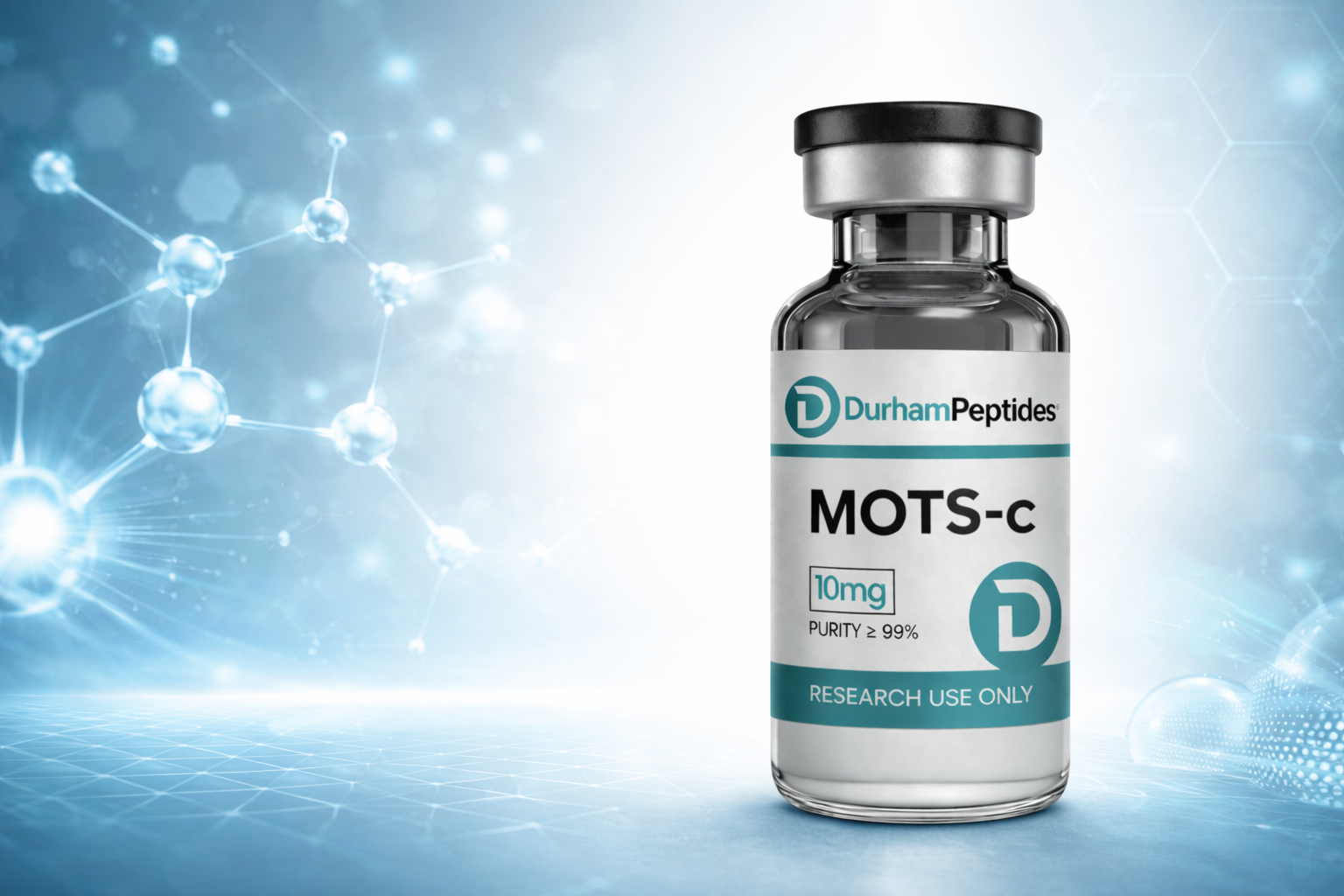
MOTS-c from Durham Peptides is supplied as a lyophilized powder at 10mg per vial. It requires reconstitution with bacteriostatic water before use in research settings. The compound has a CAS number of 1627580-64-6.
Durham Peptides carries MOTS-c at $55.00 CAD per vial, with same-day shipping across Canada and Janoshik-verified COAs available upon request.
Selected Research References
- Lee C, Zeng J, Drew BG, et al. "The mitochondrial-derived peptide MOTS-c promotes metabolic homeostasis and reduces obesity and insulin resistance." Cell Metab. 2015. PMID: 25738459
- Kim SJ, et al. "MOTS-c: an equal opportunity insulin sensitizer." J Mol Med. 2018. PMID: 27216708
All products mentioned in this article are sold by Durham Peptides for research and laboratory use only. They are not intended for human or animal consumption, diagnosis, treatment, cure, or prevention of any disease.