

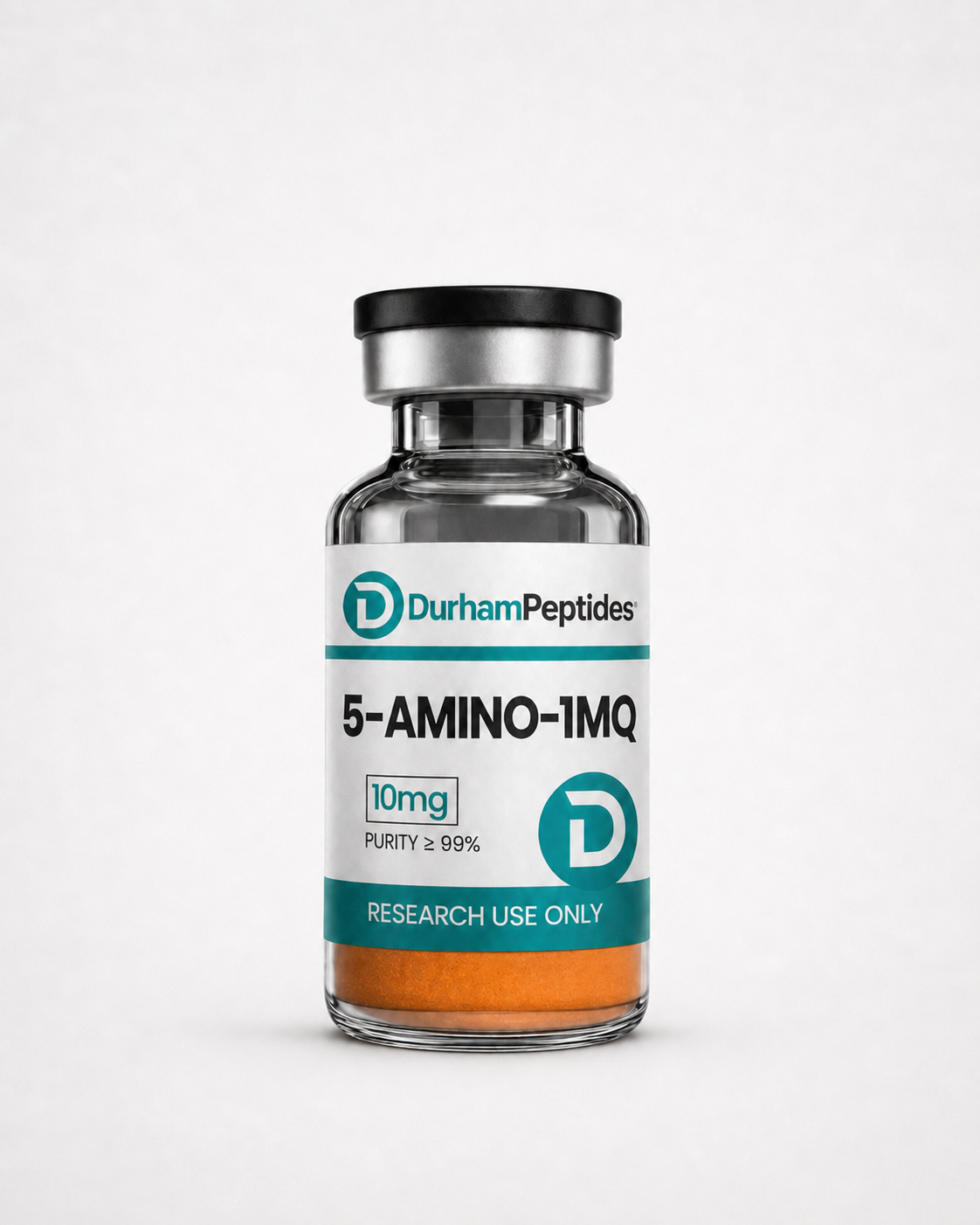
5-Amino-1MQ muscle regeneration NNMT inhibitor aged muscle stem cells research Durham Peptides Canada
5-Amino-1MQ's most-developed application area is adipose tissue research (anchored on the Kraus 2014 Nature paper), but the compound has a second well-established research thread that's mechanistically distinct: muscle regeneration research. The 2019 paper by Neelakantan and colleagues in Biochemical Pharmacology established 5-Amino-1MQ specifically in aged muscle stem cell research, demonstrating effects on senescent muscle stem cell activation and regenerative capacity of aged skeletal muscle. This research thread connects NNMT inhibition to sarcopenia and muscle-aging biology — a different research direction from the adipose work, with its own published literature and design considerations.
For the standalone 5-Amino-1MQ overview, see What Is 5-Amino-1MQ?; for the adipose research angle, see 5-Amino-1MQ for Adipose Tissue Research; for the parallel MOTS-c muscle research thread, see MOTS-c for Exercise and Muscle Research. Nothing here is medical, dosing, or therapeutic guidance.
Muscle Regeneration: The Research Context
Skeletal muscle has substantial regenerative capacity in young animals — a property mediated by specialized muscle stem cells (satellite cells) that reside in a quiescent state alongside muscle fibers and can activate, proliferate, and differentiate into new muscle cells in response to injury or training stimulus. This regenerative capacity is central to maintaining muscle mass, recovering from injury, and adapting to use.
Three properties of muscle regeneration biology are central to the research thread:
Property 1: Satellite cells decline with age. Satellite cell numbers, functional activity, and regenerative capacity all decline with aging — one of the recognized contributors to
sarcopenia (age-related muscle loss). Aged muscle regenerates more slowly and less completely than young muscle, partly because of satellite cell decline.
Property 2: Senescence accumulates in aged muscle. Aged satellite cells progressively enter senescence — a state where cells stop dividing but remain metabolically active, often releasing pro-inflammatory signals that affect surrounding tissue. Senescent muscle stem cells contribute to the regenerative deficit in aged muscle.
Property 3: Metabolic state affects stem cell function. The energy state and metabolic profile of muscle stem cells affects their function. NAD+ availability, sirtuin activity, and broader metabolic biology all influence satellite cell behavior.
This third property is where 5-Amino-1MQ's mechanism intersects directly with muscle stem cell biology — through NNMT inhibition and the downstream NAD+ pool effects.
The Neelakantan 2019 Biochemical Pharmacology Paper
The 2019 paper by Neelakantan, Brightwell, Graber and colleagues, titled "Small molecule nicotinamide N-methyltransferase inhibitor activates senescent muscle stem cells and improves regenerative capacity of aged skeletal muscle," is the foundational reference for 5-Amino-1MQ in muscle research. Key findings:
Finding 1: NNMT inhibition activates senescent muscle stem cells. The researchers documented that small-molecule NNMT inhibition (using 5-Amino-1MQ and related compounds) was associated with reactivation of senescent muscle stem cells — an investigated effect with direct implications for sarcopenia research.
Finding 2: Aged skeletal muscle regenerative capacity improved. In aged animal models, NNMT inhibitor treatment was associated with improved muscle regenerative capacity following injury — extending the satellite cell findings to functional outcome measures.
Finding 3: NAD+ pool effects mediate the mechanism. The paper provided mechanistic detail connecting NNMT inhibition to NAD+ salvage preservation — explaining how the upstream NNMT mechanism translates to the downstream stem cell effects through NAD+ availability.
Finding 4: Mechanism distinct from adipose research findings. While the broader NNMT inhibition story connects across tissues, the muscle stem cell effects represent a distinct application of the same fundamental mechanism in a different tissue context.
This paper established 5-Amino-1MQ as a research tool relevant to muscle-aging biology beyond its initial adipose research foundation.
Investigated Mechanisms in Muscle Research
Several mechanisms have been examined in the published 5-Amino-1MQ muscle research:
Mechanism 1: NAD+ pool preservation in muscle. By inhibiting NNMT, 5-Amino-1MQ preserves more nicotinamide for NAD+ salvage — preventing the diversion of nicotinamide to methylation and excretion. Higher NAD+ availability supports broader NAD+-dependent enzyme activity including sirtuin function. For the NAD+/sirtuin context, see NAD+ and Sirtuins.
Mechanism 2: Muscle stem cell sirtuin activity. NAD+-dependent sirtuins are active in muscle stem cell biology, including SIRT1 effects on stem cell quiescence and SIRT3 effects on mitochondrial biology. NAD+ preservation supports this sirtuin activity in satellite cells.
Mechanism 3: Methylation-cycle effects. NNMT consumes SAM (S-adenosyl methionine) as a methyl donor. NNMT inhibition preserves SAM for other methylation reactions, with broad implications for DNA methylation, protein methylation, and other methylation-dependent biology in muscle.
Mechanism 4: Senescence pathway interactions. Senescent cells have specific metabolic signatures, and metabolic interventions can affect senescence reversal in some research contexts. The 5-Amino-1MQ effects on senescent satellite cells engage this senescence-metabolism intersection.
Mechanism 5: Polyamine metabolism connections. NNMT inhibition affects polyamine metabolism through methylation-cycle effects. Polyamines have documented roles in cell proliferation and tissue regeneration — providing a less-explored mechanism connection.
5-Amino-1MQ vs MOTS-c in Muscle Research
Both 5-Amino-1MQ and MOTS-c have muscle research threads, but through different mechanisms:
Property | 5-Amino-1MQ | MOTS-c |
Compound class | Small molecule | Mitochondrial-derived peptide |
Primary mechanism | NNMT inhibition | AMPK activation |
NAD+ pathway role | Preserves NAD+ via salvage | Engages NAD+ indirectly through AMPK |
Muscle research focus | Aged muscle stem cells, regeneration | Exercise-mimetic, mitochondrial biology |
Foundational paper | Neelakantan 2019 (Biochemical Pharmacology) | Lee 2015 (Cell Metabolism), Reynolds 2021 (Nature Communications) |
Aging research connection | Sarcopenia, stem cell senescence | Age-related physical decline, mitochondrial decline |
For research designed around aged muscle stem cell biology specifically, 5-Amino-1MQ is the more directly relevant tool. For research designed around exercise-mimetic and mitochondrial biology, MOTS-c is the more directly relevant tool. The two compounds engage complementary aspects of muscle-aging biology through different mechanisms.
For the parallel MOTS-c thread, see MOTS-c for Exercise and Muscle Research and MOTS-c and AMPK.
Sarcopenia Research Implications
Sarcopenia — the age-related loss of muscle mass and strength — is one of the well-characterized hallmarks of aging at the tissue level. The 5-Amino-1MQ research thread is directly relevant to sarcopenia research because:
- Satellite cell decline is a recognized contributor to sarcopenia, and 5-Amino-1MQ has documented effects on satellite cell activation
- The aged muscle regeneration deficit is a sarcopenia-defining feature, and the Neelakantan 2019 paper documented improvements in this specific endpoint
- Senescence accumulation in aged muscle is part of the sarcopenia mechanism, and 5-Amino-1MQ engages senescent cell biology
- Metabolic dysregulation in aged muscle is a sarcopenia mechanism, and NAD+ pool preservation addresses this directly
For broader longevity research context, see The Best Longevity Peptides for Research in Canada.
Practical Research Considerations
5-Amino-1MQ 10mg at Durham Peptides is C$50.00 (C$5.00/mg), Janoshik-verified to ≥99% purity by HPLC with mass-spec identity confirmation; 100% synthetic. Note that 5-Amino-1MQ is a small molecule rather than a peptide, with corresponding handling considerations.
For muscle research combining the NNMT inhibition mechanism with NAD+ supplementation, the relevant catalog companions are NAD+ 500mg and NAD+ 1000mg. For the parallel exercise-mimetic muscle research, MOTS-c 10mgsupports complementary research designs.
Frequently Asked Questions
Is 5-Amino-1MQ studied in muscle research? Yes — the 2019 Neelakantan et al. Biochemical Pharmacology paper established 5-Amino-1MQ in aged muscle stem cell research, demonstrating investigated effects on senescent satellite cell activation and aged skeletal muscle regenerative capacity.
How is 5-Amino-1MQ's muscle research different from the adipose research? Same fundamental mechanism (NNMT inhibition, NAD+ pool preservation) but applied to different tissue context. Adipose research focuses on adipocyte energy expenditure and obesity protection; muscle research focuses on satellite cell activation and aged muscle regeneration.
What's the connection between NNMT inhibition and muscle stem cell activation? NNMT inhibition preserves NAD+ via salvage pathway preservation. Higher NAD+ supports sirtuin activity (particularly SIRT1 and SIRT3) which influences muscle stem cell biology, including quiescence regulation and metabolic state.
How does 5-Amino-1MQ compare to MOTS-c for muscle research? Different mechanisms (NNMT inhibition vs AMPK activation) engaging complementary aspects of muscle biology. 5-Amino-1MQ is more directly relevant to aged satellite cell research; MOTS-c is more directly relevant to exercise-mimetic and mitochondrial biology.
Is 5-Amino-1MQ studied for sarcopenia specifically? Yes — the muscle stem cell decline and regeneration deficit in aged muscle are central sarcopenia features, and 5-Amino-1MQ research engages both. The Neelakantan 2019 findings have direct sarcopenia research implications.
Where can I buy 5-Amino-1MQ in Canada? Durham Peptides supplies 5-Amino-1MQ 10mg (C$50.00), Janoshik-verified, for laboratory use only.
Final Thoughts
5-Amino-1MQ's muscle regeneration research thread, anchored on the 2019 Neelakantan et al. Biochemical Pharmacology paper, extends the compound's NNMT-inhibition mechanism beyond the adipose research foundation into aged muscle stem cell biology and sarcopenia research. The mechanism — NNMT inhibition preserving NAD+ via salvage pathway protection, supporting sirtuin activity in satellite cells — is the same fundamental biology operating in a different tissue context. For research designed around aged muscle stem cell biology, sarcopenia mechanisms, or muscle regeneration in aging contexts, 5-Amino-1MQ provides a small-molecule research tool with established research credentials in this specific application area.
For the standalone overview, see What Is 5-Amino-1MQ?; for the adipose research thread, see 5-Amino-1MQ for Adipose Tissue Research; for the parallel muscle research with MOTS-c, see MOTS-c for Exercise and Muscle Research.
Selected Research References
- Neelakantan H, Brightwell CR, Graber TG, et al. Small Molecule Nicotinamide N-Methyltransferase Inhibitor Activates Senescent Muscle Stem Cells and Improves Regenerative Capacity of Aged Skeletal Muscle. Biochemical Pharmacology. 2019;163:481-492. https://pubmed.ncbi.nlm.nih.gov/29161520/
- Kraus D, Yang Q, Kong D, et al. Nicotinamide N-Methyltransferase Knockdown Protects against Diet-Induced Obesity. Nature. 2014;508(7495):258-262. https://pubmed.ncbi.nlm.nih.gov/24717514/
- Pissios P. Nicotinamide N-Methyltransferase: More Than a Vitamin B3 Clearance Enzyme. Trends in Endocrinology and Metabolism. 2017;28(5):340-353. https://pubmed.ncbi.nlm.nih.gov/28291578/
- López-Otín C, Blasco MA, Partridge L, Serrano M, Kroemer G. The Hallmarks of Aging. Cell. 2013;153(6):1194-1217. https://pubmed.ncbi.nlm.nih.gov/23746838/
All products sold by Durham Peptides are for research and laboratory use only. They are not intended for human or animal consumption, diagnosis, treatment, cure, or prevention of any disease.