

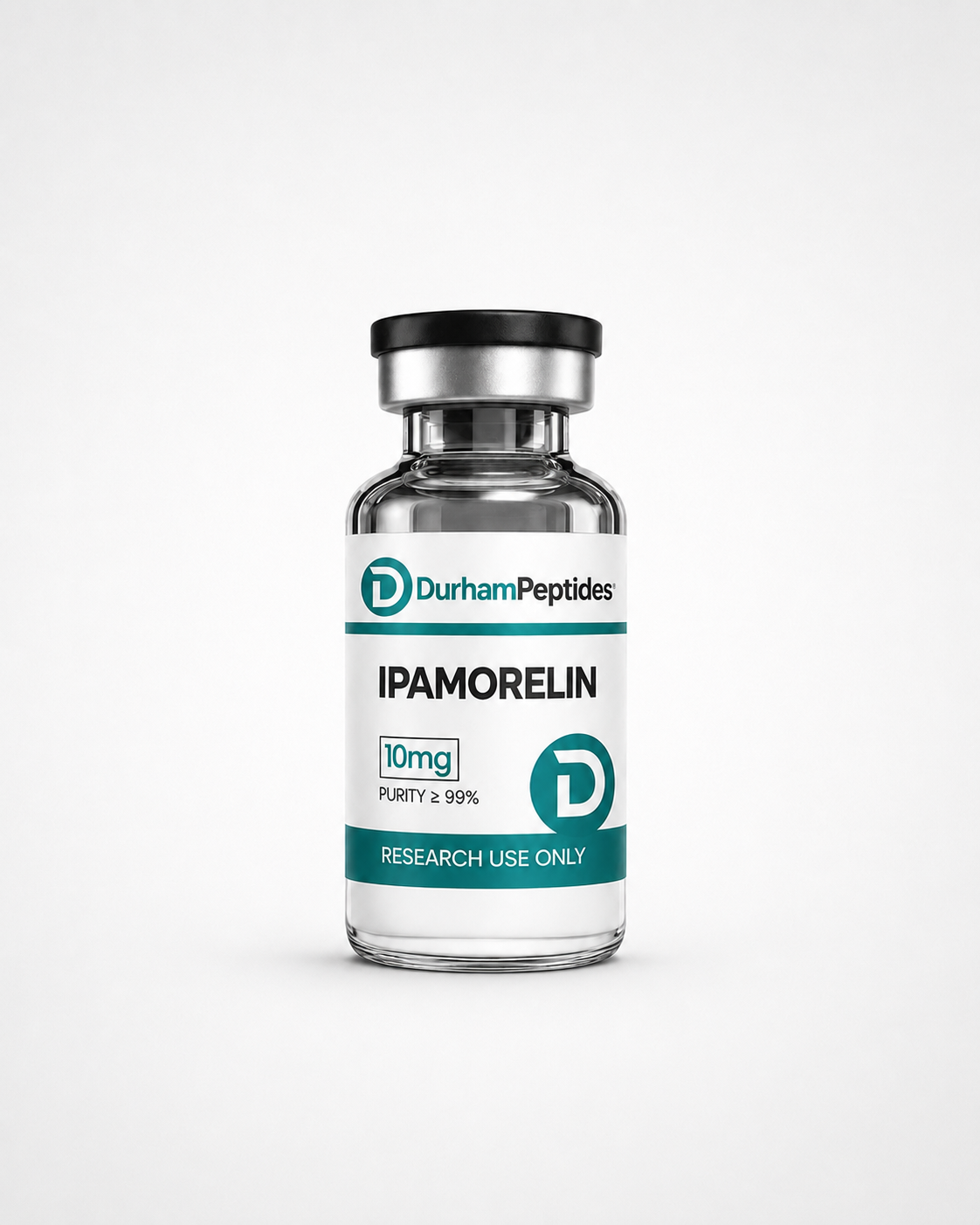
Ipamorelin somatopause aging GH IGF-1 axis decline research selective GHS-R Durham Peptides Canada
Ipamorelin's research literature includes its foundational selectivity properties, body composition research, and combination research with GHRH analogs. But there's a third major application area worth examining specifically: somatopause and aging research. Somatopause — the age-related decline in growth hormone and IGF-1 axis activity — is a recognized aspect of aging biology with substantial research literature, and the pulsatile-stimulation approach that Ipamorelin enables makes it a research-distinctive tool for somatopause research designs. This article focuses on that research thread, distinct from the selectivity mechanism in Ipamorelin's Selectivity and the body composition angle in Ipamorelin for Body Composition Research.
For the standalone Ipamorelin overview, see Ipamorelin's Selectivity; for the GHRH analog combination, see CJC-1295 vs Ipamorelin; for the broader category, see Growth Hormone Secretagogues Explained. Nothing here is medical, dosing, or therapeutic guidance.
Somatopause: The Research Context
The term "somatopause" — first popularized in the 1990s research literature — refers to the progressive age-related decline in the somatotropic axis (GH and IGF-1). Key features of the biology:
Property 1: Progressive GH decline begins in early adulthood. GH secretion peaks in adolescence and begins gradually declining in young adulthood, with continued decline through the lifespan. By the 60s and 70s, GH secretion is typically a fraction of young-adult levels.
Property 2: IGF-1 follows the GH decline. Since IGF-1 is primarily downstream of GH, IGF-1 levels also progressively decline with age. The IGF-1 decline is often used as a measurable biomarker of somatotropic axis status.
Property 3: GH secretion pattern changes, not just total amount. Beyond reduced total GH secretion, the pulsatile pattern itself changes with aging — amplitude of GH pulses decreases, the nocturnal GH peak diminishes, and the overall pattern becomes "flatter" with less dramatic peaks and troughs.
Property 4: Multiple consequences of somatopause biology. Documented research connections include: changes in body composition (sarcopenia + increased adiposity), bone mineral density changes, sleep architecture changes, skin biology changes, and various other aging-associated changes.
Property 5: The somatopause hypothesis remains nuanced. Whether somatopause is a pathological feature of aging or an adaptive response to aging is debated in research. The fact that some interventions targeting somatopause (e.g., GH replacement) have shown mixed long-term effects reflects this complexity.
This is the context in which the Ipamorelin somatopause research thread develops.
Why Ipamorelin Specifically for Somatopause Research
Several Ipamorelin properties make it a research-distinctive tool for somatopause research:
Property 1: Pulsatile GH release pattern. Ipamorelin's short half-life produces clean pulsatile GH release — meaningfully different from exogenous GH administration (which produces sustained elevation) and from longer-acting GHRH analogs (which produce more extended GH release patterns). For research aimed at restoring the pulsatile pattern that's altered in aging biology, the pulsatile-mimicking property is research-relevant.
Property 2: Selectivity preserves the GH signal. Older GHRPs elevated cortisol and prolactin alongside GH. Cortisol is itself associated with multiple aging-related concerns (catabolic effects on muscle, metabolic dysregulation, sleep disruption). Ipamorelin's selectivity (no significant cortisol elevation) lets aging research examine GH effects without cortisol confound. See Ipamorelin's Selectivity.
Property 3: Engages endogenous GH biology. Rather than replacing GH, Ipamorelin works by stimulating endogenous GH release — engaging the body's own pituitary somatotrope cells. For research interested in supporting endogenous axis function rather than replacing it, this is a meaningful research-design distinction.
Property 4: Combines naturally with GHRH analogs. For research designs engaging both upstream GHRH receptor pathway and GHS receptor pathway, Ipamorelin combines naturally with CJC-1295 (No DAC) or Tesamorelin. See CJC-1295 + Ipamorelin Blend Explained.
Investigated Aging-Relevant Effects
Published research has examined investigated Ipamorelin effects across multiple aging-relevant endpoints:
Investigated effect 1: GH and IGF-1 elevation. The foundational mechanism — research has examined investigated effects on circulating GH and IGF-1 levels, including in aging research populations where baseline levels are reduced.
Investigated effect 2: Body composition in aging. Sarcopenia (age-related muscle loss) and increased adiposity are core somatopause features. Ipamorelin's body composition research applies to aging contexts — see Ipamorelin for Body Composition Research for the broader body composition framework.
Investigated effect 3: Bone biology. GH and IGF-1 have documented roles in bone formation and density. Research has examined investigated effects on bone-related markers in aging research contexts.
Investigated effect 4: Sleep architecture. GH secretion peaks during deep sleep, and sleep architecture changes are part of aging biology. The pulsatile GH effects of Ipamorelin connect to research on sleep and aging.
Investigated effect 5: Skin and connective tissue. Skin biology changes in aging include reduced dermal thickness, reduced collagen synthesis, and reduced elasticity — all connected to declining GH/IGF-1 axis activity in research models.
Investigated effect 6: Pulsatile pattern restoration in aged subjects. A research-design specific endpoint: examining whether Ipamorelin can restore more youthful-pattern GH pulsatility in aged research models, not just elevate GH levels.
The Pulsatile vs Sustained Question in Somatopause Research
A research-design point worth understanding: aging research using compounds that affect the somatotropic axis faces a fundamental design choice between pulsatile and sustained approaches:
Approach | Examples | Pattern produced |
Exogenous GH | rhGH administration | Sustained elevated GH, not pulsatile |
Long-acting GHRH analogs | CJC-1295 with DAC | Extended GH elevation, somewhat blunted pulsatility |
Standard GHRH analogs | Tesamorelin, CJC-1295 No DAC, Sermorelin | More pulsatile pattern, shorter peak duration |
GHS receptor agonists | Ipamorelin | Clean pulsatile pattern, short peaks |
Endogenous (no intervention) | Untreated subject | Natural pulsatile pattern with age-related changes |
For somatopause research interested specifically in pulsatile pattern biology — examining whether restoring pulsatility (not just GH levels) affects aging biology — the Ipamorelin approach is one of the more research-aligned choices. For research interested in sustained GH/IGF-1 elevation regardless of pattern, sustained approaches may be more appropriate.
For the CJC-1295 No DAC vs DAC distinction relevant to this choice, see CJC-1295 No DAC vs DAC.
Somatopause Research vs Other Ipamorelin Research Threads
How somatopause research differs from the selectivity mechanism and body composition research:
Property | Somatopause research | Selectivity mechanism | Body composition |
Primary research focus | Age-related GH/IGF-1 decline biology | Receptor specificity, cortisol/prolactin avoidance | Lean mass, adiposity, IGF-1-mediated effects |
Research models | Aging research models, age-stratified studies | Cell culture (receptor binding), young animal models | Animal body composition, aging body composition |
Primary endpoints | GH/IGF-1 restoration, body composition in aging, age-related markers | Receptor binding affinity, cortisol/prolactin measurements | Lean mass, fat mass, IGF-1 |
Time horizons | Weeks to months (aging research designs) | Acute to days (mechanism studies) | Weeks to months |
The three threads share mechanistic foundations (pulsatile GH release, IGF-1 axis engagement, selectivity) but represent different research design choices.
Practical Research Considerations
Ipamorelin 10mg at Durham Peptides is C$74.69 (C$7.47/mg), Janoshik-verified to ≥99% purity by HPLC with mass-spec identity confirmation; 100% synthetic; vegan. Storage: 2–8°C short-term, -20°C long-term, protected from light and moisture; reconstitute in bacteriostatic water.
For somatopause research engaging both the GHS receptor (Ipamorelin) and GHRH receptor (CJC-1295) pathways, see the CJC-1295 + Ipamorelin Blend (C$94.99). For broader longevity research combining somatopause approaches with other aging mechanisms, see The Best Longevity Peptides for Research in Canada.
Frequently Asked Questions
What is somatopause? The age-related decline in growth hormone and IGF-1 axis activity. Includes reduced GH secretion, altered pulsatile patterns, and reduced IGF-1 levels — with downstream effects on body composition, bone density, sleep, skin biology, and various other aging-associated changes.
Why is Ipamorelin specifically studied in somatopause research? Because of its pulsatile GH release pattern (potentially mimicking the youthful pattern that's altered in aging), its selectivity (no cortisol confound — cortisol itself contributing to aging concerns), and its engagement of endogenous GH biology rather than exogenous replacement.
Is somatopause considered pathological or adaptive? Debated in research. Some research treats it as a treatable aspect of aging biology; other research considers it potentially adaptive. The fact that some somatotropic-axis interventions have shown mixed long-term effects reflects this complexity. Aging research must engage this nuance.
What's the difference between sustained vs pulsatile somatopause research approaches? Sustained approaches (exogenous GH, long-acting GHRH analogs) elevate GH/IGF-1 without restoring youthful pulsatile patterns. Pulsatile approaches (Ipamorelin, short-acting GHRH analogs) more closely mimic the youthful pattern. Different research questions, different design choices.
Should somatopause research use Ipamorelin alone or combined with CJC-1295? Both approaches are used. Alone, Ipamorelin isolates the GHS receptor activation. Combined with CJC-1295 (GHRH receptor activation), the dual-pathway approach engages both upstream pathways. See CJC-1295 vs Ipamorelin.
Where can I buy Ipamorelin in Canada? Durham Peptides supplies Ipamorelin 10mg (C$74.69) standalone and in the CJC-1295 + Ipamorelin Blend (C$94.99), both Janoshik-verified.
Final Thoughts
Ipamorelin's somatopause research thread connects the compound's foundational properties — pulsatile GH release, GHS receptor selectivity, engagement of endogenous biology — to age-related GH/IGF-1 axis decline research. The combination of mechanistic alignment with the pulsatile pattern biology of natural GH secretion, the selectivity that avoids cortisol confounds, and the engagement of endogenous somatotrope biology makes Ipamorelin a research-distinctive tool for aging research designs. For researchers entering somatopause research, particularly research designs that emphasize pulsatile pattern restoration rather than sustained GH elevation, Ipamorelin's research-tool properties are particularly well-suited.
For the selectivity context, see Ipamorelin's Selectivity; for the body composition research, see Ipamorelin for Body Composition Research; for the GHRH analog combination, see CJC-1295 vs Ipamorelin; for the broader longevity research framework, see The Best Longevity Peptides for Research in Canada.
Selected Research References
- Raun K, Hansen BS, Johansen NL, et al. Ipamorelin, the First Selective Growth Hormone Secretagogue. European Journal of Endocrinology. 1998;139(5):552-561. https://pubmed.ncbi.nlm.nih.gov/9849822/
- Bartke A. Growth Hormone and Aging: A Challenging Controversy. Clinical Interventions in Aging. 2008;3(4):659-665. https://pubmed.ncbi.nlm.nih.gov/19281058/
- Veldhuis JD, Roemmich JN, Richmond EJ, Bowers CY. Somatotropic and Gonadotropic Axes Linkages in Infancy, Childhood, and the Puberty-Adult Transition. Endocrine Reviews. 2006;27(2):101-140. (Reference on somatotropic axis biology framework.)
- Bowers CY. Editorial: Unnatural Growth Hormone-Releasing Peptide Begets Natural Ghrelin. Journal of Clinical Endocrinology & Metabolism. 2001;86(4):1464-1469. https://pubmed.ncbi.nlm.nih.gov/11297567/
- Müller TD, Nogueiras R, Andermann ML, et al. Ghrelin. Molecular Metabolism. 2015;4(6):437-460. https://pubmed.ncbi.nlm.nih.gov/26049203/
All products sold by Durham Peptides are for research and laboratory use only. They are not intended for human or animal consumption, diagnosis, treatment, cure, or prevention of any disease.