
Best peptides for recovery research BPC-157 TB-500 GHK-Cu Wolverine Stack Durham Peptides Canada
Recovery research is one of the largest segments of the research peptide field in Canada. The most-discussed peptides in fitness, biohacking, and tissue-repair research communities — BPC-157, TB-500, and combination formulations built around them — share this category. For Canadian researchers entering recovery-focused research, the question isn't whether peptides are relevant to the research literature, but which compounds and combinations best match specific research questions.
This article walks through the most-studied recovery peptides individually, explains how combination formulations bring complementary mechanisms together, and provides a framework for matching research questions to specific products in the Durham Peptides catalog.
For broader category coverage, see Recovery Peptides: A Research Guide to BPC-157, TB-500, and the Wolverine Stack.
The Recovery Peptide Category
What makes a peptide a "recovery peptide" in research literature? The category typically includes compounds with published research on:
- Tissue repair and regeneration
- Wound healing and angiogenesis
- Cell migration into damaged tissue
- Anti-inflammatory effects in injured tissue contexts
- Skin and connective tissue research
The category overlaps substantially with anti-aging research and tissue-repair research more broadly. Peptides studied for these mechanisms appear in research literature across multiple subcategories.
The Two Foundational Recovery Peptides
Two compounds anchor the Canadian recovery peptide research landscape:
BPC-157 (Body Protection Compound). A 15-amino-acid synthetic peptide derived from a naturally occurring protective sequence in human gastric juice. Studied extensively in published preclinical research for:
- Angiogenic effects (formation of new blood vessels in injured tissue)
- VEGFR2 receptor activity modulation
- Growth factor expression
- Tissue repair in tendon, ligament, muscle, and gastrointestinal models
For the deep-dive coverage, see What Is BPC-157? Why It's Canada's Most Popular Research Peptide. Available individually as BPC-157 10mg.
TB-500 (Thymosin Beta-4 fragment). A research peptide derived from the active region of Thymosin Beta-4. Studied in published research for:
- Actin binding and cytoskeleton dynamics
- Cell migration (allowing repair cells to move into damaged tissue)
- Wound healing and tissue regeneration
- Cardiac and other tissue repair models
For the deep-dive coverage, see TB-500: The Recovery Peptide Behind the Wolverine Stack. Available individually as TB-500 10mg.
For the direct comparison between the two, see BPC-157 vs TB-500: Which Recovery Peptide Do Researchers Prefer?.
Why Researchers Combine Them: The Wolverine Stack Logic
The most-searched peptide combination in the Canadian research market pairs BPC-157 and TB-500 specifically. The reasoning isn't marketing — it's mechanism-focused research logic.
BPC-157 and TB-500 engage complementary biological pathways:
- BPC-157 addresses the tissue environment for repair — bringing blood flow, growth factors, and angiogenic signaling to the damaged area
- TB-500 addresses cell migration into that environment — allowing repair cells (including inflammatory cells and stem cells) to move toward and into the area where repair is needed
The combination engages both pathways simultaneously without redundancy. This is the research logic behind the Wolverine Stack — Durham Peptides' two-peptide combination formulation containing 5mg BPC-157 + 5mg TB-500 in a single 10mg vial.
For the complete coverage of the Wolverine Stack composition logic, see The Wolverine Stack Explained: BPC-157 + TB-500.
Adding GHK-Cu: The Three-Peptide GLOW Blend
GHK-Cu (glycyl-L-histidyl-L-lysine copper) brings a third complementary mechanism to recovery research — gene expression modulation. The published microarray research literature shows GHK-Cu modulates expression of hundreds of genes including those related to skin remodeling, collagen synthesis, and tissue protection.
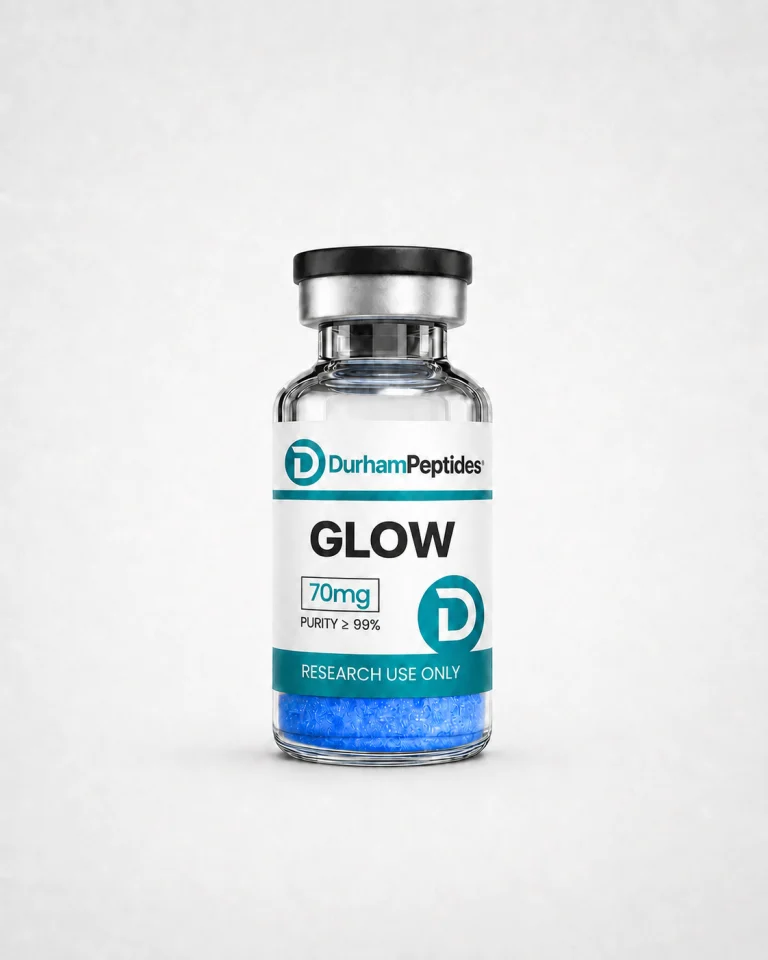
The GLOW Blend extends the Wolverine Stack logic by adding GHK-Cu. The composition: 50mg GHK-Cu + 10mg BPC-157 + 10mg TB-500 in a 70mg total vial.
The three-pathway logic of GLOW:
- GHK-Cu — gene expression and skin/tissue remodeling
- BPC-157 — angiogenic and growth factor effects
- TB-500 — cell migration
For the complete composition logic, see GLOW Blend Composition: Why GHK-Cu + BPC-157 + TB-500 Work Together.
The Four-Peptide KLOW Blend
The most comprehensive recovery research formulation in the Durham Peptides catalog is the KLOW Blend — adding KPV as a fourth peptide to the GLOW formulation.
The four-pathway logic of KLOW:
- KPV — anti-inflammatory pathway (NF-κB modulation, cytokine response)
- GHK-Cu — gene expression and tissue remodeling
- BPC-157 — angiogenic and growth factor effects
- TB-500 — cell migration
For coverage of KPV specifically, see What Is KPV? The Anti-Inflammatory Tripeptide in the KLOW Blend. For the KLOW vs GLOW decision framework, see KLOW Blend vs GLOW Blend: How the Four-Peptide Formula Compares.
Decision Framework: Which Recovery Peptide Product Fits Which Research Question
The Durham Peptides recovery peptide catalog covers a range of research applications:
For research focused specifically on tissue repair through angiogenesis: BPC-157 individually. The mechanism-focused choice when the research question is about the angiogenic/growth factor pathway specifically.
For research focused specifically on cell migration: TB-500 individually. The mechanism-focused choice when the research question is about actin binding and cell migration specifically.
For research focused specifically on gene expression and skin biology: GHK-Cu individually. The mechanism-focused choice when the research question is about gene expression modulation specifically.
For research that combines tissue repair and cell migration: Wolverine Stack. The two-peptide formulation engaging both BPC-157 and TB-500 mechanisms.
For research that adds gene expression and skin biology to tissue repair: GLOW Blend. The three-peptide formulation engaging gene expression, angiogenesis, and cell migration.
For research that includes anti-inflammatory mechanism alongside tissue repair: KLOW Blend. The four-peptide formulation engaging anti-inflammatory action, gene expression, angiogenesis, and cell migration.
For broader combination logic, see Peptide Stacking Guide: The Science Behind Combination Research Protocols.
The Cost-Per-Mechanism Comparison
Combination formulations typically offer cost efficiency over buying components separately. The math:
- Buying BPC-157 + TB-500 separately = two vials, two reconstitutions, larger total cost
- Wolverine Stack = single vial, single reconstitution, lower cost than buying separately
The same logic applies to GLOW (vs buying GHK-Cu + BPC-157 + TB-500 separately) and KLOW (vs buying KPV + GHK-Cu + BPC-157 + TB-500 separately).
For broader pricing context, see Peptide Pricing in Canada: What Drives Cost and How to Evaluate Value.
Quality Standards Across the Recovery Peptide Catalog
All Durham Peptides recovery peptide products share the same quality framework:
- Manufactured via Solid-Phase Peptide Synthesis with synthetic amino acids
- No animal-derived materials anywhere in the manufacturing chain
- Independent third-party testing by Janoshik Analytical
- ≥99% HPLC purity per peptide
- Mass spectrometry identity confirmation per peptide
- Verifiable Janoshik unique key for COA verification
- Canadian-domestic supply with same-day Ontario shipping
For the complete quality framework, see How to Verify Peptide Quality: COAs, Third-Party Testing & What to Look For.
Storage and Reconstitution
All recovery peptides follow the standard research peptide framework:
- Lyophilized form refrigerated (2-8°C) for moderate-term storage; frozen (-20°C) for long-term
- Reconstituted with bacteriostatic water for use
- Reconstituted vials refrigerated only, used within ~28 days
For complete coverage, see Peptide Storage & Shelf Life, How to Reconstitute Peptides, and Peptide Reconstitution Calculator Guide.
Frequently Asked Questions
What's the best peptide for recovery research? Depends on the research question. BPC-157 for angiogenesis-focused research. TB-500 for cell migration research. GHK-Cu for gene expression. The Wolverine Stack, GLOW Blend, or KLOW Blend for multi-mechanism combination research.
Should I buy single peptides or combinations? Combinations offer cost efficiency and convenience for multi-mechanism research. Single peptides offer more flexibility for mechanism-focused research questions. Most researchers buying for general recovery research find combinations practical.
What's the difference between Wolverine Stack and GLOW Blend? Wolverine Stack = 2 peptides (BPC-157 + TB-500), 10mg total. GLOW Blend = 3 peptides (GHK-Cu + BPC-157 + TB-500), 70mg total. GLOW adds GHK-Cu to the Wolverine logic. See Wolverine Stack Explained and GLOW Blend Composition.
What's the difference between GLOW and KLOW? GLOW = 3 peptides (70mg). KLOW = 4 peptides with KPV added (80mg). KLOW adds the anti-inflammatory mechanism to the GLOW formulation. See KLOW vs GLOW Comparison.
How do BPC-157 and TB-500 work together? BPC-157 addresses the tissue environment for repair (blood flow, angiogenesis, growth factors). TB-500 addresses cell migration into that environment. Complementary mechanisms — neither replaces the other.
Is BPC-157 alone enough for recovery research? For research focused specifically on the angiogenic and growth factor pathway, BPC-157 alone is the mechanism-focused choice. For research that includes cell migration, gene expression, or anti-inflammatory components, combinations engage additional mechanisms.
What about TB-500 alone? For research focused specifically on cell migration and actin binding mechanisms, TB-500 alone is the mechanism-focused choice. For broader tissue-repair research, combinations bring complementary mechanisms.
Which is most studied? BPC-157 has the most-discussed research literature in Canadian peptide research communities. GHK-Cu has the largest published research base (over 100 studies). TB-500 has substantial preclinical literature.
How long do recovery peptides last? Lyophilized form: ~12-18 months refrigerated, ~24+ months frozen. Reconstituted: ~28 days refrigerated. See Peptide Storage & Shelf Life.
Do recovery peptides require Janoshik testing? The research-grade industry standard is independent third-party testing. Durham Peptides recovery products all have Janoshik third-party COAs at durhampeptides.ca/lab-results.
Are recovery peptides legal in Canada? Research peptides operate under research-use-only framing for laboratory and research applications. Not approved by Health Canada for human or veterinary therapeutic use. See Are Peptides Legal in Canada?.
What's the most cost-effective way to start recovery research? The Wolverine Stack offers the most-studied two-peptide combination at lower per-mg cost than buying components separately. For broader mechanism coverage, GLOW or KLOW Blends offer increasing pathway coverage with proportional cost.
Final Thoughts
The Canadian recovery peptide research landscape in 2026 is centered around five core options — BPC-157 individually, TB-500 individually, GHK-Cu individually, the Wolverine Stack (two-peptide combination), the GLOW Blend (three-peptide combination), and the KLOW Blend (four-peptide combination). Each fits different research questions, and the combination formulations provide cost efficiency and convenience for multi-mechanism research.
For Canadian researchers, the practical takeaways:
- BPC-157 + TB-500 (Wolverine Stack) is the foundational recovery research combination
- Adding GHK-Cu (GLOW) brings gene expression and skin biology mechanisms
- Adding KPV (KLOW) brings anti-inflammatory mechanism for the most comprehensive four-pathway combination
- Single peptides remain appropriate for mechanism-focused research questions
- Quality verification through Janoshik third-party testing applies identically across all options
For continued reading, see Recovery Peptides: A Research Guide, The Wolverine Stack Explained, GLOW Blend Composition, KLOW Blend Buyer's Guide, and Peptide Stacking Guide.
Browse the complete Durham Peptides catalog at durhampeptides.ca/category/all-products. View all Janoshik-verified COAs at durhampeptides.ca/lab-results.
Selected Research References
- Sikiric P, Seiwerth S, Rucman R, et al. Stable Gastric Pentadecapeptide BPC 157: Novel Therapy in Gastrointestinal Tract. Current Pharmaceutical Design. 2011;17(16):1612-1632. https://pubmed.ncbi.nlm.nih.gov/21548867/
- Goldstein AL, Hannappel E, Sosne G, Kleinman HK. Thymosin β4: A Multi-Functional Regenerative Peptide. Expert Opinion on Biological Therapy. 2012;12(1):37-51. https://pubmed.ncbi.nlm.nih.gov/22142325/
- Pickart L, Margolina A. Regenerative and Protective Actions of the GHK-Cu Peptide. International Journal of Molecular Sciences. 2018;19(7):1987. https://pubmed.ncbi.nlm.nih.gov/29986520/
- Crockford D, Turjman N, Allan C, Angel J. Thymosin Beta-4: Structure, Function, and Biological Properties. Annals of the New York Academy of Sciences. 2010;1194:179-189. https://pubmed.ncbi.nlm.nih.gov/20536467/
- Pickart L, Vasquez-Soltero JM, Margolina A. The Human Tripeptide GHK and Tissue Remodeling. Journal of Biomaterials Science, Polymer Edition. 2008;19(8):969-988. https://pubmed.ncbi.nlm.nih.gov/18644225/
- Chang CH, Tsai WC, Lin MS, Hsu YH, Pang JH. The Promoting Effect of Pentadecapeptide BPC 157 on Tendon Healing Involves Tendon Outgrowth, Cell Survival, and Cell Migration. Journal of Applied Physiology. 2011;110(3):774-780. https://pubmed.ncbi.nlm.nih.gov/21030672/
All products sold by Durham Peptides are for research and laboratory use only. They are not intended for human or animal consumption, diagnosis, treatment, cure, or prevention of any disease. This article is informational and does not constitute medical advice.