

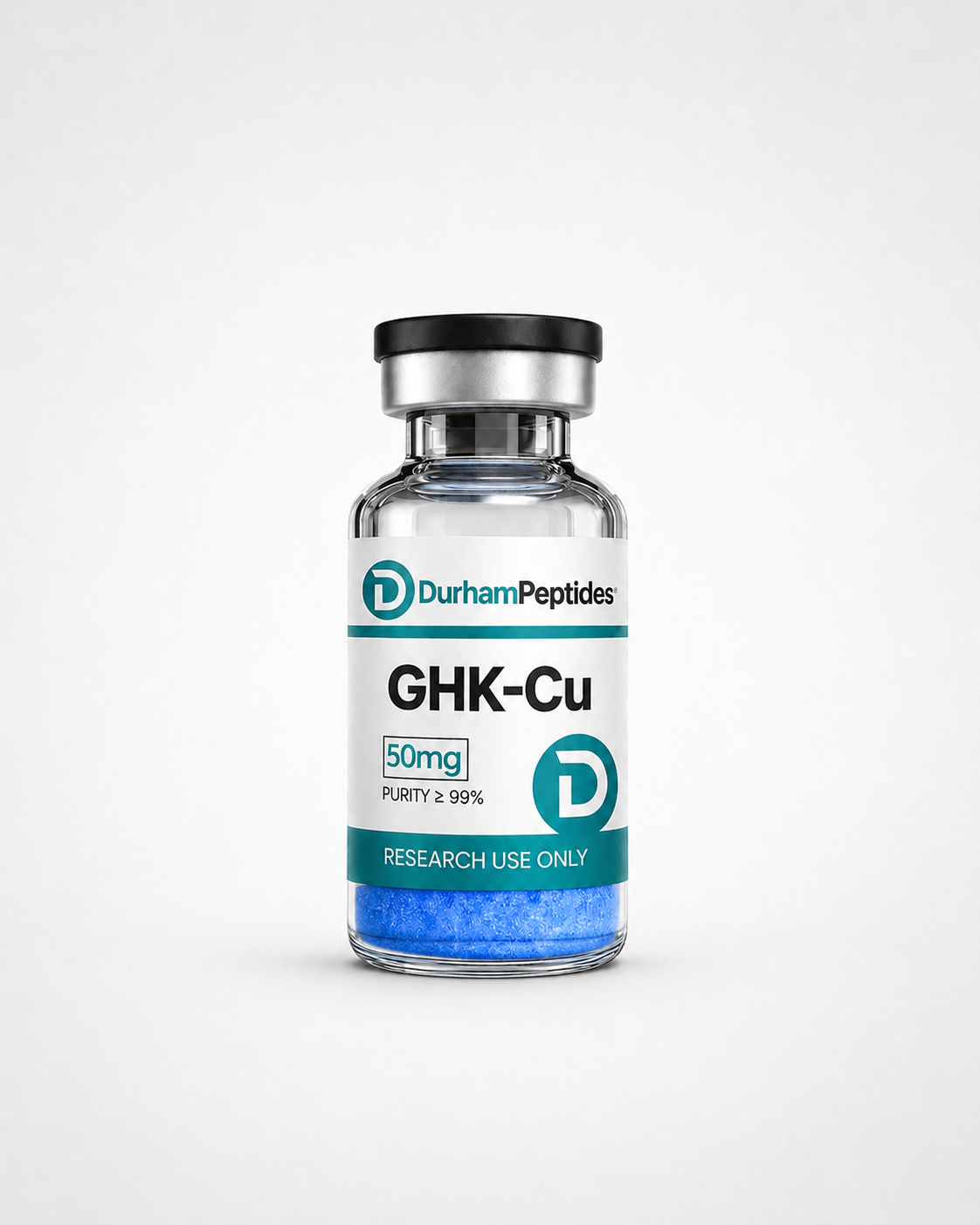
GHK-Cu photoaging UV damage skin research copper peptide Pickart Durham Peptides Canada
GHK-Cu's research literature spans multiple skin biology applications, but one specific area deserves its own focused treatment: photoaging research. Photoaging — skin damage and accelerated aging caused by chronic UV exposure — is biologically distinct from intrinsic skin aging (chronological aging without significant UV exposure) and has its own research literature, mechanisms, and endpoints. The published GHK-Cu photoaging research, building on Loren Pickart's broader copper peptide work, has examined investigated effects on photoaged skin biology specifically. This article focuses on that research thread.
For the standalone GHK-Cu overview, see What Is GHK-Cu?; for the foundational wound healing research, see GHK-Cu for Wound Healing Research; for the copper peptide chemistry foundation, see Copper Peptides Explained; for the hair-specific research, see GHK-Cu for Hair Research. Nothing here is medical, dosing, or therapeutic guidance.
Photoaging vs Intrinsic Aging: The Research Distinction
The skin aging research field distinguishes between two related but mechanistically distinct processes:
Intrinsic (chronological) aging is the time-dependent decline in skin biology that occurs in protected (sun-shielded) skin areas. Characteristics include:
- Gradual thinning of the dermis
- Reduced fibroblast activity
- Slower epidermal turnover
- Gradual reduction in collagen synthesis
- Genetic and hormonal contributors
Photoaging (extrinsic aging) is UV-induced skin damage that accumulates over decades of sun exposure. Characteristics include:
- Elastosis (degradation of elastin fibers)
- Solar lentigines (sun spots) and dyspigmentation
- Wrinkle formation patterns distinct from intrinsic wrinkles
- Telangiectasias (visible small blood vessels)
- Increased matrix metalloproteinase (MMP) activity degrading dermal extracellular matrix
- Accumulated DNA damage in skin cells
- Increased oxidative stress markers
The biology differs substantially enough that research compounds effective for intrinsic aging may or may not address photoaging-specific mechanisms, and vice versa. Photoaging research uses specific endpoints — UV-induced MMP expression, elastotic changes, photodamaged collagen markers — that don't apply to intrinsic aging research designs.
Why GHK-Cu in Photoaging Research Specifically
Several properties of GHK-Cu biology align with photoaging research questions:
Property 1: MMP modulation. Photoaging fundamentally involves dysregulated matrix metalloproteinase activity. UV exposure induces MMPs (particularly MMP-1, MMP-3, MMP-9) that degrade collagen and elastin, contributing to the characteristic photoaged appearance. GHK-Cu research has examined investigated effects on MMP expression and balance with tissue inhibitors of metalloproteinases (TIMPs) — directly relevant to photoaging mechanism.
Property 2: Collagen synthesis stimulation. Photoaging involves both increased collagen degradation (via MMPs) and reduced collagen synthesis. GHK-Cu's well-documented collagen synthesis effects address one side of this imbalance.
Property 3: Anti-inflammatory effects. UV exposure produces sustained inflammatory responses contributing to photoaging biology. GHK-Cu's investigated effects on TNF-α, IL-6, and NF-κB pathway activity (covered in GHK-Cu and Inflammation) intersect with photoaging inflammation.
Property 4: Gene expression modulation. The Pickart-group research has documented investigated GHK-Cu effects on the expression of hundreds of genes including those involved in antioxidant defense, DNA repair, and matrix remodeling — multiple of which are dysregulated in photoaged skin.
Property 5: Antioxidant biology. Copper-dependent enzymes (superoxide dismutase, ceruloplasmin) contribute to antioxidant defense. UV exposure generates substantial reactive oxygen species; the copper-peptide chemistry contributes to antioxidant biology in photoaged skin research.
For the foundational research on these mechanisms, see What Is GHK-Cu? and Copper Peptides Explained.
The Investigated GHK-Cu Photoaging Research
Published research has examined investigated GHK-Cu effects across multiple photoaging endpoints:
Investigated effect 1: Reduction of photoaged appearance markers. Research has examined investigated GHK-Cu effects on the visible features of photoaging — including studies measuring fine line and wrinkle parameters, skin texture and roughness, and broader photoaged appearance endpoints in research models and clinical research.
Investigated effect 2: MMP modulation in photodamaged skin. Research has examined investigated effects on MMP-1, MMP-3, MMP-9 expression and activity in photoaged research models — directly engaging the matrix-degradation biology central to photoaging.
Investigated effect 3: Collagen synthesis restoration in photoaged skin. The collagen synthesis effects of GHK-Cu have been examined specifically in photoaged research models, examining whether collagen synthesis can be restored toward more youthful levels.
Investigated effect 4: Antioxidant defense gene expression. Photoaging involves oxidative stress accumulation. Research has examined investigated GHK-Cu effects on antioxidant defense gene expression (including SOD, catalase, and glutathione system genes).
Investigated effect 5: DNA repair pathway effects. Photoaging includes accumulated DNA damage from UV exposure. Some research has examined investigated GHK-Cu effects on DNA repair pathway expression and activity.
Investigated effect 6: Pigmentation regulation. Photoaging includes characteristic pigmentation changes (solar lentigines, dyspigmentation). Some research has examined investigated effects on melanocyte biology and pigmentation regulation in photoaged contexts.
The Pickart Photoaging Research Framework
Loren Pickart and colleagues have authored several research publications specifically addressing GHK-Cu in photoaging contexts. The framework Pickart established emphasizes:
- Multi-mechanism engagement. Photoaging biology involves multiple parallel mechanisms; a research compound addressing photoaging needs to engage multiple mechanisms rather than targeting a single pathway.
- Gene expression modulation as central mechanism. Pickart's research framework emphasizes the breadth of gene expression effects (hundreds of genes affected) as central to GHK-Cu's photoaging biology — not just collagen genes but anti-inflammatory, antioxidant, and DNA repair genes.
- Copper-peptide chemistry as mechanistically essential. Pickart's framework specifically emphasizes that the copper component is essential for photoaging-relevant biology, not just for general copper peptide research.
- Connection to wound healing biology. Photoaging biology shares mechanisms with wound healing biology (the foundational copper peptide research application — see GHK-Cu for Wound Healing Research), and the photoaging research framework builds on the wound healing research base.
For Pickart's broader research framework, see Copper Peptides Explained.
Photoaging Research vs Other GHK-Cu Research Threads
How photoaging research differs from the other major GHK-Cu research applications:
Property | Photoaging research | Wound healing research | Hair research | Inflammation research |
Primary research focus | UV-induced skin damage biology | Acute and chronic tissue repair | Hair follicle biology | Systemic and local inflammation |
Primary endpoints | MMP expression, elastosis markers, photoaged appearance | Collagen synthesis, fibroblast biology, wound closure | Follicle size, hair characteristics | Cytokine levels, NF-κB activity |
Research models | UV-exposed skin (in vivo), photoaged dermal models | Wound models (in vivo, ex vivo) | Hair follicle cultures, animal models | Inflammation-induced models |
Time horizons | Weeks to months (slow photoaging biology) | Days to weeks (faster wound biology) | Weeks to months (hair cycle dependent) | Hours to days (acute), weeks (chronic) |
Foundational base | Pickart photoaging research extensions | Pickart wound healing foundation | Hair follicle biology extensions | Inflammation biology extensions |
The four threads share mechanistic foundations (collagen, gene expression, copper-peptide chemistry) but represent distinct research design choices.
Practical Research Considerations
Durham Peptides supplies GHK-Cu in two formats:
- GHK-Cu 50mg at C$54.99 (C$1.10/mg)
- GHK-Cu 100mg at C$94.69 (C$0.95/mg)
For photoaging research at substantial milligram quantities, the 100mg vial captures meaningful per-mg savings (~14% cheaper per milligram). See GHK-Cu 50mg vs 100mg. Both formats Janoshik-verified to ≥99% purity with mass-spec identity, 100% synthetic, vegan.
For combination photoaging research bridging GHK-Cu with the angiogenesis (BPC-157) and cell migration (TB-500) mechanisms, see the Glow Blend and Inside the GLOW Blend. For research adding anti-inflammatory mechanism, see the KLOW Blend and Inside the KLOW Blend.
Frequently Asked Questions
What's the difference between photoaging and intrinsic skin aging? Photoaging is UV-induced skin damage accumulating from chronic sun exposure (elastosis, MMP dysregulation, pigmentation changes, characteristic wrinkle patterns). Intrinsic aging is time-dependent decline in protected skin (gradual thinning, reduced fibroblast activity, slower turnover). Different biology, different research approaches.
Is GHK-Cu studied for photoaging specifically? Yes — published research has examined investigated GHK-Cu effects on photoaged skin biology specifically, including MMP modulation, collagen synthesis restoration, antioxidant gene expression, DNA repair pathways, and pigmentation regulation in photoaged research models.
Why is GHK-Cu mechanistically suited to photoaging research? Because it engages multiple pathways central to photoaging biology — MMP modulation (degradation side), collagen synthesis (rebuilding side), anti-inflammatory effects (UV-inflammation side), gene expression modulation (broad transcriptional effects), and antioxidant biology (UV-induced ROS side).
Does the copper component specifically matter for photoaging? Yes — copper-dependent enzymes (superoxide dismutase for antioxidant defense, lysyl oxidase for collagen crosslinking) are central to photoaging biology, making the copper-peptide chemistry mechanistically engaged with photoaging-relevant enzymatic pathways.
How does GHK-Cu photoaging research relate to wound healing research? The two threads share mechanistic foundations (collagen biology, gene expression, copper-peptide chemistry) and the photoaging research framework builds on the wound healing research base — but the photoaging research has its own specific endpoints (MMP balance, photoaged appearance markers) distinct from wound healing endpoints.
Where can I buy GHK-Cu in Canada? Durham Peptides supplies GHK-Cu 50mg (C$54.99) and GHK-Cu 100mg(C$94.69), both Janoshik-verified.
Final Thoughts
GHK-Cu's photoaging research thread is one of the more developed corners of the broader GHK-Cu skin research literature — addressing UV-induced skin damage through the multi-mechanism engagement that distinguishes copper peptide research from single-target skin compounds. The combination of MMP modulation, collagen synthesis stimulation, anti-inflammatory effects, gene expression modulation, antioxidant biology, and the copper-dependent enzyme chemistry positions GHK-Cu as a research-distinctive tool for photoaging research designs. For researchers entering photoaging research, the foundational Pickart copper peptide framework provides a multi-mechanism research base that extends from wound healing through to photoaging through to broader skin aging biology.
For the standalone overview, see What Is GHK-Cu?; for the foundational wound healing research, see GHK-Cu for Wound Healing Research; for the copper-peptide chemistry, see Copper Peptides Explained; for the hair-specific extension, see GHK-Cu for Hair Research; for the inflammation thread, see GHK-Cu and Inflammation.
Selected Research References
- Pickart L, Margolina A. Regenerative and Protective Actions of the GHK-Cu Peptide. International Journal of Molecular Sciences. 2018;19(7):1987. https://pubmed.ncbi.nlm.nih.gov/29986520/
- Pickart L, Vasquez-Soltero JM, Margolina A. GHK Peptide as a Natural Modulator of Multiple Cellular Pathways in Skin Regeneration. BioMed Research International. 2015;2015:648108. https://pubmed.ncbi.nlm.nih.gov/26236730/
- Fisher GJ, Quan T, Purohit T, et al. Collagen Fragmentation Promotes Oxidative Stress and Elevates Matrix Metalloproteinase-1 in Fibroblasts in Aged Human Skin. American Journal of Pathology. 2009;174(1):101-114. (Reference on photoaging MMP biology framework.)
- Pickart L. The Human Tri-Peptide GHK and Tissue Remodeling. Journal of Biomaterials Science, Polymer Edition. 2008;19(8):969-988. https://pubmed.ncbi.nlm.nih.gov/18644225/
- Quan T, Fisher GJ. Role of Age-Associated Alterations of the Dermal Extracellular Matrix Microenvironment in Human Skin Aging: A Mini-Review. Gerontology. 2015;61(5):427-434. (Reference on dermal matrix biology in skin aging.)
All products sold by Durham Peptides are for research and laboratory use only. They are not intended for human or animal consumption, diagnosis, treatment, cure, or prevention of any disease.