

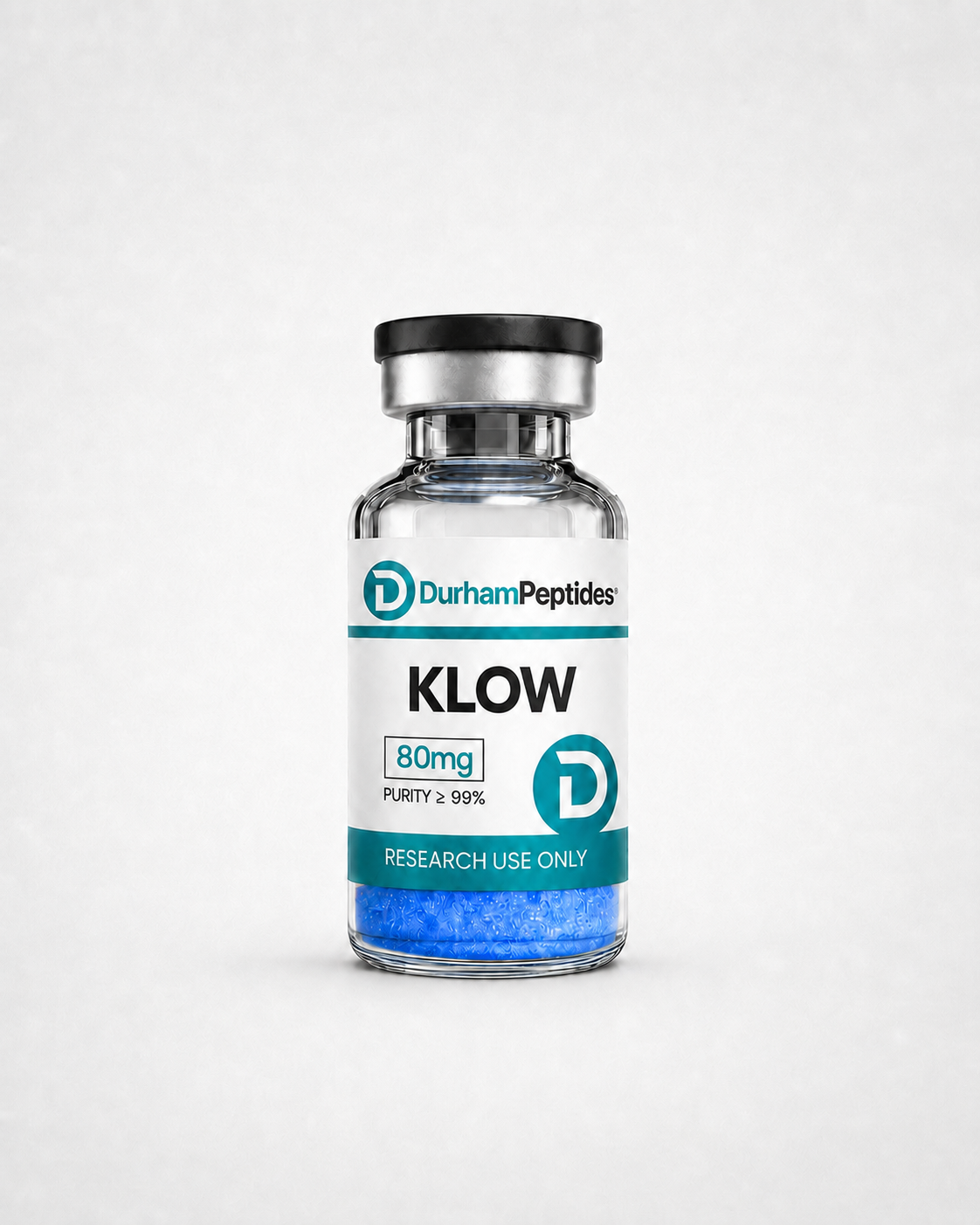
KLOW Blend components BPC-157 GHK-Cu TB-500 KPV four-peptide skin recovery research Durham Peptides Canada
The KLOW Blend is Durham Peptides' most ambitious multi-component formulation — four distinct peptides engineered into a single co-lyophilized vial, addressing four different mechanisms in parallel for skin, anti-aging, and recovery research. Most coverage of KLOW treats it as the "GLOW + KPV" four-component combination, which is technically accurate but misses the more useful question: what does each of the four components actually contribute to the combination's research profile? This article opens the hood per-component, modeled on the Inside the GLOW Blend approach.
For the standalone KLOW Blend overview, see What Is the KLOW Blend?; for the GLOW vs KLOW comparison, see GLOW vs KLOW; for the broader blend decision framework, see When Do You Actually Need a Peptide Blend?. Nothing here is medical, dosing, or therapeutic guidance.
The Composition
KLOW Blend at Durham Peptides:
- 10mg BPC-157 + 50mg GHK-Cu + 10mg TB-500 + 10mg KPV = 80mg total per vial
- 1:5:1:1 component ratio (GHK-Cu dominant by mass)
- Single co-lyophilized vial
- C$169.96 per vial (C$2.12 per total milligram of peptide)
- ≥99% purity per component, Janoshik-verified with mass-spec identity for each peptide independently
The four-component design extends the three-component GLOW Blend by adding KPV as a fourth peptide — bringing in a dedicated anti-inflammatory mechanism alongside the three GLOW mechanisms (gene expression, angiogenesis, cell migration).
Component 1: GHK-Cu — The Gene Expression and Collagen Anchor (50mg)
GHK-Cu is the dominant component by mass and the most-studied peptide in the formulation. The copper tripeptide has over 100 published research studies spanning decades.
What GHK-Cu contributes to KLOW:
- Gene expression modulation across hundreds of genes including collagen genes, anti-inflammatory mediators, and antioxidant response genes
- Collagen synthesis stimulation — primarily Type I and Type III collagen, the structural proteins of skin and connective tissue
- Wound healing biology — the foundational research application for copper peptides; see GHK-Cu for Wound Healing Research
- Anti-inflammatory effects through TNF-α, IL-6, and NF-κB pathway modulation
- Copper-peptide chemistry effects — copper is mechanistically essential, not decorative; copper-dependent enzymes (lysyl oxidase, SOD) contribute to the broader research mechanism
Why 50mg specifically: GHK-Cu research typically uses higher milligram quantities than the other components, reflecting how the underlying skin and connective tissue research has historically been designed.
For the GHK-Cu deep-dive, see Copper Peptides Explained; for the wound-healing foundational research, see GHK-Cu for Wound Healing Research; for the hair-specific extension, see GHK-Cu for Hair Research.
Component 2: BPC-157 — The Angiogenesis Mechanism (10mg)
BPC-157 — Body Protection Compound 157 — is the 15-amino-acid gastric-juice-derived pentadecapeptide.
What BPC-157 contributes to KLOW:
- Angiogenesis — investigated effects on new blood vessel formation through VEGFR2 and nitric oxide signaling. New blood vessels deliver oxygen, nutrients, and cells to the area being supported.
- Vascular and tissue protection — beyond angiogenesis, BPC-157 has been studied for vascular integrity effects.
- Broad tissue research relevance — although originally identified in gastric research, BPC-157's literature extends through multiple tissue types relevant to skin, recovery, and connective tissue research.
Why 10mg specifically: Standard single-vial research quantity for BPC-157, well-aligned with typical research consumption rates and matched 1:1 with TB-500 (echoing the Wolverine Stack proportions). For the broader BPC-157 context, see What Is BPC-157? and BPC-157 for Brain-Gut Axis Research.
Component 3: TB-500 — The Cell Migration Mechanism (10mg)
TB-500 is the synthetic fragment of Thymosin Beta-4, the 44-amino-acid actin-regulating peptide.
What TB-500 contributes to KLOW:
- Cell migration — investigated effects on actin regulation and the physical movement of cells (fibroblasts, endothelial cells, immune cells) toward sites of repair or maintenance
- Connective tissue research relevance — TB-500 has substantial published research in tendon and ligament biology where cell migration is a recognized bottleneck; see TB-500 for Tendon and Ligament Research
- Vascular endothelial cell migration — overlapping with the BPC-157 angiogenesis thread through the cell-migration angle
- Cardiac research thread — extending the actin biology to cardiac repair contexts; see TB-500 for Cardiac Research
Why 10mg specifically: Matched 1:1 with BPC-157, paralleling the Wolverine Stack 1:1 ratio. The pairing of these two recovery peptides at equal proportions is the established standard.
Component 4: KPV — The Anti-Inflammatory Mechanism (10mg)
KPV is the three-amino-acid C-terminal fragment of α-MSH (alpha-melanocyte-stimulating hormone), and the "K" in KLOW.
What KPV contributes to KLOW (the component that differentiates KLOW from GLOW):
- α-MSH-derived anti-inflammatory signaling — KPV retains the anti-inflammatory portion of α-MSH biology while being structurally simple
- NF-κB pathway modulation — relevant to multiple inflammatory contexts including skin, gut, and broader tissue research
- Pro-inflammatory cytokine reduction — investigated effects on TNF-α, IL-6, and IL-1β in research models
- Skin-research relevance — α-MSH is one of the major peptide hormones in skin biology; see KPV for Skin Research
- PepT1-mediated intestinal uptake — particularly relevant for IBD research; see KPV for Inflammatory Bowel Disease Research
Why 10mg specifically: Matched to the BPC-157 and TB-500 quantities, reflecting KPV's typical research-consumption rates.
Why Four Mechanisms Work Together
This is the core research-design point of the KLOW Blend: the four components engage
four genuinely complementary mechanisms that address different aspects of skin, recovery, and tissue research without redundantly hitting the same pathway.
Component | Primary Mechanism | What It Addresses |
GHK-Cu | Gene expression, collagen synthesis | The "what to build" — gene programs and matrix proteins |
BPC-157 | Angiogenesis | The "blood supply" — new vessels delivering oxygen, nutrients, cells |
TB-500 | Cell migration | The "cell mobilization" — repair cells physically arriving at the site |
KPV | Anti-inflammatory signaling | The "inflammation control" — modulating the inflammatory environment for productive repair |
This is the conceptual scaffold the KLOW Blend extends from GLOW. GLOW provides three of the four mechanisms (the building, the blood supply, the cell delivery). KLOW adds the fourth — explicit anti-inflammatory mechanism — for research designs where inflammation modulation is part of the picture.
The fourth mechanism matters because inflammation is part of repair biology, not separate from it. Productive repair requires a controlled inflammatory phase that resolves at the right time; chronic or dysregulated inflammation impairs the other three mechanisms. Adding KPV's anti-inflammatory mechanism alongside the GLOW components addresses the inflammation-modulation question explicitly.
For the related per-component breakdown, see Inside the GLOW Blend.
KLOW vs GLOW: When the Fourth Component Matters
The choice between KLOW and GLOW comes down to whether your research design specifically needs the dedicated anti-inflammatory mechanism:
- Choose KLOW when: Research involves inflammatory contexts (skin inflammation, broader anti-inflammatory questions, gut research where the PepT1 angle matters), or when the four-mechanism scope matches your research question
- Choose GLOW when: Research focuses on the three core mechanisms (gene expression, angiogenesis, cell migration) without specific anti-inflammatory questions, and the slightly lower cost is preferable
For the detailed comparison, see GLOW vs KLOW; for the broader Wolverine-vs-GLOW comparison (no-GHK-Cu vs three-component), see Wolverine Stack vs Glow Blend.
The Component-Level Pricing Math
KLOW Blend per-component equivalent at separate vial quantities:
- 10mg BPC-157 alone: C$65.69
- 50mg GHK-Cu alone: C$54.99
- 10mg TB-500 alone: C$79.69
- 10mg KPV alone: C$45.99
- Combined equivalent: ~C$246.36 vs KLOW Blend at C$169.96
The blend saves approximately C$76 per equivalent quantity compared to buying the four components separately at standalone vial quantities — about 31% savings, plus the documentation, reconstitution, and ratio-consistency benefits of a single co-formulated product.
For the cost-comparison framework, see Wolverine Stack vs Glow Blend (which works through similar per-component math).
Practical Research Considerations
KLOW Blend 80mg at Durham Peptides is C$169.96. Janoshik-verified per component (four separate HPLC and mass-spec identity confirmations on the one batch), ≥99% purity per peptide, 100% synthetic, vegan. Storage: 2–8°C short-term, -20°C long-term, protected from light and moisture; reconstitute in bacteriostatic water.
Frequently Asked Questions
What does the KLOW Blend contain? Four peptides co-lyophilized: 10mg BPC-157 + 50mg GHK-Cu + 10mg TB-500 + 10mg KPV = 80mg total per vial. Each component is Janoshik-verified independently.
What's the difference between KLOW and GLOW? KLOW = GLOW + KPV. GLOW is three peptides (GHK-Cu + BPC-157 + TB-500); KLOW adds KPV as a fourth dedicated anti-inflammatory component. See GLOW vs KLOW.
Why is the GHK-Cu component 50mg when the others are 10mg? Because GHK-Cu research typically uses higher milligram quantities than the other components — reflecting the typical relative quantities in the published research literature for these compounds.
Does KLOW save money compared to buying the components separately? Yes — approximately 31% savings (C$76 per equivalent quantity) versus buying the four components at standalone vial quantities. Plus documentation, reconstitution, and ratio-consistency benefits.
Is KLOW better than GLOW? Neither is universally better — they answer different research questions. KLOW is better when research design specifically engages anti-inflammatory mechanisms alongside the GLOW three-component approach. GLOW is sufficient when the three core mechanisms cover the research question.
Where can I buy the KLOW Blend in Canada? Durham Peptides supplies the KLOW Blend 80mg (C$169.96) — Janoshik-verified per component, ≥99% purity, 100% synthetic.
Final Thoughts
The KLOW Blend's four-component design represents Durham Peptides' most ambitious multi-mechanism research formulation — engaging gene expression and collagen synthesis (GHK-Cu), angiogenesis (BPC-157), cell migration (TB-500), and anti-inflammatory signaling (KPV) in a single co-lyophilized vial at established research proportions. The fourth component (KPV) extends the three-mechanism GLOW Blend by adding dedicated anti-inflammatory signaling — addressing inflammation modulation as an explicit fourth dimension of skin, recovery, and tissue research rather than leaving it as an implicit consequence of the other mechanisms. For research designed around the multi-mechanism approach with anti-inflammatory questions specifically engaged, KLOW is the standardized way to access all four mechanisms at the proportions the published research has established.
For the standalone overview, see What Is the KLOW Blend?; for the per-component breakdown of the three-component sibling, see Inside the GLOW Blend; for the direct GLOW vs KLOW comparison, see GLOW vs KLOW; for the Wolverine alternative, see Wolverine Stack vs Glow Blend.
Selected Research References
- Pickart L, Margolina A. Regenerative and Protective Actions of the GHK-Cu Peptide. International Journal of Molecular Sciences. 2018;19(7):1987. https://pubmed.ncbi.nlm.nih.gov/29986520/
- Sikiric P, Seiwerth S, Rucman R, et al. Stable Gastric Pentadecapeptide BPC 157: Novel Therapy in Gastrointestinal Tract. Current Pharmaceutical Design. 2011;17(16):1612-1632. https://pubmed.ncbi.nlm.nih.gov/21548867/
- Goldstein AL, Hannappel E, Kleinman HK. Thymosin Beta-4: Actin-Sequestering Protein Moonlights to Repair Injured Tissues. Trends in Molecular Medicine. 2005;11(9):421-429. https://pubmed.ncbi.nlm.nih.gov/16099219/
- Dalmasso G, Charrier-Hisamuddin L, Nguyen HT, Yan Y, Sitaraman S, Merlin D. PepT1-Mediated Tripeptide KPV Uptake Reduces Intestinal Inflammation. Gastroenterology. 2008;134(1):166-178. https://pubmed.ncbi.nlm.nih.gov/18061177/
All products sold by Durham Peptides are for research and laboratory use only. They are not intended for human or animal consumption, diagnosis, treatment, cure, or prevention of any disease.