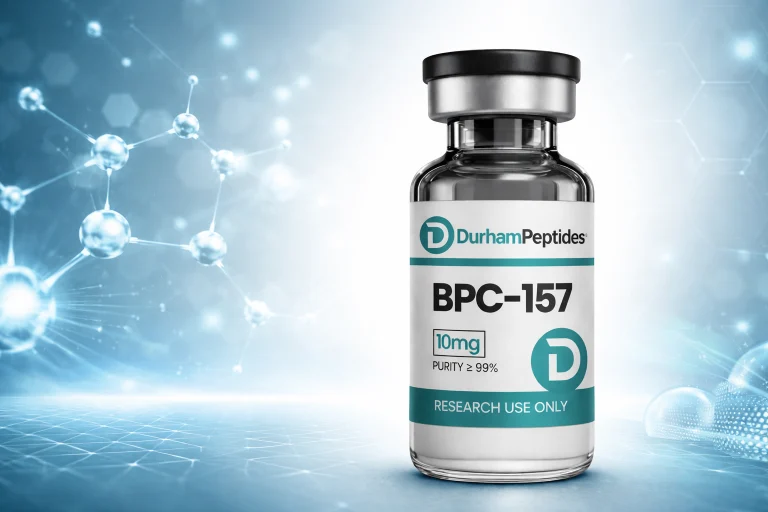

If you've looked at any research peptide product listing, you've seen the term "lyophilized powder." Every peptide sold by Durham Peptides — and virtually every other peptide supplier — ships their products in this form. But what exactly is lyophilization, why is it the universal standard for peptide storage, and what does it mean for handling and quality?
What Is Lyophilization?
Lyophilization — commonly called freeze-drying — is a dehydration process that removes water from a substance while preserving its structure and biological activity. The process involves three steps.
First, the peptide solution is frozen to very low temperatures, typically below -40°C. Second, the surrounding pressure is reduced, and heat is gently applied, causing the frozen water to sublimate — converting directly from ice to vapor without passing through a liquid phase. Third, any remaining bound moisture is removed through secondary drying at slightly elevated temperatures.
The result is a dry, porous powder or cake that retains the molecular structure of the original peptide. This powder is sealed in a glass vial under vacuum or inert gas and can be stored for extended periods without degradation.
Why Peptides Must Be Lyophilized
Peptides are inherently unstable in solution. When dissolved in water, peptides are susceptible to hydrolysis (chemical breakdown by water molecules), oxidation (particularly peptides containing methionine or cysteine residues), microbial contamination (bacteria can grow in aqueous solutions), and aggregation (peptide molecules can clump together and lose activity).
These degradation pathways are dramatically slowed or eliminated when the peptide is in lyophilized form. Without water present, hydrolysis cannot occur. Sealed vials with minimal oxygen exposure reduce oxidation. The absence of liquid prevents microbial growth. And the solid-state form limits molecular movement that leads to aggregation.
This is why research peptide suppliers ship all products as lyophilized powders rather than pre-mixed solutions.
What the Powder Looks Like
A properly lyophilized peptide typically appears as a white to off-white powder or a compact "cake" or "puck" at the bottom of the vial. The appearance can vary — some peptides form a fluffy loose powder, while others form a more solid disc. Both are normal.
What's not normal is a peptide that appears wet, discolored (yellow, brown), or has visible particles that don't dissolve upon reconstitution. Any of these signs could indicate degradation, contamination, or improper lyophilization.
Reconstitution: Returning to Solution
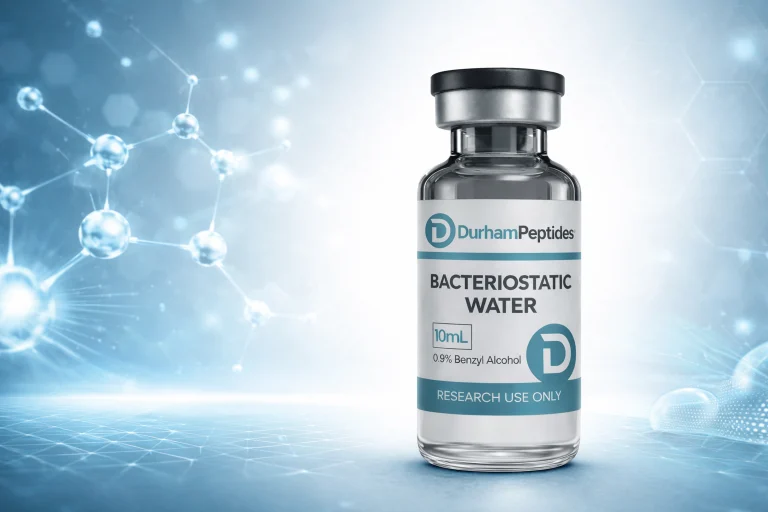
Before use in laboratory settings, lyophilized peptides must be reconstituted — dissolved back into solution. The standard solvent for this is bacteriostatic water, which contains 0.9% benzyl alcohol as a preservative that inhibits bacterial growth.
When reconstituting, add the bacteriostatic water slowly down the side of the vial rather than directly onto the peptide cake. Let the powder dissolve naturally — avoid shaking vigorously, as this can cause foaming and potentially damage the peptide. Gentle swirling is acceptable if needed.
Once reconstituted, the peptide is back in solution and the degradation clock starts again. Reconstituted peptides should be stored at 2-8°C and used within a reasonable timeframe. The bacteriostatic water preservative extends this window compared to sterile water, which is why it's the preferred reconstitution solvent.
Storage Before and After Reconstitution
Before reconstitution (lyophilized form), peptides should be stored at 2-8°C for short-to-medium term storage, or at -20°C for long-term storage. They should be protected from light and moisture. In this form, most peptides remain stable for months to years.
After reconstitution (in solution), peptides should be stored at 2-8°C, used within 28 days when reconstituted with bacteriostatic water, and never frozen once in solution (freezing and thawing can damage the peptide structure).
For a complete guide to peptide storage, see our article: Peptide Storage Guide: How to Keep Your Research Peptides Stable.
Why Lyophilization Quality Matters
Not all lyophilization is equal. Poorly executed freeze-drying can leave residual moisture in the peptide, leading to reduced shelf life and potential degradation. Improper sealing can expose the peptide to air and humidity.
This is one reason why sourcing from suppliers who use established cGMP manufacturers matters — proper lyophilization requires controlled equipment and validated processes. Durham Peptides sources all products from established manufacturers and verifies quality through independent Janoshik Analytical testing.
All products sold by Durham Peptides are for research and laboratory use only. They are not intended for human or animal consumption, diagnosis, treatment, cure, or prevention of any disease.