

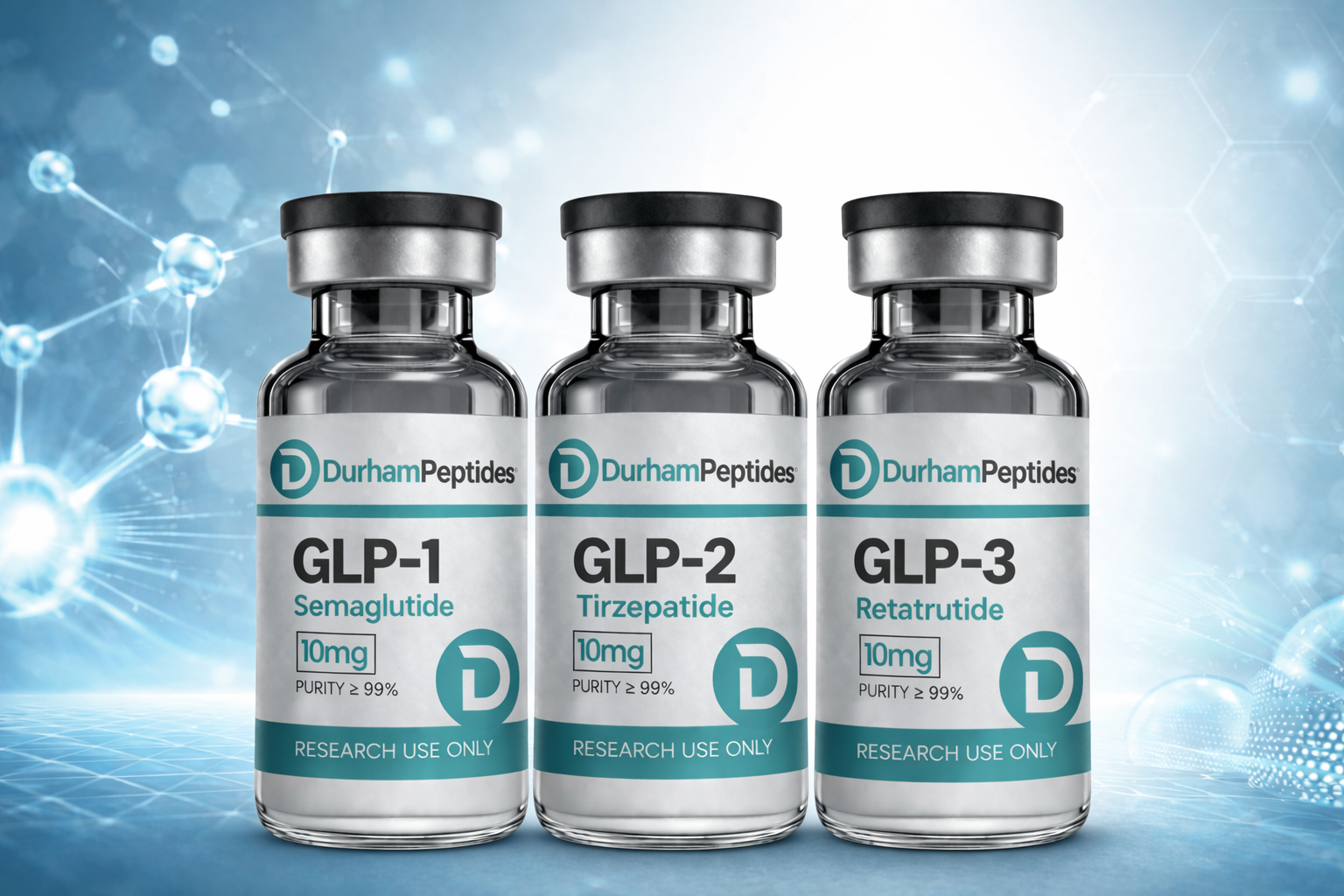
Peptide receptor families incretin GHS calcitonin melanocortin GHRH research map Durham Peptides Canada
Every research peptide does its work by binding a receptor. That sentence sounds obvious, but it hides something important: there's no single "peptide receptor system." Different peptides engage different receptor families, with different signaling cascades, different downstream effects, and different research applications. Understanding the receptor landscape is what separates "this peptide does X" from "this peptide does X because it engages receptor family Y, which signals through Z." This article is a research-grade map of that landscape — the major peptide receptor families and how the compounds in current research fit into them.
This is a pathway-level pillar that complements the compound-specific posts on individual peptides. For specific deep dives, see Growth Hormone Secretagogues Explained and The Amylin Pathway in Metabolic Research. Nothing here is medical, dosing, or therapeutic guidance.
Why Receptor Families Matter
A receptor is a protein on a cell that recognizes specific signaling molecules. When a peptide binds its receptor, a cascade of intracellular events follows — gene expression changes, enzyme activations, hormone releases, behavioral responses. The family a receptor belongs to determines what kind of cascade gets triggered, where in the body the effect happens, and which other receptors might be engaged simultaneously.
Two consequences flow from this. First, when researchers combine peptides (the entire rationale behind blends), the mechanistic complementarity depends on whether the peptides engage different receptor families or the same one. Second, when a peptide is engineered to be selective, the engineering happens at the level of receptor binding — choosing one family or one receptor within a family over related ones.
Family 1: The Incretin Receptors (GLP-1, GIP, Glucagon)
The incretin family includes three closely related G-protein coupled receptors that have become the central nervous system of modern metabolic research:
- GLP-1 receptor — engaged by semaglutide, studied for hypothalamic appetite suppression, glucose-dependent insulin secretion, gastric emptying, and glucagon regulation.
- GIP receptor — engaged as the second receptor in tirzepatide's dual-agonist design.
- Glucagon receptor — engaged as the third receptor in retatrutide's triple-agonist design.
All three receptors sit in the same G-protein-coupled receptor family and share structural similarities — which is what made it possible to engineer single molecules that bind multiple receptors with different affinities. This single-molecule multi-agonist strategy is the design behind tirzepatide (GLP-1 + GIP) and retatrutide (GLP-1 + GIP + glucagon).
Family 2: The Calcitonin Receptor Family (Amylin, Calcitonin)
A completely separate family — and importantly, not part of the incretin family despite the overlapping metabolic research interest. The calcitonin receptor family includes:
- Amylin receptor — formed by the calcitonin receptor plus a receptor activity-modifying protein (RAMP). Engaged by cagrilintide (an amylin analog). Studied for brainstem satiety, gastric emptying, glucagon suppression.
The family separation is what makes the cagrilintide + semaglutide combination mechanistically distinct from the single-molecule multi-agonists: combining amylin (calcitonin family) with GLP-1 (incretin family) engages two non-overlapping receptor systems, which is the entire rationale behind the combination. See The Amylin Pathway in Metabolic Research.
Family 3: The Growth Hormone Secretagogue Receptor
The GHS receptor (also called GHS-R1a or the "ghrelin receptor") is the target of one of the two upstream pathways governing growth hormone release:
- GHS-R1a / ghrelin receptor — engaged by Ipamorelin (selective), and by older GHRPs (GHRP-6, GHRP-2, with less selectivity). Studied for amplifying growth-hormone pulse amplitude and reducing somatostatin tone.
Critically, the GHS receptor is separate from the GHRH receptor (next family), which is the other upstream GH-release pathway. Engaging both simultaneously is the rationale behind the CJC-1295 + Ipamorelin Blend. See Growth Hormone Secretagogues Explained.
Family 4: The GHRH Receptor
The GHRH receptor is the other major upstream GH-release control:
- GHRH receptor — engaged by CJC-1295 (No DAC), Sermorelin, and Tesamorelin. Studied for stimulating growth hormone synthesis and release; effect remains subject to somatostatin's inhibitory tone.
The GHRH and GHS receptors are different molecules that converge on the same pituitary somatotroph cells to influence GH release — engaging both at once is the dual-pathway logic that makes CJC + Ipamorelin combinations a research staple. See CJC-1295 vs Ipamorelin and Tesamorelin vs CJC-1295 vs Sermorelin.
Family 5: The Melanocortin Receptors (MC1R–MC5R)
The melanocortin family has five distinct receptors (MC1R through MC5R), each with different tissue distributions and functions. Two compounds in the broader research peptide space engage this family:
- PT-141 (bremelanotide) — engages MC3R and MC4R; studied for centrally-mediated sexual response pathways. (Note: PT-141 is not currently in the Durham Peptides catalog.)
- KPV — derived from α-MSH (the natural melanocortin), but specifically the C-terminal fragment that retains anti-inflammatory activity rather than the melanocortin-receptor-mediated pigmentation effects of the full hormone. KPV 10mg is studied for NF-κB and cytokine modulation in gut and skin research.
KPV is an instructive case for understanding receptor families: it descends from α-MSH (melanocortin family) but its research story has moved largely outside melanocortin-receptor signaling into more general anti-inflammatory pathways. See What Is KPV?.
Family 6: Tissue Repair Pathways (Distinct, Multiple Receptors)
The tissue-repair research peptides don't share a single receptor family — they each engage their own distinct pathway:
- BPC-157 — angiogenesis and gut-protection pathways involving VEGFR2 and nitric oxide signaling. Not a single named receptor; engages multiple repair-related signaling routes. See What Is BPC-157?.
- TB-500 (Thymosin Beta-4 fragment) — actin regulation and cell migration. Engages the cytoskeletal machinery directly rather than a classical receptor. See What Is TB-500?.
- GHK-Cu — gene-expression modulation across hundreds of genes; not a single-receptor binding event. See Copper Peptides Explained.
The tissue-repair category illustrates a different organizational principle than the receptor-family approach: these compounds are grouped by outcome (tissue repair) rather than receptor. Their combination in the Wolverine Stack and Glow Blend works because their mechanisms are non-overlapping at the pathway level, not the receptor level. See Healing & Recovery Peptides Explained.
Family 7: Longevity and Mitochondrial Pathways
The longevity peptides sit in yet another organizational space:
- MOTS-c — engages metabolic signaling through AMPK activation rather than classical receptor binding. Mitochondrial-derived peptide. See What Is MOTS-c?.
- Epithalon — studied for telomerase induction and telomere biology; pineal-derived. See What Is Epithalon?.
- NAD+ — coenzyme (not a peptide), engages enzyme kinetics rather than receptor binding. See What Is NAD+?.
These compounds don't share a receptor family — they share a research domain (aging biology). The four-pathway longevity map in The Best Longevity Peptides for Research in Canada captures this.
Cognitive Peptides: Neuropeptide Receptors
- Semax — engages central nervous system pathways including BDNF/TrkB signaling and monoaminergic neurotransmitter systems. Derived from ACTH(4-10) with a stabilizing modification. See What Is Semax?.
Neuropeptide-receptor signaling is among the most complex receptor landscapes in pharmacology, with many receptors and intricate cross-talk. Semax-class compounds engage multiple central pathways rather than a single receptor.
The Receptor Map, Summarized
Family | Representative receptors | Compounds in research |
Incretin | GLP-1, GIP, glucagon | Semaglutide, Tirzepatide, Retatrutide |
Calcitonin / Amylin | Amylin receptor (calcitonin + RAMP) | Cagrilintide |
Growth hormone secretagogue | GHS-R1a (ghrelin) | Ipamorelin, older GHRPs |
GHRH | GHRH receptor | CJC-1295, Sermorelin, Tesamorelin |
Melanocortin | MC1R–MC5R | PT-141 (MC3/MC4); KPV (α-MSH-derived but anti-inflammatory) |
Tissue repair (mixed pathways) | Multiple, not single-receptor | BPC-157, TB-500, GHK-Cu |
Longevity (mixed pathways) | AMPK, telomerase, NAD-dependent enzymes | MOTS-c, Epithalon, NAD+ |
Neuropeptide | BDNF/TrkB, monoaminergic | Semax |
Why This Map Matters for Research Design
The receptor map clarifies several common questions in research design:
- Why are some combinations synergistic? Because they engage receptors from different families that don't overlap (e.g., GLP-1 + amylin co-agonism, GHRH + GHS in CJC + Ipamorelin).
- Why are some compounds "selective"? Because they bind one receptor in a family without engaging related receptors in the same family (e.g., Ipamorelin is a selective GHS agonist with minimal cortisol/prolactin effects).
- Why is multi-agonism the modern direction? Because engineering a single molecule to engage multiple receptors in a related family (e.g., GLP-1 + GIP + glucagon) is one way to achieve the combination effect of separate compounds.
Frequently Asked Questions
What are the major peptide receptor families? Incretin (GLP-1, GIP, glucagon), calcitonin/amylin, growth hormone secretagogue (GHS-R1a), GHRH, melanocortin (MC1R–MC5R), plus mixed-pathway groupings for tissue repair (BPC-157, TB-500, GHK-Cu) and longevity (MOTS-c, Epithalon, NAD+).
Are GLP-1 and amylin in the same family? No. GLP-1 is in the incretin receptor family; amylin is in the calcitonin receptor family. They're completely separate, which is why combining them engages non-overlapping pathways.
Are GHRH and GHS the same? No. GHRH and GHS (ghrelin) are separate receptors that both influence growth hormone release through different upstream signals. Combining a GHRH analog (CJC-1295) with a GHS agonist (Ipamorelin) is the rationale behind the dual-pathway blend.
What family is KPV in? KPV is derived from α-MSH (melanocortin family), but its research has moved largely outside melanocortin-receptor signaling into general anti-inflammatory pathways like NF-κB modulation.
Why don't BPC-157 and TB-500 have a "receptor family"? Because they engage repair pathways through multiple signaling routes (angiogenesis for BPC-157, actin regulation for TB-500) rather than a single classical receptor. They're grouped by outcome, not receptor.
What's a multi-agonist? A single molecule engineered to bind multiple related receptors. Tirzepatide is a GLP-1 + GIP dual agonist; retatrutide is a GLP-1 + GIP + glucagon triple agonist.
Final Thoughts
Understanding peptide research as a receptor-family landscape transforms how you read the field. Comparisons sharpen ("BPC-157 vs TB-500" becomes "angiogenesis pathway vs actin/cell-migration pathway, neither of which is a classical receptor"). Combinations make sense ("combining amylin + GLP-1 works because they're in different receptor families"). Design choices become legible ("multi-agonist molecules engineer cross-family binding into a single molecule"). The map is the conceptual scaffold the field is built on.
For specific receptor-family deep dives, see Growth Hormone Secretagogues Explained and The Amylin Pathway in Metabolic Research. Browse the full catalog at durhampeptides.ca/category/all-products.
Selected Research References
- Müller TD, Finan B, Bloom SR, et al. Glucagon-Like Peptide 1 (GLP-1). Molecular Metabolism. 2019;30:72-130. https://pubmed.ncbi.nlm.nih.gov/31767182/
- Hay DL, Chen S, Lutz TA, Parkes DG, Roth JD. Amylin: Pharmacology, Physiology, and Clinical Potential. Pharmacological Reviews. 2015;67(3):564-600. https://pubmed.ncbi.nlm.nih.gov/26071095/
- Howard AD, Feighner SD, Cully DF, et al. A Receptor in Pituitary and Hypothalamus That Functions in Growth Hormone Release. Science. 1996;273(5277):974-977. https://pubmed.ncbi.nlm.nih.gov/8688086/
- Catania A, Lonati C, Sordi A, Carlin A, Leonardi P, Gatti S. The Melanocortin System in Control of Inflammation. The Scientific World Journal. 2010;10:1840-1853. https://pubmed.ncbi.nlm.nih.gov/20852829/
- Bowers CY, Momany FA, Reynolds GA, Hong A. On the In Vitro and In Vivo Activity of a New Synthetic Hexapeptide That Acts on the Pituitary to Specifically Release Growth Hormone. Endocrinology. 1984. https://pubmed.ncbi.nlm.nih.gov/1349865/
All products sold by Durham Peptides are for research and laboratory use only. They are not intended for human or animal consumption, diagnosis, treatment, cure, or prevention of any disease.