

Selank cognitive performance learning memory attention tuftsin analog nootropic research Durham Peptides Canada
Selank's most-discussed research applications are anxiolytic effects and stress response research — the two threads where Selank shares territory with established anxiolytic compounds while bringing its distinctive multi-mechanism profile. But there's a third major Selank research thread that's mechanistically distinct: cognitive performance research. The Russian-language Selank research literature includes substantial published work on learning, memory, attention, and conditioned-response paradigms — engaging Selank's nootropic dimensions independently of the anxiolytic/stress contexts. This article focuses on that cognitive research angle specifically.
For the standalone Selank overview, see What Is Selank?; for the stress response research thread, see Selank for Stress Response Research; for the comparison with Semax, see Selank vs Semax. Nothing here is medical, dosing, or therapeutic guidance.
The Cognitive Research Context
Cognitive performance research uses standardized behavioral paradigms to measure aspects of learning, memory, attention, and cognitive function in animal and (in some research) human models. The major research paradigms include:
- Conditioned response paradigms — Pavlovian conditioning, conditioned avoidance, operant conditioning measures of learning
- Spatial learning paradigms — Morris water maze, radial arm maze, T-maze, measuring spatial memory and learning
- Object recognition paradigms — novel object recognition, measuring recognition memory
- Attention and working memory paradigms — various tasks measuring sustained attention, response inhibition, working memory
- Long-term memory paradigms — measuring memory consolidation and retention over hours-to-days time horizons
Research compounds studied for cognitive effects engage these paradigms to characterize what aspects of cognition (learning, memory consolidation, retrieval, attention) the compound affects.
The Foundational Selank Cognitive Research
The Russian-language Selank research literature includes a foundational series of studies on cognitive paradigms, beginning with research by Kozlovskii and colleagues that examined Selank effects on conditioned active avoidance learning. The 2003 paper by Kozlovskii and Danchev in Neuroscience and Behavioral Physiology, "The Optimizing Effect of the Synthetic Peptide Selank on a Conditioned Active Avoidance Reflex in Rats," is a representative reference for this research thread.
Key findings across the cognitive research literature:
Investigated effect 1: Conditioned learning optimization. Research has examined investigated Selank effects on the acquisition and performance of conditioned responses — reporting "optimization" effects that suggest improved learning efficiency in research models.
Investigated effect 2: Memory consolidation. Some research has examined investigated effects on memory consolidation — the process by which short-term memories become long-term memories through gene expression and synaptic plasticity changes during the hours after learning.
Investigated effect 3: Attention and behavioral inhibition. Research has examined investigated effects on attention-related endpoints, including sustained attention paradigms and response inhibition tasks.
Investigated effect 4: BDNF-mediated cognitive effects. The BDNF research thread (Selank affects BDNF expression in hippocampal tissue per published Russian research) provides a mechanistic foundation for cognitive effects — BDNF being one of the central neurotrophic factors in learning and memory biology.
Investigated effect 5: Cognitive function under stress. A particularly distinctive research application: Selank's effects on cognitive performance in stressed states — examining whether cognitive function is preserved or enhanced under stress conditions. This bridges the cognitive and stress research threads.
For the stress research thread, see Selank for Stress Response Research.
The BDNF Mechanism Connection to Cognition
A specific mechanistic point: BDNF (brain-derived neurotrophic factor) is one of the central proteins in learning, memory, and synaptic plasticity biology. BDNF supports:
- Neuronal survival and growth
- Synaptic plasticity (the molecular basis of learning and memory)
- Long-term potentiation (LTP), the cellular correlate of memory formation
- Adult neurogenesis in the hippocampus (a brain region central to memory)
Research has documented that Selank increases BDNF expression in hippocampal tissue (Inozemtseva et al. 2008) — providing a mechanistic foundation for Selank's investigated cognitive effects. The BDNF connection links Selank's research thread to one of the central pathways in cognitive neuroscience.
For the parallel Semax research on BDNF and cognition, see Selank vs Semax and Semax for Stroke and Neuroprotection Research (which addresses Semax's neuroprotection thread that overlaps with cognitive biology).
GABAergic Gene Expression: The Other Mechanism
Beyond BDNF, Selank has documented effects on GABAergic gene expression (Volkova et al. 2016, Frontiers in Pharmacology). The GABAergic system is the brain's primary inhibitory neurotransmitter system and is central to:
- Anxiety regulation (the well-known GABA-anxiolytic connection)
- Attention and cognitive control
- Sleep biology
- Cognitive function more broadly through inhibitory regulation of excitatory neurons
Selank's effects on GABAergic gene expression connect the anxiolytic, stress, and cognitive research threads — they're all engaging the same neurobiology from different angles. This integrative mechanistic profile is part of what makes Selank a distinctive research tool compared to single-mechanism anxiolytics or single-mechanism nootropics.
Cognitive Research vs Stress Research vs Anxiolytic Research with Selank
How the three main Selank research threads differ:
Property | Cognitive research | Stress research | Anxiolytic research |
Primary paradigms | Learning, memory, attention tasks | Stress-induction models, HPA axis, cortisol | Anxiety-related behavior (elevated plus-maze, conditioned fear) |
Primary endpoints | Cognitive performance metrics | Stress markers, cognitive function under stress | Anxiety-related behavior endpoints |
Mechanism focus | BDNF, GABAergic gene expression | HPA axis, stress signaling, immune effects | GABAergic gene expression (not direct GABA-A binding) |
Population context | Healthy or cognitively-impaired research models | Stress-exposed models | Anxiety-relevant research models |
The three threads overlap mechanistically (BDNF and GABAergic gene expression operate across all three) but engage research design choices that emphasize different aspects of Selank's research-tool profile.
Cognitive Research Comparison: Selank vs Semax
A useful contextual framing: both Selank and Semax are Russian-developed neuropeptides with cognitive research applications. How they differ:
Property | Selank | Semax |
Origin | Tuftsin analog (immunopeptide-derived) | ACTH(4-10) analog (neuroprotection-derived) |
Primary research focus | Anxiolytic + cognitive | Neuroprotection + nootropic |
BDNF research | Yes — documented investigated effects | Yes — documented investigated effects |
GABAergic research | Yes — gene expression effects | Less direct |
Distinctive feature | Tuftsin-immune connection (immune research overlap) | ACTH-stroke connection (cerebrovascular research overlap) |
For cognitive research specifically, both compounds have research credentials, but they bring different mechanistic profiles to the research design. Many research protocols include both for cross-compound comparison.
Practical Research Considerations
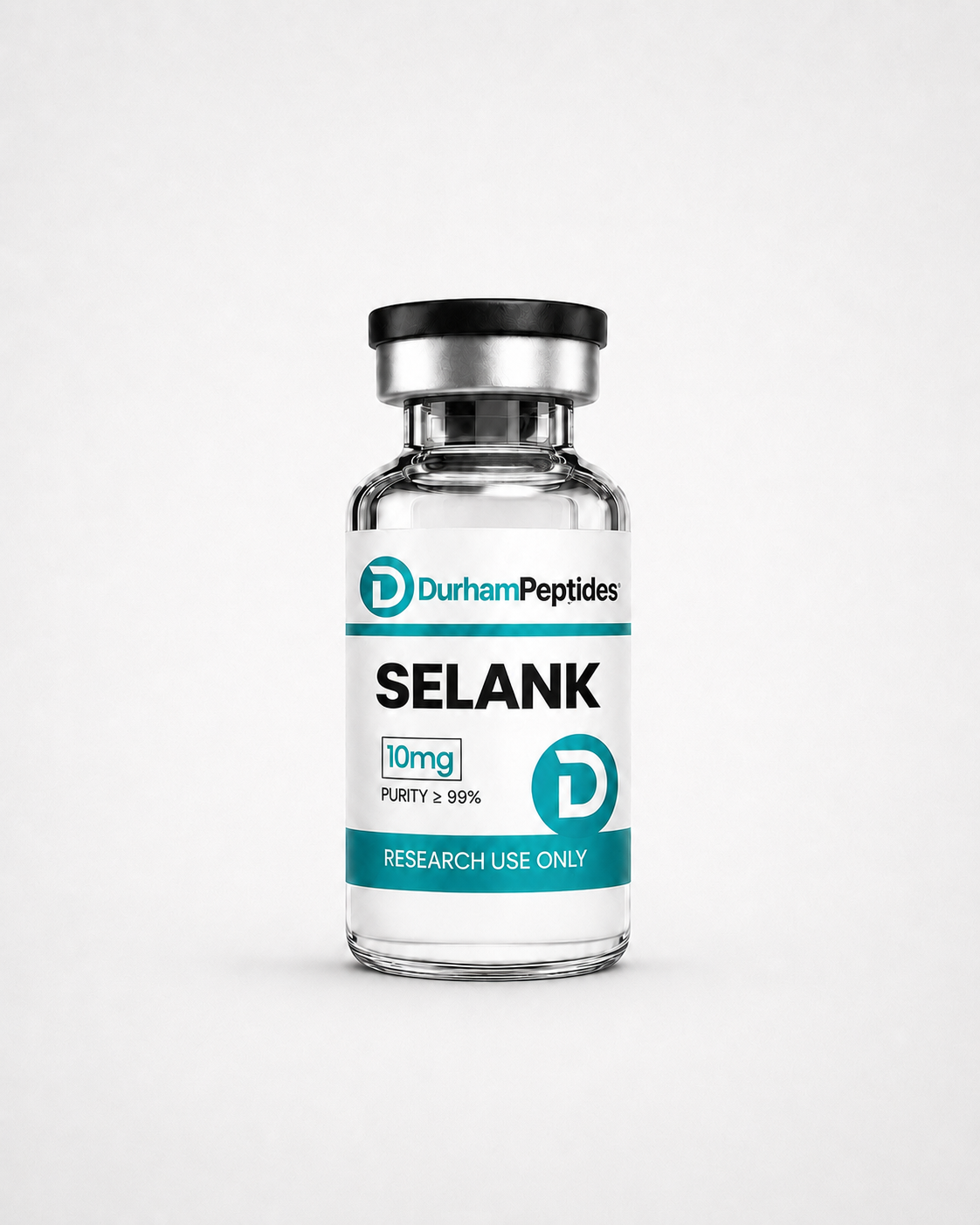
Selank 10mg at Durham Peptides is C$54.99 (C$5.50/mg), Janoshik-verified to ≥99% purity by HPLC with mass-spec identity confirmation; 100% synthetic; vegan. Storage: 2–8°C short-term, -20°C long-term, protected from light and moisture; reconstitute in bacteriostatic water.
For cross-compound cognitive research, the relevant catalog companion is Semax 10mg (C$45.00), the parallel Russian-developed neuropeptide with overlapping but distinct cognitive research applications.
Frequently Asked Questions
Is Selank actually studied for cognitive performance specifically? Yes — the Russian-language research literature includes substantial published work on Selank effects in cognitive paradigms (conditioned learning, memory consolidation, attention), beyond the more commonly-cited anxiolytic and stress research.
What's the mechanistic foundation for Selank's cognitive effects? Primarily BDNF expression effects (with hippocampal BDNF being central to learning and memory biology) and GABAergic gene expression effects (relevant to cognitive function through inhibitory regulation of excitatory neurotransmission).
Why is Selank distinctive in the cognitive peptide research category? Because of the multi-mechanism profile combining anxiolytic, stress-modulating, cognitive, and immune research threads through a single compound. Most cognitive research peptides engage one or two of these mechanisms; Selank engages multiple through the BDNF + GABAergic + tuftsin-immune combination.
How does Selank compare to Semax for cognitive research? Both have BDNF-related cognitive research threads. Selank brings the tuftsin-immune connection and GABAergic gene expression effects; Semax brings the ACTH-derived neuroprotection thread. Different mechanistic profiles, both with cognitive research applications.
Is Selank studied for cognition under stress conditions specifically? Yes — this is one of the more sophisticated Selank research applications, examining how cognitive function is affected by stress and whether Selank preserves cognitive performance in stressed states. Bridges the cognitive and stress research threads. See Selank for Stress Response Research.
Where can I buy Selank in Canada? Durham Peptides supplies Selank 10mg (C$54.99), Janoshik-verified, for laboratory use only.
Final Thoughts
Selank's cognitive performance research is the third major research thread for the compound, alongside the anxiolytic and stress response threads. The Russian-language research literature on learning, memory, attention, and conditioned-response paradigms — anchored on BDNF expression effects and GABAergic gene expression mechanisms — provides a research-anchored foundation for cognitive applications. The distinctive feature of Selank's cognitive research is its integrative profile, engaging multiple cognitive-relevant mechanisms (neurotrophic, GABAergic, immune-derived) through a single compound. For researchers designing cognitive research protocols, especially research that bridges cognition with stress or immune biology, Selank's multi-mechanism research base supports more nuanced research designs than single-mechanism nootropics.
For the standalone overview, see What Is Selank?; for the stress thread, see Selank for Stress Response Research; for the Semax comparison, see Selank vs Semax; for the broader Russian nootropic context, see Nootropic Peptides Research Overview.
Selected Research References
- Kozlovskii II, Danchev ND. The Optimizing Effect of the Synthetic Peptide Selank on a Conditioned Active Avoidance Reflex in Rats. Neuroscience and Behavioral Physiology. 2003;33(7):639-643. https://pubmed.ncbi.nlm.nih.gov/14552538/
- Volkova A, Shadrina M, Kolomin T, et al. Selank Administration Affects the Expression of Some Genes Involved in GABAergic Neurotransmission. Frontiers in Pharmacology. 2016;7:31. https://pubmed.ncbi.nlm.nih.gov/26941640/
- Inozemtseva LS, Karpenko EA, Dolotov OV, et al. Intranasal Administration of the Peptide Selank Regulates BDNF Expression in the Rat Hippocampus In Vivo. Doklady Biological Sciences. 2008;421:241-243. https://pubmed.ncbi.nlm.nih.gov/18841804/
- Sollertinskaya TN, Shorokhov MV. Comparative Characteristics of the Effects of Selank and Tactivin on Selective and Generalized Forms of Learning in Lower Monkeys. Zhurnal Vysshei Nervnoi Deiatel'nosti Imeni I P Pavlova. 2010. (Reference on Selank cognitive learning research in primates.)
All products sold by Durham Peptides are for research and laboratory use only. They are not intended for human or animal consumption, diagnosis, treatment, cure, or prevention of any disease.